TLDR
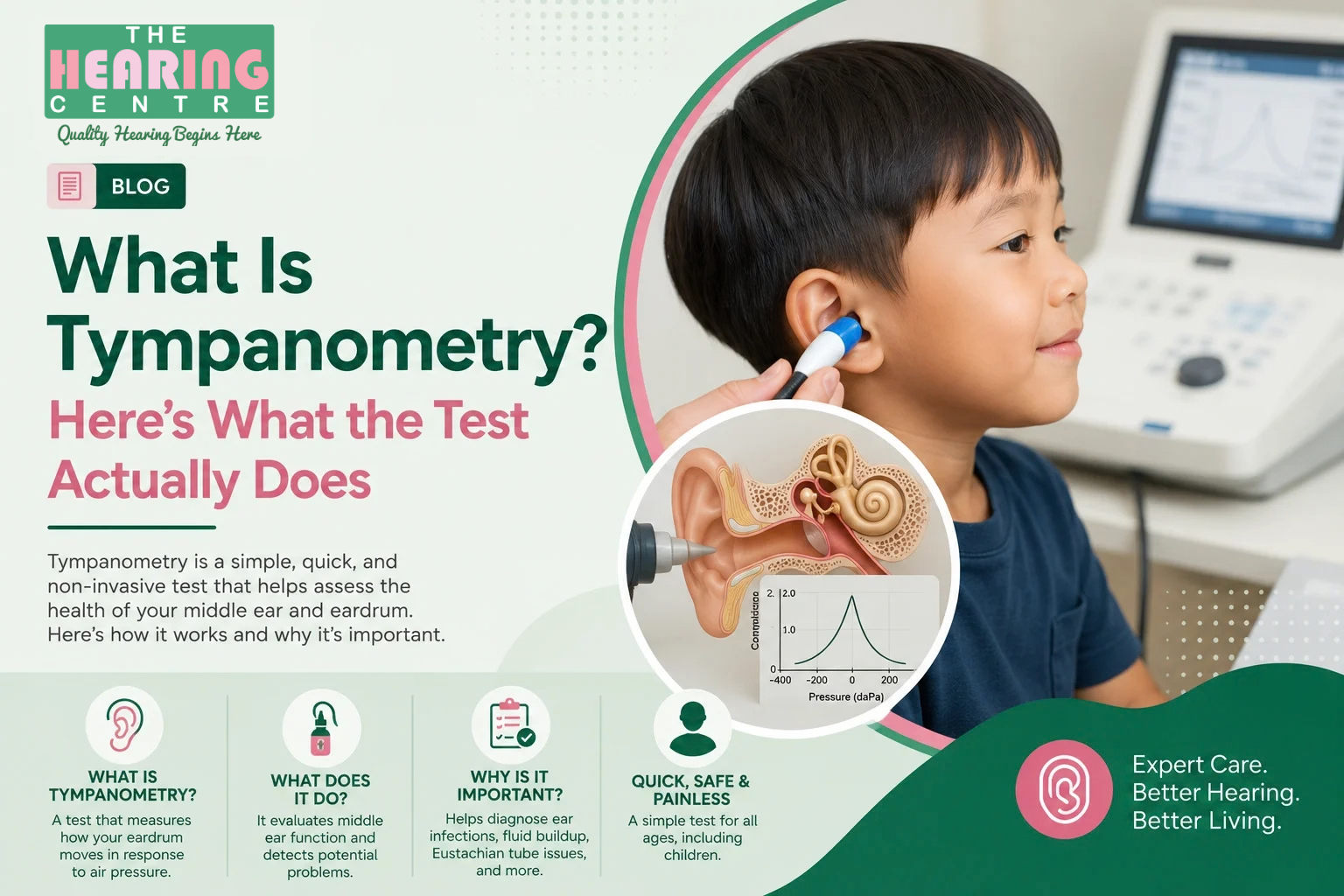
Tympanometry checks your eardrum. Not your hearing your eardrum. It measures how freely it moves when air pressure changes inside your ear canal. The whole test takes about two minutes. No pain. No needles. Just a small probe sitting at your ear opening while the machine does the work.
Doctors order it when something feels off blocked ears, recurring infections, fluid that won’t drain, muffled sounds after a cold. It picks up problems that a standard hearing test simply cannot find. The result comes out as a graph. A normal graph has a peak in the middle. A flat line usually means fluid behind the eardrum. A peak shifted to the left usually means a blocked Eustachian tube.
It works on everyone babies, children, adults, the elderly. Nobody has to press buttons or respond to sounds. You just sit still.
If your GP sent you for one, there is nothing to worry about. It is a routine check, not a sign something serious is wrong. And if you want to get it done properly in Singapore, The Hearing Centre has audiologists across five locations who have been doing this for over 20 years.
What Is Tympanometry?
Your eardrum is a thin piece of tissue that sits between your outer ear and your middle ear. When sound reaches it, it moves. When you swallow or yawn, the pressure around it changes. In a healthy ear, the eardrum handles all of this without a problem.
Tympanometry checks whether that is actually happening.
The test sends a soft tone and controlled changes in air pressure into your ear canal. Then it measures how much the eardrum moves in response. If it moves freely, the graph looks normal. If something is blocking it or sitting behind it, the movement is restricted and the graph looks different.
That graph is called a tympanogram. The shape tells the audiologist what is going on inside your middle ear without them having to look inside at all.
At The Hearing Centre in Singapore, tympanometry is part of a thorough hearing assessment. It gives the audiologist information that a basic hearing test alone cannot provide.
What It Does Not Test
A lot of people think tympanometry is a hearing test. It is not.
It does not check whether you can hear a beep at 1000Hz. It does not measure how well you understand speech in a noisy room. It does not tell you whether you need a hearing aid.
What it tests is the mechanical side of things. Is the eardrum moving? Is the middle ear healthy? Is the pressure inside the ear correct?
You could pass a tympanometry test and still have significant hearing loss. You could also have an abnormal tympanogram and score well on a standard hearing test. The two things measure completely different parts of your ear.
That is exactly why most audiologists run both together.
Why a Doctor Might Send You for One
There are several reasons your GP or specialist might refer you for a tympanometry test.
A feeling of fullness or pressure in the ear that does not go away. Muffled hearing after a cold or sinus infection. Ear pain when swallowing. Fluid draining from the ear. Recurring ear infections in a child. A popping or clicking sound that keeps coming back.
Sometimes it is ordered before fitting a hearing aid — the audiologist needs to confirm the middle ear is healthy before prescribing a device. Sometimes it is part of a balance assessment, since middle ear problems can affect your sense of balance too.
In children especially, it is done when a parent or teacher notices the child seems to mishear things or does not respond well to spoken instructions. The child cannot always explain what they are feeling, so the test gives an objective answer.
Step by Step — What Happens During the Test
There is no preparation needed. You just show up.
First, the audiologist uses a small device called an otoscope to look inside your ear. This takes about ten seconds and just verifies there is no visible obstruction like a heavy wax build-up that would affect the results.
Then a probe is placed softly at the entrance of your ear canal. Not deep inside, just at the opening. The examine creates a seal so the pressure evaluation can work correctly.
Once the seal is in place, the machine runs naturally. You will feel a minor change in pressure similar to what happens when a plane drops and hear a soft constant tone. The entire thing is over in about 20 to 30 seconds per ear.
The only thing you need to do is sit still. No talking. No swallowing if you can help it. No jaw movements. Any movement can shift the reading slightly.
When it is done, the audiologist pulls up the graph immediately and goes through what it shows.
The Tympanogram — What the Graph Means
The tympanogram is the graph the machine produces. It has air pressure along the bottom and eardrum movement on the side.
The essential thing to look at is if the graph has a peak, where that peak sits, and how tall it is.
A robust eardrum shifts most freely when the pressure inside the ear canal contests the pressure in the middle ear. That happens close to the centre of the graph, and it displays up as a clear peak right in the middle.
If the peak is flat, moved, too shallow, or too deep, each of those models points to something specific occurring inside the middle ear. The audiologist reads the build and connects it to your symptoms to work out what is going on.
Type A, Type B, Type C — Explained Simply
There are several ways to categorise tympanogram results, but three come up most often.
Result Type | What the Graph Looks Like | What It Usually Means |
Type A | Clear peak near the centre | Middle ear is healthy and working normally |
Type B | Flat — no real peak | Fluid behind the eardrum, or a hole in the eardrum |
Type C | Peak shifted to the left | Eustachian tube not equalising pressure properly |
Type A is what you want to see. The eardrum moves freely. The middle ear is doing its job.
Type B is flat. The eardrum barely moves at all. This usually means one of two things — either there is fluid sitting behind the eardrum (very common in children with glue ear), or the eardrum has a small hole. Your audiologist will use your history and symptoms to figure out which is more likely.
Type C still has a peak but it has moved left. That shift points to negative pressure building up behind the eardrum, which usually means the Eustachian tube is not opening and closing properly. People who feel their ears are constantly blocked, or whose ears take ages to pop after a flight, often show a Type C result.
There are also less common subtypes. Type As has a shallow peak and can suggest the middle ear system is stiffer than normal. Type Ad has an unusually deep peak and can point to a loose or damaged ossicle chain. These come up less often but are important when they do.
What Causes an Abnormal Result
An abnormal tympanogram is not a diagnosis by itself. It is information. Here is what different findings tend to point to:
Fluid in the middle ear is the most common cause of a flat Type B result. It is what happens with glue ear in children and with ear infections that leave fluid sitting behind the eardrum even after the infection clears. Hearing tends to sound muffled when this happens.
A perforated eardrum also produces a flat graph because the pressure seal that tympanometry relies on cannot form properly. Small perforations often heal on their own over a few weeks. Larger ones may need treatment.
Eustachian tube dysfunction shows up as a Type C. The Eustachian tube connects the middle ear to the back of the throat. Its job is to keep the pressure equal on both sides of the eardrum. When it stops opening properly — often after a cold, during allergy season, or in people who fly often — pressure builds up and the eardrum gets pulled slightly inward.
Wax blockage can also affect the test. If enough wax is sitting in the ear canal to prevent the probe from sealing properly, the reading comes out unreliable. In that case, the audiologist will arrange for ear cleaning before repeating the test.
Otosclerosis is less common. It is a condition where abnormal bone growth inside the middle ear stiffens the ossicle chain. This often shows up as a Type As result and usually develops gradually over time.
Who Needs This Test?
Tympanometry works for everyone. Newborns, toddlers, adults, elderly patients — there is no age restriction.
Adults should consider getting one if they have noticed their hearing feels muffled and there is no clear reason why, if they have had ear infections that keep coming back, if one ear feels blocked or under pressure for more than a couple of weeks, or if they are being assessed for a hearing aid.
For elderly patients, middle ear problems sometimes develop quietly alongside age-related hearing loss. A tympanometry result helps the audiologist understand whether the hearing loss is coming from the middle ear, the inner ear, or both — which changes the treatment approach.
Children and Tympanometry
Children come in for this test more than anyone else, and for good reason.
Middle ear problems are extremely common in young children. Glue ear — where sticky fluid fills the middle ear — affects a large number of children at some point before they start school. The frustrating thing is that children often cannot describe what they are feeling. They just seem distant, easily distracted, or slow to respond to spoken language.
Tympanometry gives an objective answer without the child having to do anything. No buttons to press, no sounds to listen for. The child just needs to sit still for half a minute. Audiologists who work with children are used to making the experience feel normal and calm.
If your child has had repeated ear infections, if their speech development seems slightly behind, or if their school teacher has mentioned they seem to struggle with listening, a tympanometry test is worth doing. You can read more about ear pain in children and what signs to look out for before the appointment.
How It Compares to Other Hearing Tests
Tympanometry is one tool among several that an audiologist might use. Here is a quick side-by-side:
Test | What It Measures | Works For |
Tympanometry | Middle ear function — eardrum movement | All ages including newborns |
Pure Tone Audiometry | Which sounds you can and cannot hear | Adults and older children |
Otoacoustic Emissions (OAE) | Inner ear (cochlea) health | Newborns and young children |
Auditory Brainstem Response (ABR) | Hearing nerve pathway to the brain | Newborns, non-cooperative patients |
Speech Audiometry | How clearly you understand spoken words | Adults and older children |
None of these replaces the others. A full hearing assessment usually combines two or three of them depending on your age and symptoms. Tympanometry is typically done first because it rules out middle ear problems before the audiologist moves on to testing actual hearing ability.
What Happens After Your Results
The audiologist goes through the tympanogram with you straight after the test. They will show you the graph and explain what it means in plain terms — not medical shorthand.
If the result is normal, no middle ear issue needs addressing. The assessment continues with other tests if needed.
If the result shows something, the next step depends on what it is.
Fluid in the middle ear in a child is often monitored for a few weeks first, since it sometimes resolves on its own. If it does not, a referral to an ENT specialist is usually the next step.
A perforated eardrum gets assessed for size and likely cause before any treatment decision is made.
Eustachian tube dysfunction is sometimes managed conservatively — avoiding triggers, treating underlying allergies or sinus congestion. In more persistent cases, an ENT review is appropriate.
If the tympanometry result is normal but hearing loss is still present, that tells the audiologist the problem is likely in the inner ear rather than the middle ear. At that point, the conversation may shift toward hearing aids in Singapore as a solution.
Where to Get Tested in Singapore
The Hearing Centre has been providing hearing assessments in Singapore for over 20 years. Tympanometry is included as part of a comprehensive hearing evaluation at their clinics.
Their audiologists carry out the test, explain the graph in plain language, and walk you through the next steps depending on what is found. If hearing aids turn out to be relevant, the team can guide you through what is available across different budgets and styles. The hearing aids buying guide on their website is also worth reading beforehand if you want to go into the consultation informed.
With five locations across Singapore, the clinic is accessible wherever you are in the city.
Frequently Asked Questions
No. A hearing test checks what sounds you can hear. Tympanometry checks how your eardrum physically moves. They measure different things and most assessments include both.
No. You will feel a tiny change in pressure — like the start of a yawn — and hear a soft tone. That is it. No discomfort at all.
About 20 to 30 seconds per ear. Including the otoscope check beforehand and the result explanation after, most people are in and out in 20 minutes.
Yes. It is safe from birth. The baby does not need to be awake or cooperative. Newborn hearing programmes in Singapore sometimes use it as part of follow-up assessments.
Very likely. Blocked ears after a cold are often caused by fluid in the middle ear or Eustachian tube dysfunction — both of which tympanometry can detect.
A flat graph — called a Type B — usually means fluid is sitting behind the eardrum, or the eardrum has a small perforation. The audiologist will look at your symptoms to work out which is more likely.
Nothing specific. Just avoid very loud noise in the hours before your appointment. Try to keep your ears reasonably clear. That is all.
Children do not need to do anything active during the test. They just need to stay reasonably still for about 30 seconds. Audiologists who work with children are good at keeping them calm and distracted.
Yes. A significant wax build-up prevents the probe from sealing properly. The audiologist checks for this first. If wax is the issue, they will sort that out before running the test.
Tympanometry tests the middle ear — specifically the eardrum and the structures around it. An ABR test checks the hearing nerve and the path from the ear to the brain. They look at completely different parts of the auditory system and are sometimes used together.