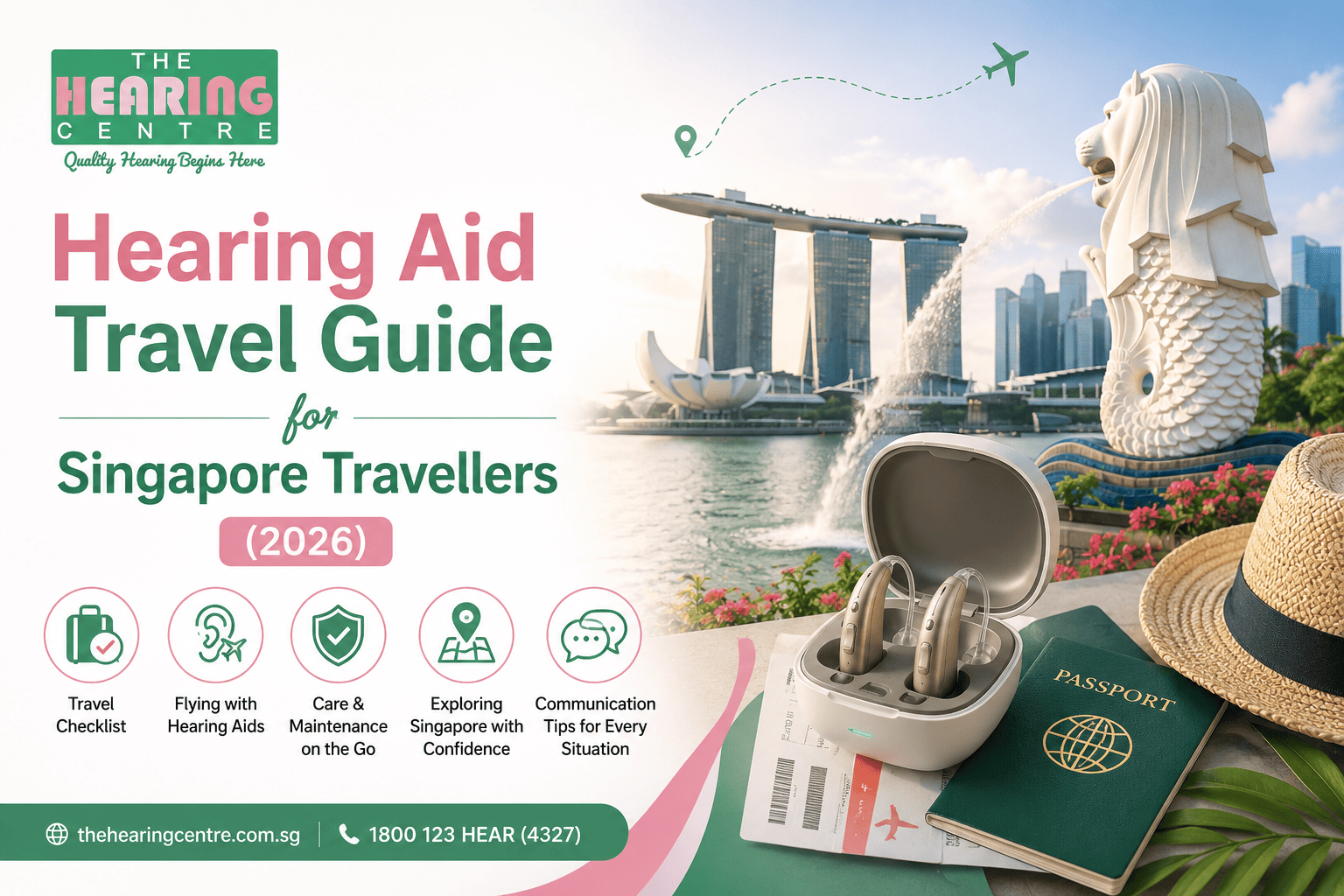
Let’s be honest. Most Singaporeans book a flight the same way they order food on GrabFood. Quick, easy, barely a second thought. Bali long weekend? Done. Tokyo with the family? Sorted. KL for the weekend? Why not.
But if you wear hearing aids, there’s always a quieter version of this conversation happening in your head at the same time. Can I keep them on at security? Is the Phuket humidity going to wreck them? And what exactly am I supposed to do if something breaks down while I’m sitting in a hotel room in Osaka at 11pm?
This hearing aid travel guide was written to sort all of that out properly, and for Singaporeans specifically.
Start Your Hearing Aid Travel Guide Here: See Your Audiologist First
Before anything else — before you even think about packing — go see your audiologist.
I know. It sounds like the kind of advice people nod at and then ignore. But the number of people who skip this step and then spend half their trip dealing with something totally fixable is genuinely depressing. A dome quietly cracking. A wax guard at 80% blockage. A battery that’s been losing capacity for weeks and nobody noticed. At home, any of these is a minor inconvenience. Somewhere in rural Indonesia with no hearing clinic for two hours? Very different story.
The Hearing Centre Singapore has five branches — Lucky Plaza, Jurong IMM, Raffles ENT Centre, Ang Mo Kio, and Tampines. Getting a pre-travel appointment there means your audiologist goes through everything: deep clean, worn parts replaced, a proper listening check, and custom programs loaded for wherever you’re heading. Going somewhere loud and chaotic like Bangkok’s Chatuchak market or Universal Studios Japan? Stronger noise reduction profile. Quieter trip? Different settings entirely. That’s personalised setup you genuinely can’t replicate by reading articles.
Also worth doing at the same visit: ask for a short written note confirming you wear hearing aids. Changi almost never needs it. But some smaller regional airports do ask, and having a document on your phone takes care of that instantly.
What to Pack: The Only Hearing Aid Travel Guide Checklist You Need
Everything below goes in your carry-on. Not your checked bag. Your carry-on. Every single trip.
Spare batteries or your charging case. Disposable zinc-air batteries? Pack double whatever you think you need. Travel days are long. Delays happen. You’ll be wearing your devices way more hours per day than usual at home. Rechargeable devices? Your charging case is now officially the most important item you own while travelling. Forget it once and your hearing aids are completely dead within 24 hours. That’s not an exaggeration.
A portable dehumidifier or drying kit. This one gets forgotten most often and regretted most bitterly. Flying from Singapore to Bali, Phuket, the Philippines — you’re landing into serious humidity. Moisture works its way inside your devices gradually over a few days, causing static, weird distortion, or just a full stop. A small desiccant drying kit solves this while you sleep. Use it every night. Not most nights. Every night.
A hard-shell protective case. Your charging case handles overnight storage. During the day though — at the pool, on a boat, at the beach — you need something separate and solid. A zip-lock bag isn’t good enough. A cloth pouch isn’t good enough. Hard shell.
Spare wax guards, domes, and a cleaning brush. A blocked wax guard kills your sound in seconds flat. A torn dome makes the device uncomfortable enough to not want to wear it. And no, there’s no pharmacy in Lombok stocking hearing aid accessories. Pack spares. They’re tiny.
International power adapter. Singapore uses the Type G three-pin socket. Big parts of Europe, North America, and East Asia don’t. Your charging case is a useless brick if you can’t plug it in.
Your audiologist’s contact info and your device model and serial number. Both saved in your phone. These are the first two things anyone will ask if something goes wrong abroad and you need help fast.
What to Pack | Why It Matters |
Spare batteries or charging case | Keeps devices running through delays and long days |
Portable drying kit | Prevents moisture damage in tropical climates |
Hard-shell protective case | Protects devices when not wearing them |
Spare wax guards and domes | Instant fix for the most common on-road failures |
International power adapter | Essential for charging abroad |
Audiologist contact and serial number | Needed if anything goes wrong overseas |
Hearing Aid Travel Guide: Getting Through Changi Airport
Changi is, by most measures, one of the friendliest airports in the world for people with hearing loss. Good visual signage everywhere, staff who are actually trained to help, and a security process that’s pretty manageable once you know what to expect.
Do You Need to Remove Your Hearing Aids at Security?
No. They stay in. Full stop.
Hearing aids are medical devices. The walk-through metal detectors, body scanners, and handheld wand detectors at Changi are looking for genuine security threats — not the microscopic amount of metal inside a Phonak, Signia, ReSound, or Oticon device. It won’t register. Nothing will beep. You’ll just walk through.
What you should do is say something to the officer before you go through. Literally just “I’m wearing hearing aids” — that’s all it takes. It helps them communicate properly with you and prevents any confusion if they want to check anything. You can also ask for a visual inspection instead of using the scanner if you’d prefer, though honestly most people never need to.
One thing you should never do: don’t put your hearing aids in the security tray with your keys and phone. They stay in your ears.
Battery Rules at the Airport
Zinc-air disposable batteries can go in carry-on or checked luggage, no problem. Keep them in the original card packaging to stop them short-circuiting against other metal things in your bag.
Rechargeable hearing aid charging cases are a different matter. They contain lithium-ion batteries, which means carry-on only — not checked luggage. This applies on Singapore Airlines, Scoot, and every other airline flying out of Changi. External power banks follow exactly the same rule.
Hearing Loops at Changi
If your hearing aids have a T-coil setting, ask The Hearing Centre to activate it before your trip. Certain areas of Changi have induction loop systems built in. When you’re in a looped zone and switch to T-coil mode, announcements come straight into your hearing aids rather than fighting with the general noise of the terminal. At gate areas especially, it’s a meaningful difference.
What Happens When You’re Actually on the Plane
Leave your hearing aids in. For the whole flight. Boarding, takeoff, mid-flight, landing — all of it.
Hearing aids aren’t part of the electronic device restrictions that cover phones and tablets. They don’t interfere with aircraft systems. The flight crew asking everyone to switch off electronics is not talking about your hearing aids.
The reason to keep them in is pretty straightforward: you need to be able to hear. Safety announcements, crew instructions, turbulence warnings — these all happen out loud. Taking your hearing aids out to save some battery life and then missing something is just not a sensible trade-off.
When the crew asks you to put your phone in flight mode, do it. On most hearing aids from Phonak, Signia, and ReSound, the Bluetooth connection between your phone and your devices stays active even in flight mode. You can still adjust volume, switch programs, stream audio — it all works.
Ear pressure during takeoff or landing? Chew gum, swallow, yawn. Usually clears in a minute. If it’s genuinely uncomfortable, pop your hearing aids out briefly while your ears adjust, then put them back.
Humidity and Heat: The Biggest Risk in This Hearing Aid Travel Guide
For Singaporeans flying to tropical destinations, nothing else in this guide matters more.
Moisture is the main reason hearing aids fail while travelling. It sneaks into the microphone slowly, corrodes the internal circuits over several days, and then the device stops working in a way that feels sudden — but really isn’t. What makes this particularly annoying is that your hearing aids can look and feel completely dry while the damage is already happening inside.
Here’s what actually works:
Drying kit, every night, no exceptions. Not when you remember. Every night. Put your devices in when you go to sleep. Take them out in the morning. This single habit stops most moisture problems from ever starting.
Keep your case in the room, not the bathroom. Shower steam hangs around in bathrooms long after you’ve finished. Bedside table. Desk. Anywhere but the bathroom counter.
Take your hearing aids out before swimming, showering, or any water activity. No hearing aid sold right now is genuinely waterproof — water-resistant models from Phonak and Signia included. Saltwater and chlorine cause permanent damage. Sand that gets into microphone ports is almost impossible to fully remove. Every time. Before water. Take them out.
Same goes before spraying sunscreen or insect repellent. Aerosol chemicals block microphone ports and damage the outer casing. Spray, wait for it to absorb or dry properly, then put your hearing aids back on.
Destination Tips for Singapore Travellers
Bali, Lombok, Phuket, and Southeast Asia. Heat, saltwater, sand, relentless humidity — these are probably the toughest destinations for hearing aids. Drying kit every night. Hearing aids out at any beach or pool. Wipe them down each evening. Don’t leave them in a beach bag or near an open window overnight.
Bangkok and other tropical cities. Constantly moving between freezing air-conditioned malls and hot, sticky streets outside causes condensation to form inside your devices. When you come back indoors from the heat, give your hearing aids a moment to breathe before closing them into a case. Just a short pause helps more than you’d think.
Japan, South Korea, and cold-weather destinations. Cold drains batteries faster than people expect. Keep spare batteries in an inner jacket pocket so your body heat keeps them performing. Watch for condensation when moving between cold outside air and warm indoor heating.
Australia, Europe, and long-haul destinations. Long-haul means your devices run for 10 to 14 hours straight. Start with fresh batteries or a full charge before boarding. In major cities across the UK, Netherlands, and Australia, many museums, theatres, and transport hubs have hearing loop systems. If your T-coil is active, you can connect directly without any extra gear.
If Your Hearing Aid Stops Working Abroad
Don’t panic. Start with the basics.
Recharge or replace the battery. Check the wax guard and swap it out if you’ve got a spare. Wipe the device down with a dry cloth and leave it in the drying kit for two to three hours. The majority of failures that happen while travelling are moisture or blockage issues — and most of them resolve completely with drying. Don’t assume the worst before you’ve tried this.
If that doesn’t fix it, call The Hearing Centre Singapore. Phone is +65 6474 2216, email is enquiry@thehearingcentre.sg — reachable during clinic hours. Have your device model and serial number ready. It cuts down the troubleshooting conversation significantly.
For situations that need someone to physically look at the device, use the manufacturer’s international service locator. Phonak, Signia, Oticon, and ReSound all have authorised service centres in major cities across Asia, Europe, and Australia.
Ready to Travel? One Last Thing Before You Go
No hearing aid travel guide — this one or anyone else’s — is a substitute for 30 minutes with your audiologist before you fly. Devices properly serviced, programs updated, worn components replaced before they cause problems on the road. That’s the actual difference between a trip that goes smoothly and one that doesn’t.
If your hearing aids haven’t been in for a service in six months, or you’ve got something booked soon, sort out a pre-travel appointment at The Hearing Centre Singapore before you go. Five branches, audiologists who know what they’re doing, and advice that’s specific to you — not some generic checklist.
Frequently Asked Questions
Yes, and you should. Modern screening equipment won’t flag or damage hearing aids. Just let the officer know you’re wearing them before you walk through.
No. Hearing aids aren’t subject to electronic device restrictions and don’t affect aircraft systems. Keep them on from boarding through to landing.
No. X-ray equipment used for carry-on bags doesn’t harm hearing aid components. Keep your devices in your ears — not the security tray.
Drying kit every single night. Store devices somewhere cool and dry when not wearing them. Take them out before any water contact and keep them away from hot cars and direct sunlight.
Yes. Zinc-air disposable batteries are fine in carry-on and checked luggage. Rechargeable lithium-ion batteries and charging cases must go in carry-on only. Keep everything in original packaging.
Yes, especially for trips longer than a few days. The Hearing Centre Singapore does pre-travel servicing across all five branches. A short visit gets your devices properly cleaned, checked, and set up for your destination.
Recharge or swap the battery. Replace the wax guard if you have spares. Leave the device in your drying kit for two to three hours. Still not working? Call your Singapore audiologist for remote guidance.
Many standard Singapore travel insurance policies include medical devices — but not all of them do. Read your policy before you fly. If hearing aids aren’t mentioned, look into adding a rider or separate equipment cover.
Yes, once your phone is in flight mode. Most modern Bluetooth hearing aids from Phonak, Signia, and ReSound keep their connection to your phone in flight mode. Check your specific app beforehand just to confirm.
The Hearing Centre Singapore has branches at Lucky Plaza, Jurong IMM, Raffles ENT Centre, Ang Mo Kio, and Tampines. Call +65 6474 2216 or email enquiry@thehearingcentre.sg to set up a pre-travel appointment.