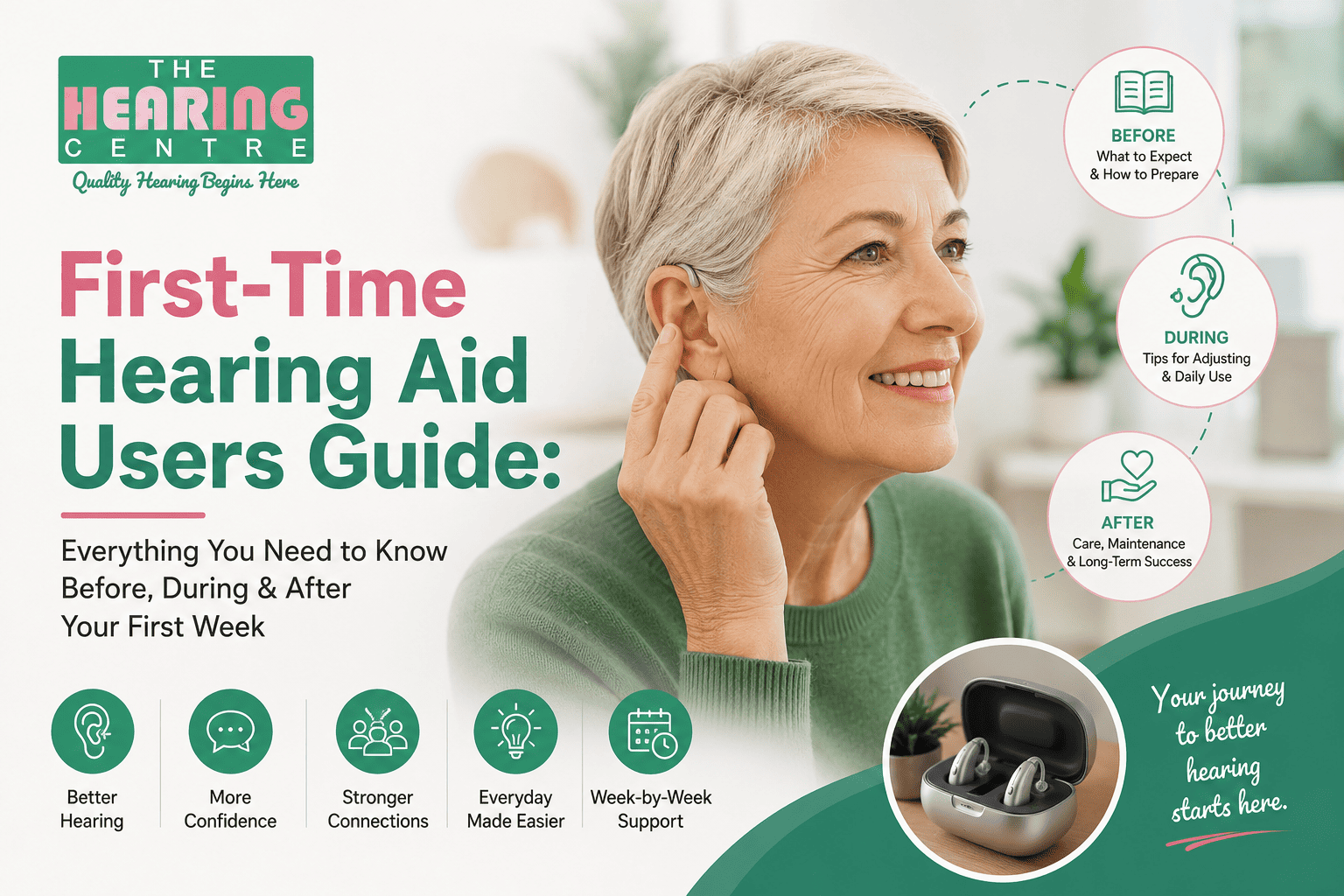
At The Hearing Centre, we have walked hundreds of first-time hearing aid users through exactly this experience. We know the questions that keep you up the night before your fitting appointment. We know the frustrations that crop up in week two, when the novelty fades and the adjustment truly begins. And we know the quiet, ordinary joy that comes a few months later, when you stop thinking about your hearing aid at all — because it has simply become part of you.
Why the First-Time Hearing Aid Users Experience Feels So Strange
Before we get into practical tips, it helps to understand why adjusting to a hearing aid takes time. And the answer is not really about the device. It is about your brain.
Hearing happens in the auditory cortex, not in your ear. Your hearing aid’s job is simply to deliver amplified, processed sound signals. Your brain’s job is to interpret those signals — and if your brain has been receiving diminished or distorted input for months or years, it has quite literally forgotten how to process certain sounds efficiently.
Think of it like physical rehabilitation after an injury. When you start using muscles that have been inactive, they ache, tire quickly, and feel awkward. Your auditory system works the same way. The brain needs time and consistent exposure to re-learn sound processing — and that process, according to audiological research, typically takes anywhere from six weeks to six months, depending on the severity and duration of your hearing loss.
This is why most audiologists, including our team at The Hearing Centre, ask patients not to judge their hearing aids in the first two weeks. That is simply not enough time for meaningful adjustment to occur.
Step 1: Your First Day — Start Smaller Than You Think
The single most common misunderstanding first-time hearing aid users make is doing too much, too soon.
Your first day should be quiet. Deliberately quiet. Wear your hearing aids for two to four hours maximum, in the most familiar environment you have — your own home. Walk around slowly. Listen to the sounds you have been lacking: the kettle boiling, the birds exterior your window, the rhythm of your own steps on the floor. These are the sounds that have been declining from your life without you even fully achieving it.
This deliberate, gentle start does two things. It allows your brain to begin recalibrating without being overwhelmed, and it gives you the chance to notice whether the physical fit of the device feels comfortable — or if you need to come back to us for an adjustment.
Step 2: Read the Manual — Then Call Us Anyway
Every hearing aid comes with a user manual, and you should read it. Modern hearing aids are refined pieces of technology. Learned how to change the program setting, how to use the associate app, how to charge or replace batteries correctly, and how to recognise common issues — all of this matters greatly for your day-to-day encounter.
That said, your manual cannot replace your audiologist.
If you encounter something the manual does not address — a whistling sound when you chew, a feeling that your own voice sounds hollow, a sense that certain frequencies are too sharp — these are not things to quietly endure. These are things to bring to us. Small adjustments in your programming can make an huge difference to your console, and they are a fully normal part of the post-fitting process.
Step 3: Understand the Occlusion Effect — Your Voice Will Sound Weird at First
When you first put a hearing aid in your ear canal, your own sound will sound different. Often louder. Sometimes hollow, like you are talking inside a barrel. You might feel like your voice is flourishing inside your own head.
This is called the occlusion effect, and it occurs because the physical existence of the hearing aid in your ear canal shifts how the vibrations from your own voice achieve your inner ear.
It is entirely normal, it is temporary, and it is something your audiologist can address through changes to the device’s venting (the tiny opening that allows air circulation in the canal) or by changing the low-frequency programming.
Step 4: Build Your Wear Time Gradually — And Then Keep Building It
Here is a framework that works well for most first-time hearing aid users:
Days 1–3: Wear your hearing aids for 2–4 hours in quiet, familiar environments. Focus on everyday household sounds. Rest when you feel fatigued.
Days 4–7: Extend to 4–6 hours. Try plain, one-on-one conversations. Observe how dialogue sounds different — clearer consonants, richer voice tones.
Week 2: Move into slightly more complex listening environments. A small family gathering. A quieter café. A short walk outside. Start using the television at the volume that is comfy for everyone else in the room, not the greater volume you may have trusted on before.
Weeks 3–4: Work toward 8–10 hours of daily wear. Research consistently shows that wearing hearing aids for more than eight hours a day significantly improves long-term satisfaction and reduces listening fatigue. By this point, many users report that taking their hearing aids out feels strange.
Month 2 and beyond: Wear them throughout all waking hours if feasible. This is when the real dividends appear — reduced cognitive load, more natural conversation, less effort spent concentrating on speech.
Step 5: Involve the People Around You
Your family members, your partner, your friends — they have all been adapting to your hearing loss along with you, repeatedly, without fully actualising it. They have been speaking louder, duplicating themselves, sitting on your “better” side. Now that you have a hearing aid, there will be a period of adjustment for them, too.
Ask your family to help you practise in low-force settings. Have discussions at a natural volume and natural distance. Let them know that you may still sometimes ask for repetition, and that this is a part of the process, not a signal that the hearing aid is flawed.
You can also try reading aloud together — a news article, a passage from a book — while you wear your hearing aids. This guides your brain to connect the auditory signal from the device with usual language patterns, which expedites adaptation considerably.
Step 6: Keep a Hearing Journal
A hearing journal is simply a place — a notebook, a notes app on your phone, anything — where you record your daily experience with your hearing aids. What environments you were in. What sounded good. What sounded uncomfortable. Whether you noticed fatigue. Whether conversations felt easier or harder.
This evidence serves two purposes. The first is emotional: it helps you see advancement over time, which can be greatly motivating during the difficult early weeks when advancement feels invisible. The second is clinical: when you come in for your follow-up at The Hearing Centre, your magazine gives your audiologist accurate, specific feedback that makes programming adjustments far more exact.
Step 7: Do Not Fiddle With the Volume
Modern hearing aids are remarkably sophisticated. Many of them have automatic surroundings detection, which means the device energetically analyses the sound environment around you and adjusts its processing consequently — shifting into a different mode when you enter a restaurant, as opposed to when you are in a calm room versus when you are outside.
When you constantly adjust the volume manually, you interfere with this automatic processing. You also interrupt the natural adaptation curve of your auditory system.
Trust the device. Trust the programming your audiologist has set. And if you honestly feel that a particular sound atmosphere is constantly problematic — restaurants, for instance, are a common dispute for new hearing aid users — note it in your journal and bring it to your next meeting. We can create a specific ecological program for that position.
Step 8: Caring for Your Hearing Aids From Day One
Your hearing aid is a precision instrument. The way you care for it from the very beginning will directly affect its performance and its lifespan.
Daily cleaning matters enormously. Earwax is the single most common cause of hearing aid malfunction in Singapore’s humid climate. Every day, gently wipe the device with the dry cleaning tool provided, clear the wax guard if your model has one, and allow the device to air out overnight in its drying case or dehumidifier box.
Moisture is the enemy. Singapore’s humidity is particularly hard on hearing aids. Remove your devices before showering, swimming, or any activity that involves significant sweating. If your hearing aids get wet, do not use a hairdryer — use a proper electronic drying kit or come to us for professional drying.
Handle them gently. Always insert and remove your hearing aids over a soft surface. A towel on the bathroom counter, for instance. Drops from even a small height can damage the delicate components inside.
Replace wax guards and domes regularly. Depending on your usage and earwax production, these typically need replacing every three to six months. Our hearing aid cleaning service includes inspection and replacement of these components as a standard part of maintenance visits.
When to Come Back to The Hearing Centre
We always recommend scheduling your first follow-up appointment within two to four weeks of your initial fitting. But there are specific signs that mean you should come in sooner:
Persistent physical discomfort. Some initial soreness where the device rests against your ear is normal. Pain, redness, or soreness that continues after the first few days is not — and is usually a simple fit adjustment.
Whistling or feedback sounds. A occasional whistle when you hug someone or hold the phone too close to your ear is normal. Constant or frequent feedback is not, and indicates either a fit issue or a programming adjustment is needed.
Muffled or hollow sound quality. If speech sounds consistently muffled or your own voice remains hollow after the first two weeks, this needs professional attention.
The device is not turning on or holding charge. Our hearing aid repairs and adjustments team can diagnose and address hardware issues quickly.
You are simply not wearing it. This one matters most. If you find yourself leaving your hearing aids in the case most days, that is not a personal failure — it is a signal that something about the fit, the sound, or the programming is not working for you. Come and tell us. We can fix it.
What First-Time hearing aid Users Here Often Tell Us
Busy hawker centres are acoustically complex spaces. High ambient noise, reverberant surfaces, and multiple competing conversations make them demanding even for people with normal hearing. If you find your hearing aids overwhelming in these environments initially, that is not a malfunction. It means your device’s noise reduction settings need adjustment, and it means you should build up to these environments gradually rather than diving in on week one.
Many of our patients in Singapore also tell us they found the transition easier once they worked with a hearing specialist Singapore who understood not just the clinical aspects of fitting, but also the practical realities of daily life here — the volume of MRT stations, the challenges of open-plan offices, the particular acoustic demands of eating out with family.
What the Research Actually Says About Long-Term Success
Studies show that people who wear their hearing aids consistently for eight or more hours daily report significantly better quality of life, lower listening fatigue, and improved social participation compared to intermittent users. There is also a growing body of evidence connecting untreated hearing loss to increased cognitive decline risk — which means that the decision to use your hearing aids consistently is not just about hearing better today, but about protecting your cognitive health over the long term.
If you have concerns about hearing loss and its broader health implications, our page on hearing loss treatment Singapore covers the medical dimensions of this topic in detail.
Why The Hearing Centre Singapore
We are sometimes asked by prospective patients what distinguishes a specialist hearing centre from a general health provider when it comes to hearing aids.
The honest answer is: continuity and expertise at every stage.
Getting a hearing aid fitted correctly is the beginning of a relationship, not a transaction. The clinical programming on your first day is based on your audiogram — a baseline measure of your hearing loss across frequencies. But your real-world experience over the following weeks is the data that makes that programming genuinely personal to you. Every follow-up appointment, every adjustment, every update to your settings builds on everything that came before.
At The Hearing Centre, we are MOH-approved and affiliated with the Society of Audiology Professionals Singapore (SAPS). Our audiologists work with all the major hearing aid brands — Signia, Phonak, Starkey, ReSound, Oticon, and Rexton — which means our recommendations are always based on what suits your specific hearing profile and lifestyle, not on brand incentives.
Frequently Asked Questions:
Most people feel fully adapted between three and six months of steady daily use. The most significant changes — containing version to your own voice and reduction in listening fatigue — typically occur within the first four to six weeks.
No, this is named the occlusion effect, and it is one of the most common issues for new users. It takes place because the hearing aid physically modifies how the vibrations from your own voice reach your inner ear.
Absolutely, but moisture management is specifically important here. Advanced hearing aids are designed to handle everyday moisture, but you should remove them before bathing or swimming, use a drying kit or ventilator case overnight, and come in for regular expert cleaning. Our team can advise on suitable equipment for Singapore’s climate.
Start with 2–4 hours on your first day and build little by little. The clinical goal is 8–10 hours of daily wear by the end of your first month, and all waking hours thereafter. Research constantly shows that eight or more hours of daily use is associated with significantly better outcomes — diminished fatigue, improved speech, sympathy, and better quality of life.
A brief whistle when you hug someone or hold a phone close to your ear is normal. Persistent or frequent feedback usually indicates either a fit issue (the device is not seated correctly in your ear) or a programming issue.
Yes — this is listening fatigue, and it is a sign that your brain is actively working to process sound information it has been missing. It is essentially neurological exercise, and like physical exercise, it becomes less tiring as your capacity builds.
Absolutely, and we encourage it. Many modern hearing aids have Bluetooth connectivity that allows direct streaming from your phone or television, which can make these environments significantly easier to navigate.
Wipe the device daily with a dry cleaning cloth or the tool provided. Do not use water, alcohol, or cleaning sprays directly on the device. Clear the wax guard if your model has one. Store the devices overnight in a drying case or dehumidifier. Replace domes and wax guards every three to six months, or when you notice a change in sound quality.
Yes — older adults often have a longer adjustment period, partly because they may have lived with untreated hearing loss for longer and partly because the brain’s neuroplasticity (its ability to adapt) changes with age. Patience and consistent support from family members makes a significant difference. Our page on hearing aids for senior citizens in Singapore covers specific strategies for elderly first-time hearing aid users.
If you are unsure whether you need a hearing aid, an audiometry test is the right first step. This test measures your hearing thresholds across different frequencies and gives your audiologist a clear picture of where your hearing stands and what type of hearing loss, if any, is present.