
TLDR: An invisible hearing aid sits inside the ear canal and can’t be seen at normal conversation distance. The two main types are IIC (invisible-in-canal — the deepest fit, genuinely invisible) and CIC (completely-in-canal — nearly invisible, slightly more functional). In 2026, rechargeable and Bluetooth CIC options now exist — a major change from even three years ago. These devices suit mild to moderate hearing loss. Not everyone’s ear canal anatomy can accommodate them. Start with a proper hearing test and ear impression to know if you’re a candidate.
You can hear the hesitation in the question when patients ask it. “Is there one that nobody can see?” It’s one of the most common things people say at a first consultation at The Hearing Centre. And the honest answer now, in 2026, is yes — better than ever before.
Invisible hearing aids have genuinely improved. Rechargeable invisible-in-canal devices now exist. Bluetooth streaming in a completely-in-canal size is no longer theoretical. The trade-offs are still real — and worth knowing about — but the options for people who want a hearing aid nobody notices have never been better.
What Is an Invisible Hearing Aid?
An invisible hearing aid is a small electronic device that fits entirely or almost entirely inside the ear canal. From a normal conversation distance, you can’t see it. The only thing occasionally visible is a tiny removal cord used to pull the device out.
These devices do the same things as larger hearing aids — pick up sound, process it, and deliver amplified audio to the ear — but in a much smaller package. Because they sit so close to the eardrum, less amplification is actually needed to achieve the same effect. The natural shape of the outer ear also helps capture and funnel sound in a more natural way than devices worn behind the ear.
The two styles that fall under the “invisible hearing aid” category are IIC and CIC. They’re different enough that it’s worth understanding which is which before you look at specific brands or prices.
IIC vs CIC: What’s the Difference?
Both are discreet. Both sit inside the canal. But they’re not the same thing.
IIC (Invisible-in-Canal) | CIC (Completely-in-Canal) | |
Placement | Deep inside the canal | Inside the canal, slightly less deep |
Visibility | Essentially invisible | Nearly invisible — tiny rim may show |
Size | Smaller | Slightly larger |
Battery | Disposable only (most models) | Rechargeable now available |
Bluetooth | Rare | Available on select 2026 models |
Amplification range | Mild to moderate loss | Mild to moderate (some up to severe) |
Handling | Harder — very small | Slightly easier |
Who fits | Narrower range of ear anatomies | More patients can use it |
For people who want absolutely zero visibility, IIC is the deeper option. For people who want maximum discretion while keeping access to rechargeable batteries and modern connectivity features, a premium CIC is the better balance in 2026.
A detailed comparison is in our CIC vs IIC hearing aids guide if you want to go deeper on this before your appointment.
What’s Changed in 2026
For years, choosing an invisible hearing aid meant accepting significant limitations. No rechargeable battery — the shell was simply too small. No Bluetooth streaming. Limited processing power. Suitable only for mild hearing loss.
In 2026, several of those limitations have been addressed:
Rechargeable CIC is now real. The Signia Silk Charge&Go IX was the first rechargeable instant-fit CIC to market, and the Phonak Virto Infinio R followed. Up to 30 hours per charge in a device that sits inside your ear canal. Three years ago this wasn’t possible.
Bluetooth streaming in canal-fit devices. The Oticon Zeal CIC now offers Bluetooth streaming in a truly discreet form. That means music, calls, and TV audio streamed directly into a hearing aid that nobody can see.
AI processing in smaller shells. The Starkey Edge AI CIC runs a full AI processor (the G2 Neuro) in a CIC shell — the same intelligence used in their larger models, now in a discreet canal device.
The invisible hearing aid category in 2026 is meaningfully different from what existed even in 2022.
Who Is Suitable for an Invisible Hearing Aid?
Not everyone can wear one, and it’s important to know this before getting attached to the idea.
You’re likely a good candidate if:
- Your hearing loss is in the mild to moderate range
- Your ear canal is wide enough and straight enough to fit the device shell
- You’re comfortable handling very small objects
- You don’t have ear canal infections or significant earwax buildup issues
- You’ve had an ear impression taken and your anatomy can accommodate the device
You may not be suitable if:
- Your hearing loss is severe or profound — most invisible devices can’t deliver enough amplification
- Your ear canal is very narrow, curved, or has an unusual shape
- You have chronic ear canal infections
- You produce a lot of earwax — invisible devices sit in the path of wax migration and can block faster more easily
- You have reduced dexterity that makes handling very small devices difficult
The only way to know for certain is to have your ear canals measured and an impression taken. The Hearing Centre carries out this assessment as part of the fitting process.
Best Invisible Hearing Aid Brands in Singapore (2026)
Phonak Virto Infinio Titanium (IIC)
Phonak’s flagship invisible hearing aid. The titanium shell is thinner than standard materials, allowing the device to sit deeper in the canal than most IIC models — rated invisible in 9 out of 10 ears tested. The ERA chip provides a 45% reduction in listening effort and runs Phonak’s AutoSense OS 6.0, which automatically switches programs based on your listening environment.
- Truly IIC — deepest fit available
- Titanium shell — thinner, stronger, more comfortable long-term
- Not rechargeable — disposable battery (this is the IIC version)
- No Bluetooth streaming
- AutoSense automatic environment detection
- Suitable for mild to moderate hearing loss
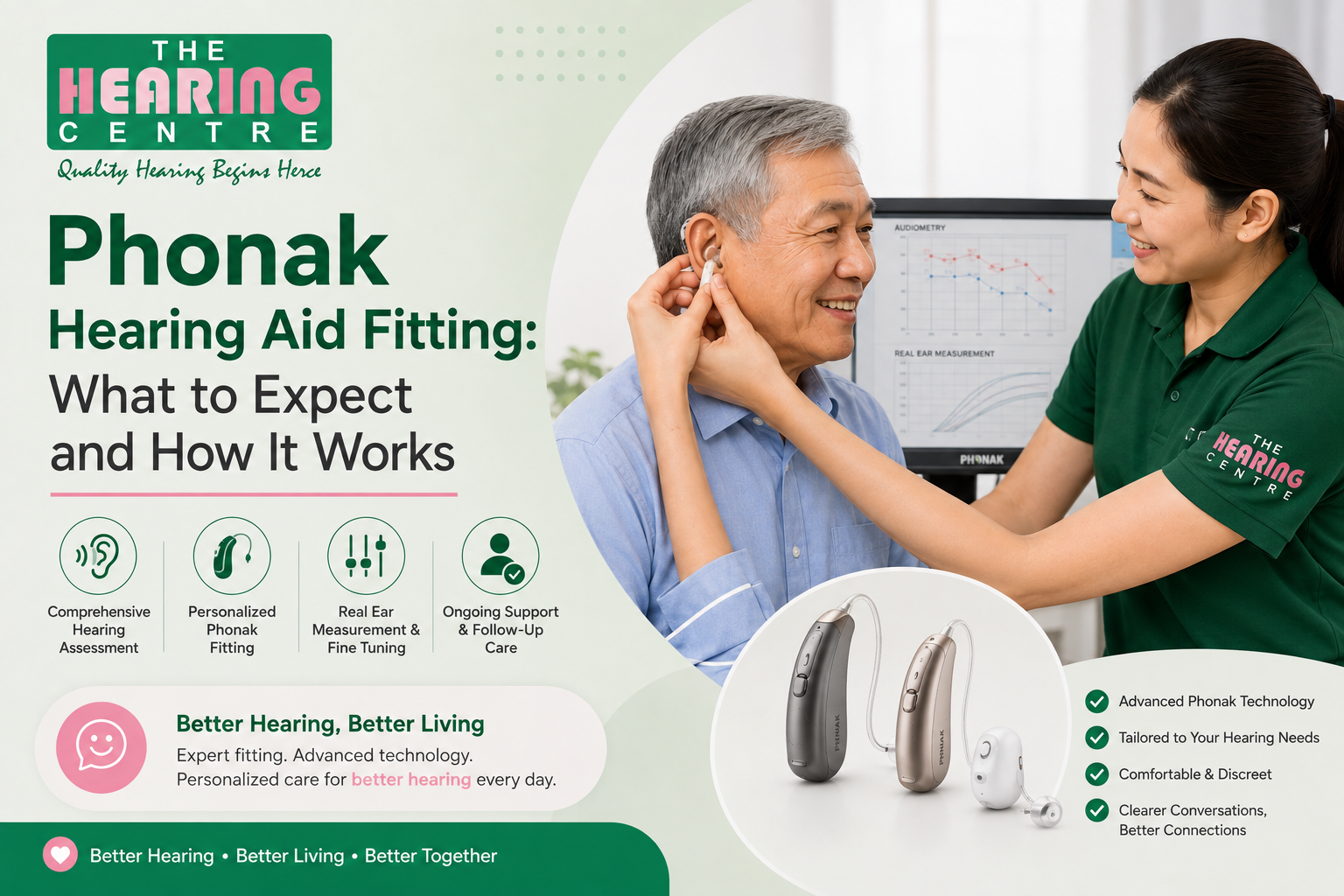
Also available: Phonak Virto Infinio R — the CIC version with rechargeable battery, Universal Bluetooth 5.3 for hands-free calling and streaming, and up to 30 hours per charge. Slightly less invisible than the titanium IIC but significantly more functional.
Signia Silk Charge&Go IX
The world’s first rechargeable instant-fit CIC. What makes the Silk different from custom IIC and CIC devices is that it uses soft silicone click sleeves rather than a custom-moulded shell. That means no ear impression is needed and you can walk out wearing it the same appointment. It’s also rechargeable — unusual in this size category.
- Rechargeable CIC — no battery changes
- Instant fit — soft silicone sleeves, no custom mould
- Full IX platform technology including Own Voice Processing
- Nearly invisible at conversation distance
- Bluetooth (limited streaming compared to larger models)
- Available in premium 7IX technology level
This is the top choice for patients who want immediate fitting, rechargeable convenience, and a nearly invisible result. Signia’s OVP technology also makes the adjustment experience significantly smoother for first-time wearers.
Oticon Own IIC and Oticon Zeal
Oticon Own IIC — custom-fitted, deep canal placement, powered by the Sirius chip with Deep Neural Network processing. Up to 90 dB fitting range — one of the wider amplification ranges available in an IIC. IP68 rated. Battery-powered with 3 to 5 day runtime. No Bluetooth, no rechargeable.
Oticon Zeal (2026) — a newer CIC that changes the conversation. It offers AI-driven speech-in-noise processing, supports Auracast wireless audio, and has Bluetooth streaming in a CIC form factor. This is one of the most significant invisible hearing aid launches of 2026, bringing flagship Oticon processing into a discreet canal device.
Oticon’s BrainHearing philosophy — giving the brain a fuller sound scene rather than a heavily filtered signal — translates well to canal devices where the natural ear anatomy already does some of that work.
Starkey Edge AI CIC
Starkey’s smallest devices now run the G2 Neuro Processor with full AI capabilities. The Edge AI CIC covers mild to severe hearing loss, which is broader than most canal-fit devices. The My Starkey app allows program switching. Starkey is the only major brand with health monitoring built into hearing aids — the CIC version has limited health features compared to larger models but the core AI processing is the same.
- G2 Neuro Processor — real-time AI noise classification
- Mild to severe hearing loss range
- Custom fit
- App control via My Starkey
- Battery powered
Widex Moment IIC and CIC
Widex is known for sound naturalness and ZeroDelay processing. Their Moment IIC and CIC models bring that philosophy into a discreet shell. For patients who find other brands sound slightly processed or mechanical, Widex tends to feel more natural — which applies in a canal device where close-to-eardrum placement already improves this somewhat.
Invisible Hearing Aid Price Guide — Singapore 2026
Invisible hearing aid prices in Singapore start from around SGD 2,000 and can go up to SGD 9,000 per device, depending on the brand, technology tier, and level of customisation.
Brand naturally shapes both price and what you’re getting:
- Phonak — known for its titanium IIC shell, sitting deeper in the canal than most, plus rechargeable CIC options with strong connectivity
- Signia — the Silk Charge&Go IX stands out as a rechargeable, instant-fit CIC that skips the ear impression step entirely, fitted same-day
- Starkey — brings AI processing (including its flagship DNN-based platform) into a discreet CIC shell, covering a wider hearing loss range than most invisible options
- ReSound — offers custom hearing aids across IIC, CIC, and ITC formats. Its Nexia range sits at the premium end with Bluetooth LE Audio streaming and rechargeable options, while the Key range offers a solid mid-tier custom option — the ITC version supports wireless connectivity, while CIC and IIC stay non-wireless to preserve their compact, discreet size
- Oticon — offers invisible options like the Own IIC and the newer Zeal CIC, which brings Bluetooth streaming and Auracast support into a discreet canal shell
- Widex — known for natural, less “processed” sound quality in its Moment IIC and CIC lines, popular with patients sensitive to how other brands sound
Note: The Hearing Centre currently carries Phonak, Signia, Starkey, and ReSound. Oticon and Widex are included above for general comparison purposes only and are not brands we stock — ask our audiologists if you’d like to explore options within the brands we carry.
Invisible vs Other Hearing Aid Styles: Honest Comparison
Invisible (IIC/CIC) | RIC | BTE | |
Visibility | Not visible / barely visible | Low visibility | Most visible |
Battery | Disposable (most IIC), rechargeable (some CIC) | Rechargeable standard | Rechargeable standard |
Bluetooth | Limited (some CIC models) | Full on most | Full on most |
Hearing loss range | Mild to moderate | Mild to severe | Mild to profound |
Handling | Hardest | Moderate | Easiest |
Wind noise | Less (canal shields mic) | Some | More |
Natural sound | Good (close to eardrum) | Very good | Good |
Suitable for glasses wearers | Ideal — nothing behind ear | Generally fine | Can interfere |
One thing people don’t always consider: invisible hearing aids actually have less wind noise than behind-ear styles because the microphone sits inside the canal rather than outside. And because they sit close to the eardrum, they can feel more natural in quiet settings. The trade-off is consistently in complex noise situations, where the directional microphone arrays in RIC devices outperform the smaller canal-fit microphone.
Custom Fit vs Instant Fit
Most invisible hearing aids require a custom mould made from an impression of your ear canal. The audiologist takes the impression in the clinic, and it’s sent to the manufacturer, and before the device comes back two to three weeks later shaped exactly to your ear.
The Signia Silk Charge&Go IX is the notable exception — it uses universal soft silicone sleeves so it can be fitted and worn during the same appointment.
Custom fit has real advantages: better seal, more consistent performance, more stable placement. Instant fit is more convenient if you want to start wearing a device immediately.
For more on whether custom is the right choice for your situation, our guide on why custom hearing aids might be the best choice gives an honest breakdown of the trade-offs.
Caring for an Invisible Hearing Aid
Canal devices need a bit more daily attention than behind-ear styles because they sit in the path of natural earwax migration.
- Check the wax guard daily — this is the most common reason an invisible device suddenly goes quiet. Most brands include a wax guard replacement tool. Replace it every two to four weeks depending on how much wax you produce
- Store in the carry case when not worn — store it with a drying capsule overnight in Singapore’s humidity
- Clean the outer surface gently with a dry cloth
- Never use water directly on the device — even IP68-rated devices should be kept dry during cleaning
- Come in for professional servicing every three to six months — canal devices benefit from professional checks more frequently than larger styles because of earwax exposure
Our guide on completely- in- canal hearing aids has more detail on day-to-day care for canal-fit devices.
Getting Fitted at The Hearing Centre
Step 1 — Hearing Test
Full audiogram including pure tone audiometry and tympanometry. This confirms whether invisible devices are appropriate for your degree of hearing loss.
Step 2 — Ear Canal Assessment
Your ear canal is examined to confirm size, shape, and whether a custom IIC or CIC can be accommodated. Not every canal can physically fit these devices.
Step 3 — Ear Impression (for custom models)
A soft putty impression is taken of your ear canal. This is sent to the manufacturer. Takes 2 to 3 weeks. For the Signia Silk, this step is skipped.
Step 4 — Fitting and Programming
The device is programmed to your audiogram. Real ear measurement verifies the output is correct. Adjustments are made until the sound feels right.
Step 5 — Follow-Up
Fine-tuning appointments as your brain adapts. Canal devices often need slightly more follow-up than larger devices because the ear occlusion effect takes some adjusting to.
For hearing aids Singapore patients specifically interested in the invisible route, our audiologists at The Hearing Centre are experienced with custom impressions and fitting canal devices across all the major brands.
Frequently Asked Questions
A hearing aid that sits entirely or almost entirely inside the ear canal. At normal conversation distance it can’t be seen. The two main types are IIC (invisible-in-canal, deepest fit) and CIC (completely-in-canal, slightly less deep but more functional).
Most IIC and CIC devices suit mild to moderate hearing loss. The Starkey Edge AI CIC extends to severe in some configurations, and the Oticon Own IIC handles up to 90 dB, which is on the severe boundary. For profound hearing loss, behind-ear styles are generally more appropriate.
Yes, but it depends on the model. The Oticon Zeal CIC and Phonak Virto Infinio R both offer Bluetooth streaming in 2026. The Signia Silk IX has limited wireless connectivity. True IIC styles generally don’t support Bluetooth because of size constraints.
Some now are. The Signia Silk Charge&Go IX and the Phonak Virto Infinio R are rechargeable CIC devices. Most IIC models still use disposable batteries. This has changed significantly since 2023 when rechargeable CIC was essentially unavailable.
IIC sits deeper in the canal — genuinely invisible in most ears. CIC sits slightly less deep, with a tiny portion sometimes visible at the canal opening. CIC can accommodate slightly more features including rechargeable batteries and Bluetooth. A full comparison is in our CIC vs IIC hearing aids guide.
Most custom canal devices last five to seven years with proper care and regular servicing. Wax guard replacement and professional cleaning every three to six months significantly extend this.
No. Canal size, shape, and curvature determine whether a custom device can be made for your ears. Very narrow or unusually curved canals may not accommodate an IIC or CIC shell. An ear canal assessment before any order is placed confirms this.
Custom IIC and CIC devices start around SGD 2,500 per device and go up to SGD 6,500+ for premium models. The Signia Silk is similarly priced despite being instant-fit. Binaural fitting means these prices typically apply to both ears.
Yes, the same SMF and ATF subsidies apply to invisible hearing aids as to other styles. SMF covers up to 90% for eligible patients aged 60 and above. ATF covers up to 90% for eligible patients with a disability at any age. However, the SMF assessment and application process must go through a Restructured Hospital’s ENT/audiology department, a subsidised referral typically starts at a polyclinic or CHAS clinic, and the device itself is dispensed through the hospital. This means SMF cannot be applied to a purchase made at The Hearing Centre or any private clinic, even after approval, the entire pathway sits within the public hospital system.
That said, many patients choose the private route anyway: private clinics generally offer shorter waiting times, more attentive follow-up, and access to a wider range of promotions, while restructured hospitals typically carry a broader range of subsidised brand options. Our audiologists are happy to talk through both paths so you can decide what fits your situation and budget.
Most people describe a feeling of ear fullness or slight pressure initially, similar to wearing foam earplugs. This is called the occlusion effect. It tends to reduce as the brain adapts, usually within two to four weeks of consistent wear. Own Voice Processing in Signia devices specifically addresses this by making your own voice sound more natural during the adjustment period.