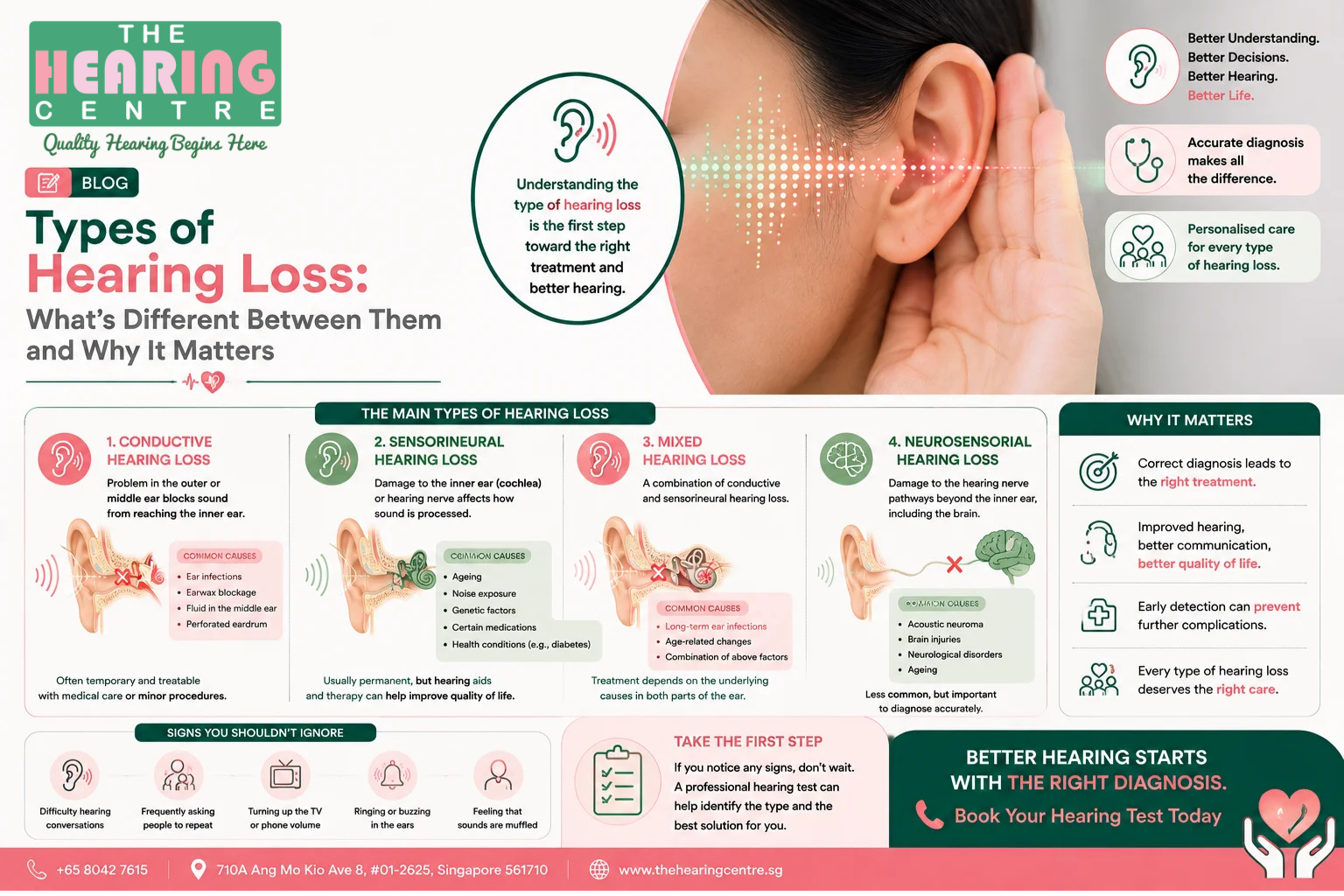
TLDR: There are three main types of hearing loss — conductive, sensorineural, and mixed. Conductive loss is a volume problem from blockages in the outer or middle ear, often treatable. Sensorineural loss is a nerve or cochlea problem, usually permanent but manageable with hearing aids or implants. Mixed combines both. A fourth type called auditory neuropathy is less common. Knowing which type you have is what determines whether treatment can reverse it or just manage it.
Hearing loss isn’t one thing. Two people can both say “I’m struggling to hear” and have completely different problems in completely different parts of the ear — needing completely different approaches. One might need earwax removed and be fine. The other might need hearing aids for the rest of their life.
That’s why the first step in dealing with any hearing concern is figuring out which of the types of hearing loss is actually affecting you. It sounds like a technical question but it’s actually the most practical one — because the answer changes everything about what happens next.
Over 60% of adults in Singapore above the age of 60 have some degree of hearing loss. Noise exposure from Singapore’s busy urban environment adds to this, and hearing loss from earbuds and workplace noise is being identified in younger adults more often than before. Knowing the types of hearing loss and what separates them is useful for anyone — not just those already diagnosed.
At The Hearing Centre, every patient who comes in for hearing concerns gets a full assessment that identifies not just how much hearing loss is present, but which type, and what that means for treatment.
How Hearing Works
Sound travels as waves through the air. They enter your outer ear, move down the ear canal, and make the eardrum vibrate. Those vibrations pass through three tiny bones in the middle ear — the malleus, incus, and stapes. They reach the cochlea in the inner ear, where thousands of tiny hair cells convert the vibration into electrical signals. Those signals travel along the auditory nerve to the brain, which reads them as sound.
The types of hearing loss are defined by where in that chain something goes wrong.
Type 1: Conductive Hearing Loss
What It Is
Conductive hearing loss is a volume problem. Sound is being blocked or reduced somewhere in the outer or middle ear before it reaches the inner ear. The cochlea and auditory nerve are usually completely fine — the problem is that sound isn’t arriving there properly.
Think of it like a blocked pipe. The engine at the end is working perfectly. It’s just not getting enough fuel.
What Causes It
- Earwax buildup — the most common cause. Compacted wax blocks the ear canal and reduces how much sound gets through
- Fluid in the middle ear — often from an ear infection, especially common in children
- Ear infections — otitis media causes swelling and fluid that disrupts sound transmission
- Perforated eardrum — a tear in the eardrum reduces how effectively it vibrates
- Otosclerosis — abnormal bone growth that stiffens one of the middle ear bones
- Malformed ear canal — some people are born with structural issues in the outer or middle ear
- Cholesteatoma — an abnormal skin growth in the middle ear that erodes structures
Read more on conductive hearing loss causes and treatment in detail.
How It Sounds
Sounds seem softer and more muffled — like someone turned the volume down. Clarity is usually preserved. So if you can hear someone clearly when they’re close but not from a distance, or if you feel like sounds are coming through cotton wool, that’s the pattern of conductive loss.
Most people with conductive hearing loss can still understand speech clearly once the volume is sufficient.
Treatment
This is the most treatable type of hearing loss. Addressing the cause usually resolves or significantly improves the hearing:
- Earwax removal by microsuction or irrigation
- Antibiotics or drainage for ear infections
- Surgical repair for perforated eardrums
- Surgery for otosclerosis (stapedectomy)
- Bone anchored hearing aids for cases where the outer or middle ear issue cannot be resolved
Type 2: Sensorineural Hearing Loss
What It Is
Sensorineural hearing loss is the most common type. It happens when the cochlea (inner ear) or the auditory nerve itself is damaged. Unlike conductive loss, this isn’t usually reversible because the hair cells in the cochlea don’t regenerate once damaged.
It’s both a volume and a clarity problem. Sounds are softer, but even when amplified, they can still sound distorted or unclear. This is why people with sensorineural hearing loss often say “I can hear people talking, I just can’t make out what they’re saying” — especially in noise.
What Causes It
- Age-related hearing loss (presbycusis) — the most common cause in Singapore. Hair cells gradually die off as we get older. Most people over 60 have some degree of this
- Noise-induced hearing loss — sustained exposure to loud noise damages hair cells permanently. Relevant for people in industrial jobs, regular concert-goers, or those who use earphones at high volumes for years
- Sudden sensorineural hearing loss — unexplained rapid hearing drop in one ear, treated as a medical emergency
- Viral infections — mumps, measles, and some forms of meningitis can damage the cochlea
- Meniere’s disease — episodes of vertigo with fluctuating hearing loss
- Acoustic neuroma — benign tumour on the auditory nerve
- Ototoxic medications — certain antibiotics, chemotherapy drugs, and high-dose aspirin can damage cochlear hair cells
- Genetics — some people inherit a tendency toward earlier or faster hearing loss
How It Sounds
Not just quieter — unclear. Speech sounds garbled. High-pitched sounds like consonants (s, f, th, sh) disappear first, which is why words start sounding similar — “cat” and “bat” become hard to distinguish. Background noise becomes overwhelming because the brain can no longer separate speech from noise the way it used to.
Learn more about hearing loss symptoms that commonly point to sensorineural loss.
Treatment
Sensorineural hearing loss is usually permanent, but that doesn’t mean it can’t be managed well.
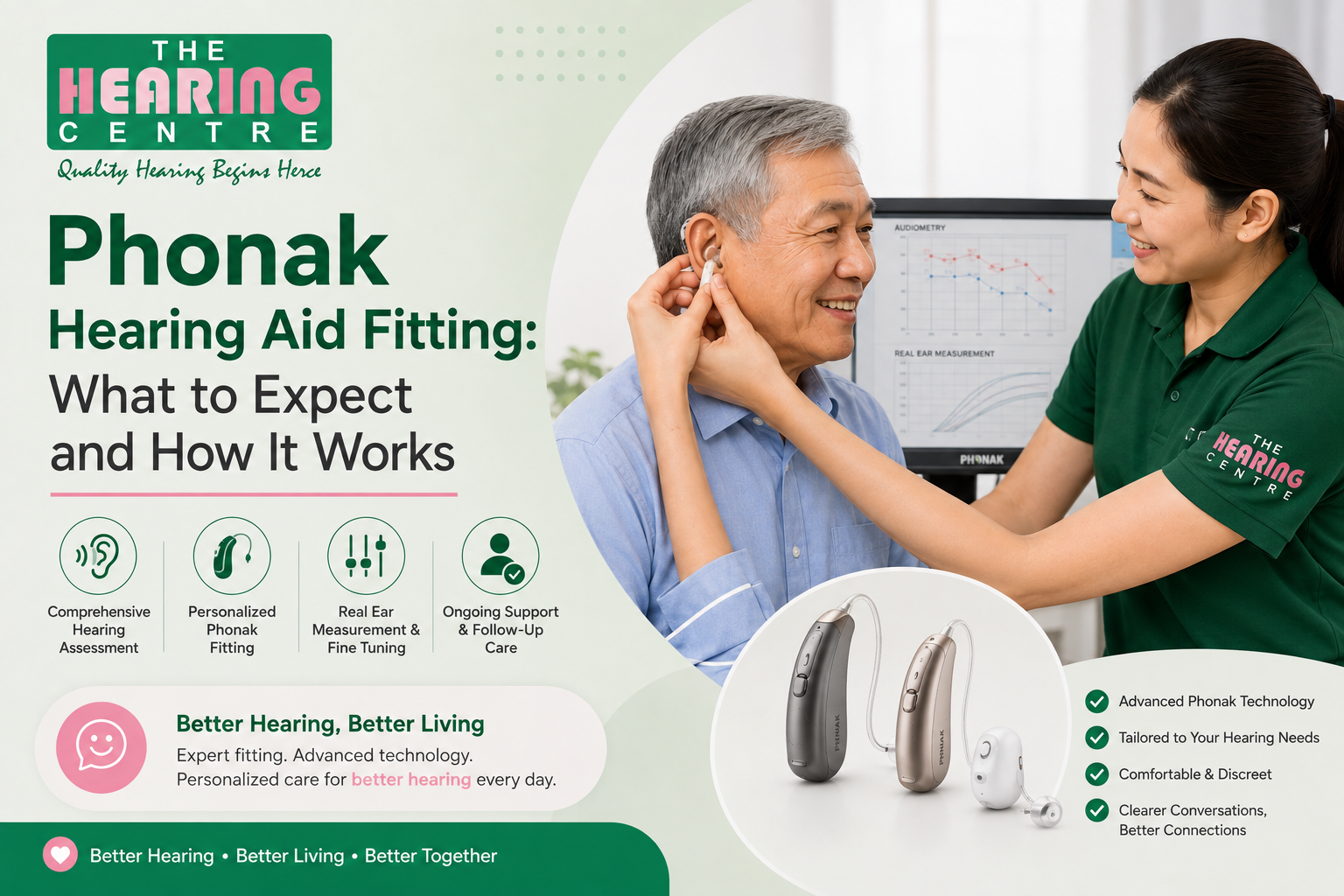
- Hearing aids — the main treatment for mild to severe sensorineural loss. Modern AI-powered like the Phonak Virto R Infinio and Infinio Ultra Sphere. Both were named winners in the 2026 Artificial Intelligence Excellence Awards, presented by the Business Intelligence Group, for leveraging AI to dynamically enhance speech clarity and reduce background noise. The Infinio Ultra Sphere is the only Phonak hearing aid with a dedicated AI chip for separating speech from background noise, and it’s available in the i90 and i70 tiers only . This Phonak’s deep neural network technology approach are specifically designed to help with the clarity problem that sensorineural loss causes
- Cochlear implants — for severe to profound sensorineural loss where hearing aids are no longer providing enough benefit. The device bypasses the damaged cochlea and directly stimulates the auditory nerve
- Bone anchored hearing aids — for specific cases
Read more on sensorineural hearing loss causes and options.
Type 3: Mixed Hearing Loss
What It Is
Mixed hearing loss is exactly what it sounds like — a combination of conductive and sensorineural loss in the same ear. There’s damage or dysfunction in the outer or middle ear, and there’s also damage to the inner ear or auditory nerve.
An example: someone with age-related sensorineural hearing loss who also develops a chronic ear infection that adds a conductive component. Both problems exist simultaneously.
What Causes It
Any combination of causes from both categories above. Common scenarios include:
- Long-standing otitis media alongside age-related cochlear decline
- A perforated eardrum in someone who already has noise-induced sensorineural loss
- Otosclerosis progressing to also affect the cochlea
How It Sounds
Both softer and unclear. Sounds are harder to hear and harder to understand even when heard. It tends to feel more disabling than either type on its own because both the volume and the clarity problems are present at the same time.
Treatment
Both components need to be addressed. The conductive part may be treatable medically or surgically. The sensorineural part will likely need hearing aids or implants. Signia, Phonak, Starkey and ReSound both produce hearing aids well-suited to mixed loss where both amplification and sound processing clarity are needed. The audiologist at The Hearing Centre tailors the recommendation based on which component is larger and what’s causing each.
Type 4: Auditory Neuropathy Spectrum Disorder (ANSD)
Most guides about types of hearing loss stop at three. ANSD is worth including because it’s frequently misunderstood and mismanaged when it’s present.
ANSD is a condition where the cochlea picks up sound reasonably well, but the signal doesn’t transmit reliably to the brain. The result is inconsistent, variable hearing — someone may pass a standard tone test but still struggle significantly with speech understanding, especially in noise.
It’s more common in children and can be associated with premature birth, jaundice, or certain genetic conditions. Standard hearing aids help some people with ANSD. Others do better with cochlear implants. The key is that this type of hearing loss needs specific testing — ABR/ASSR testing at The Hearing Centre specifically assesses auditory nerve function, which is how ANSD gets properly identified.
Degrees of Hearing Loss
Within each type, hearing loss is also graded by how severe it is. This matters for treatment decisions.
Degree | Hearing Threshold | What You Notice |
Mild | 26 to 40 dB | Soft speech and whispers missed, quiet environments manageable |
Moderate | 41 to 55 dB | Normal conversation difficult, frequent requests to repeat |
Moderately severe | 56 to 70 dB | Loud speech needed, phone calls very difficult |
Severe | 71 to 90 dB | Only very loud sounds heard, speech mostly inaudible |
Profound | 91 dB+ | Little to no sound detected without significant amplification |
Most people with mild to moderate hearing loss benefit from hearing aids. Severe and profound loss may need more powerful devices or cochlear implants.
Conductive vs Sensorineural: The Key Differences
Conductive | Sensorineural | |
Where the problem is | Outer or middle ear | Inner ear or auditory nerve |
Main effect | Sounds too soft | Sounds unclear and soft |
Clarity affected | Usually no | Yes |
Reversible | Often yes | Usually no |
Treatment | Medical or surgical | Hearing aids or implants |
Best hearing aid approach | Amplification-focused | Amplification + clarity processing |
How the Types of Hearing Loss Get Diagnosed
You can’t tell which type of hearing loss you have without a proper hearing assessment. The type matters too much to guess.
At The Hearing Centre, diagnosis uses several tests together:
- Pure tone audiometry — measures hearing thresholds at different frequencies by air conduction (through the ear) and bone conduction (through the skull). Comparing these two results is how the audiologist separates conductive from sensorineural
- Tympanometry — checks how the eardrum and middle ear are functioning. A flat tympanogram suggests fluid in the middle ear. A very stiff result may suggest otosclerosis
- Otoacoustic emissions (OAE) — measures the cochlea’s response to sound by picking up faint echoes produced by healthy outer hair cells. A quick, non-invasive test, it’s often used in newborn hearing screening and, paired with ABR/ASSR, is key to identifying ANSD
- Speech audiometry — tests how well you understand speech, which is especially useful for identifying sensorineural loss where clarity is the issue
- ABR/ASSR testing — assesses auditory nerve function. Key for identifying ANSD and for testing infants and young children who can’t respond to standard audiometry
The audiogram that comes out of these tests shows both the degree and the type of hearing loss in each ear. It’s the foundation for every treatment recommendation that follows.
Treatment Matched to Type
Type | First Options | Hearing Device Options |
Conductive | Medical or surgical treatment of cause | Bone anchored hearing aid if canal can’t be repaired |
Sensorineural | Hearing aids for most severity levels | Phonak, Signia, Oticon, ReSound, Starkey, Widex; cochlear implants for severe/profound |
Mixed | Treat conductive component + hearing aids | Combination approach depending on severity |
ANSD | Assessment first, cochlear implant often best | Device selection specific to individual |
Children and Types of Hearing Loss
Children can have any of the types of hearing loss, and early identification changes outcomes significantly.
Conductive loss from ear infections is extremely common in Singapore children. Fluid in the middle ear after repeated infections can persist and affect hearing during critical development years without being obvious. Children with unexplained speech delays, who don’t respond to their name consistently, or who seem inattentive are often found to have hearing loss when properly tested.
Sensorineural loss in children from birth is detected through newborn hearing screening. When it’s identified early, fitting appropriate hearing devices — from brands like Phonak, Resound, Starkey and Signia or other hearing aids such as Oticon and Widex who all have paediatric-specific ranges — during the key language development window makes a profound difference to how a child develops speech and communication.
The hearing test for children at The Hearing Centre adapts the assessment approach to the child’s age, using play-based methods for toddlers who can’t follow standard instructions.
When to Come to The Hearing Centre
Come in if hearing feels different from how it used to be — in any way, on either side. Come in if you ask people to repeat themselves regularly. Come in if noise makes conversations genuinely hard to follow. Come in if a child is slower to speak than expected or seems not to respond to sound the way they should.
For hearing aids Singapore patients already using devices who feel their hearing has changed, or whose aids no longer seem to be covering the loss adequately, an updated assessment identifies whether the type or degree has changed.
Book a hearing test at The Hearing Centre as the first step. That assessment tells you which of the types of hearing loss is present, how severe it is, and what the most appropriate next steps look like for your specific situation.
Frequently Asked Questions
The three main types are conductive, sensorineural, and mixed. Conductive affects the outer or middle ear. Sensorineural affects the inner ear or auditory nerve. Mixed combines both. A fourth type, auditory neuropathy spectrum disorder (ANSD), affects how the nerve transmits sound to the brain.
Sensorineural hearing loss is the most common type worldwide and in Singapore. Age-related hearing loss and noise-induced hearing loss are both sensorineural. Most adults who develop hearing loss gradually are experiencing this type.
Conductive hearing loss is often reversible when the underlying cause is treated. Sensorineural loss is generally permanent because cochlear hair cells don’t regenerate. Mixed loss depends on which component is addressed. ANSD treatment is case by case.
A proper hearing assessment including pure tone audiometry and tympanometry separates conductive from sensorineural loss. You can’t reliably tell from symptoms alone — both types can feel like “I can’t hear properly.”
It’s generally permanent, but serious depends on severity and how it’s managed. Mild to moderate sensorineural loss managed with well-fitted hearing aids from brands likePhonak, Resound, Starkey and Signia or other hearing aids such as Oticon and Widex can have minimal impact on daily life when addressed early.
Yes. Conductive loss from ear infections is very common in children. Sensorineural loss from birth or genetic causes is less common but caught through newborn screening. Early management with appropriate devices during language development years makes a significant long-term difference.