TLDR: Hearing aid types and costs in Singapore range from around SGD 1,500 to over SGD 9,000 per ear, depending on style and technology level. The main types are BTE, RIC, ITE, ITC, CIC, and IIC — each suits different degrees of hearing loss and lifestyle needs. Entry-level digital devices work well for mild loss. Premium AI-powered models handle complex listening environments better. Government subsidies through SMF and ATF can cover up to 90% of costs for eligible Singaporeans. Always start with a proper hearing test before buying anything.
Sitting in the audiologist’s chair after getting your results and being told you need hearing aids — that moment tends to come with a lot of questions all at once. What type do I need? How much is this going to cost? Will people notice? Will it actually work in a noisy hawker centre or just in a quiet room?
These are all fair questions and most people spend weeks stuck on them before making any decision. This guide cuts through that confusion. Real types, real prices as of 2026, real brand information, and the honest trade-offs that clinic brochures usually gloss over.
At The Hearing Centre, we’ve been fitting hearing aids across Singapore for over 20 years. What follows is the kind of guide our audiologists would walk you through at a first appointment — before any device gets recommended and before any money changes hands.
Why the Type Matters as Much as the Brand
Most people approach hearing aid shopping the same way they’d buy a phone — compare specs, read reviews, pick a brand. That’s the wrong order.
The type of hearing aid you wear is determined by three things: your degree of hearing loss, your ear canal anatomy, and your daily life. A device that’s perfect for someone with mild loss who wants invisibility is completely wrong for someone with severe loss who needs strong amplification. Starting with type, then narrowing to technology level, then choosing a brand — that’s the right sequence.
It’s also worth knowing that hearing aids have come a long way from the ear trumpets of the 1600s and the boxy devices of the 1980s. What’s available today is genuinely impressive by any comparison. But impressive technology only helps if it’s the right type for your situation.
The 6 Types of Hearing Aids: What Each One Is and Who It’s For
Behind-the-Ear (BTE)
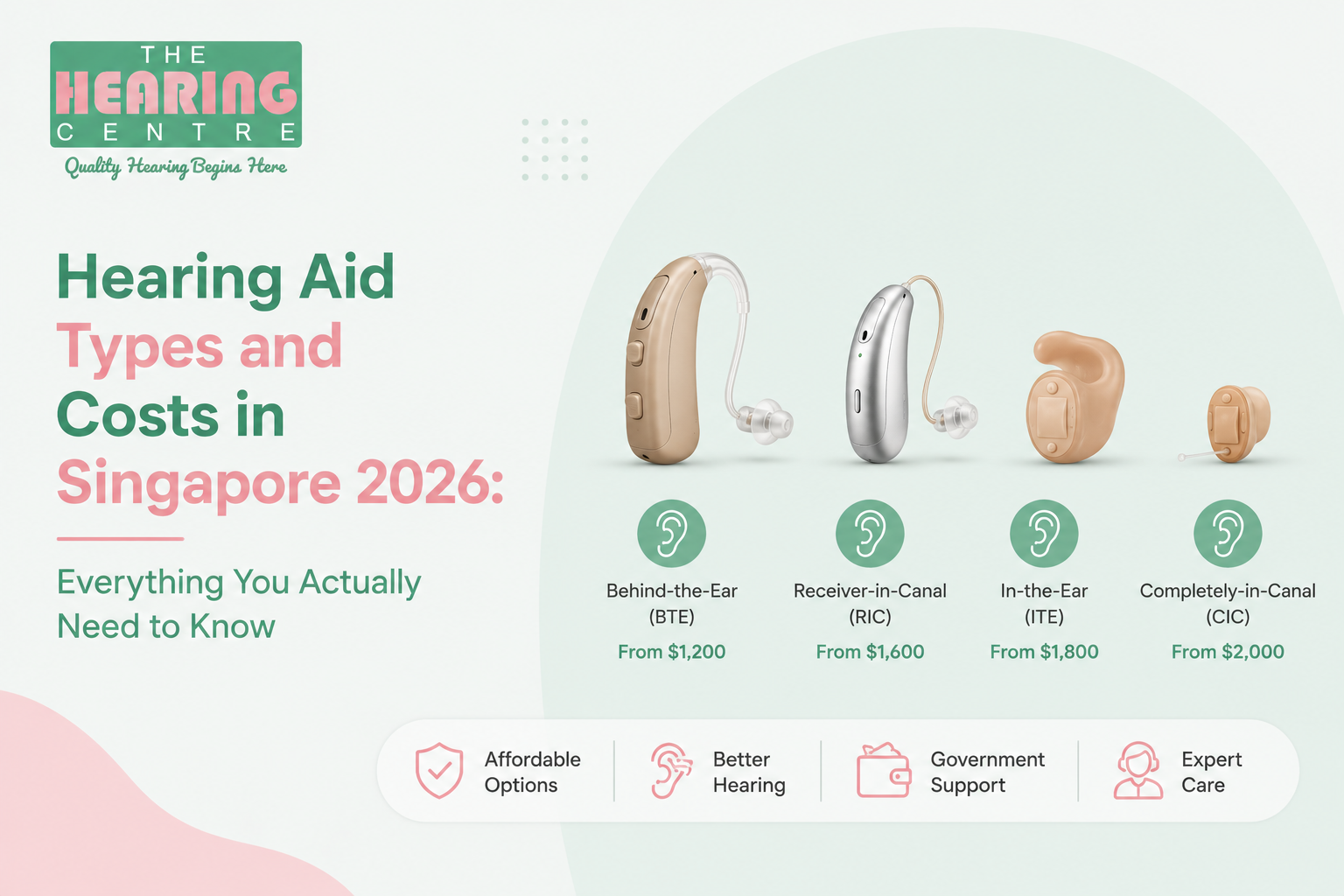
The main electronics sit in a case behind the ear. A thin clear tube connects that case to a custom earmold sitting inside the ear canal. Everything — microphone, processor, amplifier, battery — lives behind the ear.
Who it suits:
- Children and teenagers (earmold replaced as child grows; device stays)
- Elderly patients who need easier handling
- Anyone with moderate to profound hearing loss
- Patients who need maximum amplification
Pros:
- Handles the full range from mild to profound hearing loss
- Easiest to handle and clean
- Longest battery life of all styles
- Most durable design
Cons:
- Most visible style
- Earmold tube needs occasional replacement
- Can feel bulky for some users
BTE hearing aid price in Singapore: SGD 1,500 to SGD 6,000+ per ear depending on technology level
Receiver-in-Canal (RIC) / Receiver-in-the-Ear (RITE)
Similar to BTE in that a small unit sits behind the ear — but the receiver (speaker) moves from the main unit into the ear canal, connected by a thin wire rather than a tube. The unit behind the ear is noticeably smaller and slimmer.
This is the most popular hearing aid style in Singapore right now, and globally. There’s a real reason audiologists reach for it first with most new patients.
Who it suits:
- Adults with mild to severe hearing loss
- People who want a balance of discretion and performance
- First-time hearing aid users
- Anyone who wants Bluetooth connectivity
Pros:
- Smaller and more discreet than BTE
- More natural sound quality — receiver closer to eardrum
- Most models support rechargeable batteries
- Bluetooth streaming available on most mid-range and premium models
- Wide range of technology levels available
Cons:
- Receiver wire can be fragile
- Not ideal for profound hearing loss (though high-power versions exist)
- Requires periodic receiver replacement
RIC hearing aid cost in Singapore: Starts from SGD 1,800
In-the-Ear (ITE)
Custom-made to fit the outer bowl of the ear. Everything sits within the ear itself — no component behind the ear at all. Made from an impression of the wearer’s ear, so the fit is individual.
Who it suits:
- Adults with moderate to severe hearing loss
- People who want something more discreet than BTE but more powerful than canal-fit styles
- Anyone who struggles with behind-the-ear components interfering with glasses
Pros:
- Custom-fit means comfortable wear
- Larger size allows good battery life and more features than canal styles
- Easier to insert and remove than smaller styles
- Can accommodate directional microphones and volume controls
Cons:
- More visible than canal-fit styles
- Prone to earwax damage due to position
- Custom making requires a few weeks’ lead time
ITE hearing aid cost in Singapore: SGD 2,000 to SGD 5,500+ per ear
In-the-Canal (ITC)
Smaller than ITE — sits partially inside the ear canal rather than filling the outer bowl. A small portion of the device remains visible at the canal opening.
Who it suits:
- Adults with mild to moderate hearing loss
- Those who want more discretion than ITE with slightly more functionality than CIC
Pros:
- More discreet than ITE
- Room for some controls and directional microphone features
- Custom fit
Cons:
- Limited power for severe or profound loss
- Can be harder to handle than larger styles
- Smaller battery than ITE
ITC hearing aid cost in Singapore: SGD 2,000
Completely-in-Canal (CIC)
Custom-made to fit almost entirely inside the ear canal. From a normal conversation distance, it’s barely visible — just a small removal cord at the canal entrance.
Who it suits:
- Adults with mild to moderate hearing loss
- People who prioritise discretion above all else
- Those with good manual dexterity
Pros:
- Nearly invisible
- Positioned close to eardrum means more natural sound
- Less wind noise than behind-the-ear styles
Cons:
- Limited amplification — not suitable for severe or profound loss
- Most models don’t support Bluetooth
- Small battery needs changing every 3–7 days
- More vulnerable to earwax and moisture
CIC hearing aid price in Singapore: Starts from SGD 2,500
Invisible-in-Canal (IIC)
The smallest hearing aid available. Sits so deep in the ear canal that it’s genuinely invisible even at close range. Requires the right ear canal shape to accommodate it.
Who it suits:
- Adults with mild to moderate hearing loss
- Those for whom absolute invisibility is the priority
- Patients with ear anatomy that can accommodate deep canal placement
Pros:
- Completely invisible
- Uses the natural ear anatomy to capture sound
- Minimal occlusion effect
Cons:
- Very limited amplification
- No Bluetooth, no manual controls
- Smallest battery life of any style
- Not suitable for everyone’s anatomy
- Higher price point for a device with fewer features
Invisible hearing aid price in Singapore: SGD 3,000 to SGD 9,000+ per ear
Hearing Aid Types at a Glance
Style | Visibility | Hearing Loss Range | Bluetooth | Rechargeable |
BTE | Most visible | Mild to profound | Some models | Yes |
RIC | Low | Mild to severe | Most models | Yes |
ITE | Moderate | Moderate to severe | Limited | Some |
ITC | Low | Mild to moderate | Limited | No |
CIC | Nearly invisible | Mild to moderate | Rarely | No |
IIC | Invisible | Mild to moderate | No | No |
Technology Tiers: What the Price Difference Actually Buys You
Within every hearing aid style, devices come in three broad technology tiers. This is where most of the price variation comes from.
Entry-Level
Basic digital amplification. Handles quiet environments and one-on-one conversation well. Manual program switching. Limited noise management.
Good for: First-time users with mild loss, people who spend most of their time in quiet environments, anyone who needs basic help without complexity.
Typical price: SGD 1,500 to SGD 2,500 per ear
Mid-Range
Better noise reduction, automatic program switching, Bluetooth connectivity on most models, rechargeable batteries available. Performs well in moderate noise environments like offices and small restaurants.
Good for: Working adults, active social lives, regular phone and TV use.
Typical price: SGD 2,500 to SGD 4,500 per ear
Premium
Real-time AI processing that classifies acoustic environments and adjusts automatically. Speech-from-noise separation. Health monitoring features on some models. Full smartphone integration. Remote fine-tuning available.
Good for: Anyone regularly in challenging listening environments — noisy restaurants, large meetings, outdoor spaces, concerts. Also for anyone who wants the absolute best sound quality and is willing to pay for it.
Typical price: SGD 4,500 to SGD 9,000+ per ear
Rechargeable vs Disposable Battery: Which Is Better?
This comes down to lifestyle rather than any absolute technical advantage.
Rechargeable hearing aids charge overnight and give a full day of use. No changing tiny batteries every few days. Convenient, consistent, and increasingly the default on mid-range and premium models. The downside: if you forget to charge and you’re out of the house, you’re stuck.
Disposable battery hearing aids give you flexibility — carry spare batteries and you’re never caught short. Size 10 batteries (common in smaller devices like CIC) last 3–7 days. Size 312 batteries (common in RIC and BTE devices) last 7–10 days. The downside: changing small batteries can be fiddly, particularly for elderly users or anyone with reduced dexterity.
Most patients with practical daily schedules prefer rechargeable. Most elderly patients who are anxious about running out of power prefer disposable with a good supply of spares. Neither is wrong.
Brands at The Hearing Centre: What Each One Does Best
The Hearing Centre carries all the world’s leading hearing aid manufacturers. Here’s an honest summary of what each brand is known for.
Brand | Known For | Best For |
Phonak | Speech clarity in noise, SmartSpeech AI | Active adults, noisy environments |
Signia | Own Voice Processing, natural self-sound | First-time users, voice clarity |
Oticon | BrainHearing™, open sound philosophy | Natural listening experience |
ReSound | Deep Neural Network, strong Bluetooth | Complex sound environments, phone users |
Starkey | Fall detection, health monitoring | Elderly users, health-conscious wearers |
Widex | Sound naturalness, music quality | Music lovers, highly sensitive listeners |
No brand wins across every category. The right brand for you depends on your specific audiogram, your daily lifestyle, and what matters most to you day-to-day.
What Affects Hearing Aid Cost in Singapore?
Understanding why prices vary so much makes it easier to evaluate what you’re actually getting.
- Style — CIC and IIC cost more than BTE in many cases, partly because custom manufacturing is more expensive and partly because fitting very complex electronics into a tiny space costs more to engineer
- Technology tier — entry vs mid vs premium is the biggest single price driver
- Brand — brands with more R&D investment tend to price higher
- Custom vs standard — custom-moulded devices cost more than dome-fit standard sizes
- What’s included — does the quoted price include the hearing test, fitting appointments, follow-up sessions, and warranty? Or just the device? Always ask
- Bilateral vs unilateral — most fittings are for both ears, so per-ear prices typically apply twice
Custom Hearing Aids: Are They Worth It?
Custom hearing aids — ITE, ITC, CIC, IIC — are made from impressions of your specific ear anatomy. The shell is built to fit you exactly.
Beyond comfort, custom fit has real performance implications. A device that fits precisely sits more stably, seals the ear canal more consistently, and delivers amplification more accurately. There’s also less chance of feedback because there’s less gap for sound to escape and re-enter the microphone.
The trade-offs are lead time (usually two to three weeks for the device to be manufactured) and the higher upfront cost. Whether those trade-offs are worth it depends on how much discretion and comfort matter to your daily life. Why custom hearing aids might be the best choice for you covers this in more depth if you’re weighing up this decision.
Beyond the Device: What Comes With Your Hearing Aid
The hearing aid is only part of the picture. What surrounds it matters enormously for long-term success.
A device that’s been properly fitted and fine-tuned performs completely differently from the same device fitted in a rush with no follow-up. Most people need two to four adjustment appointments in the first three months as the brain adapts and preferences become clearer. The audiologist makes changes, you go back to real life, report what worked and what didn’t, and adjustments get refined. This is how you go from a device that helps to a device you forget you’re wearing.
At The Hearing Centre, every fitting includes follow-up appointments and ongoing care. Understanding what lies beyond a hearing aid — the counselling, the fine-tuning, the long-term relationship with your audiologist — is what separates a good hearing aid experience from a great one.
For anyone still at the “do I even need one?” stage, our guide on what hearing aids actually are is a good place to start before thinking about type and cost.
Singapore Government Subsidies for Hearing Aids
Medisave cannot be used for hearing tests or hearing aids. This catches people off guard regularly. But there are two meaningful subsidy schemes available.
Senior Mobility and Enabling Fund (SMF)
- Who qualifies: Singapore Citizens and Permanent Residents aged 60 and above, staying at home
- Subsidy: Up to 90% of the hearing aid cost, subject to subsidy cap
- How to apply: Through an application administrator at a hospital, social service agency, or relevant institution
Assistive Technology Fund (ATF)
- Who qualifies: Singapore Citizens and Permanent Residents of any age with a disability
- Subsidy: Up to 90% of the device cost, capped at SGD 40,000
- How to apply: Through an assessor from a hospital, social service agency, or other approved institution
Choosing the Right Type: A Practical Framework
Don’t start with price. Don’t start with brand. Start with these questions in order.
- What is your degree of hearing loss? Your audiogram tells you this. Mild loss opens up all options. Moderate loss narrows the field slightly. Severe or profound loss means BTE or high-power RIC is the most appropriate starting conversation.
- How important is discretion to you? Genuinely important vs mildly preferable vs not a concern at all — these lead to completely different type recommendations.
- What are your dexterity and handling needs? Can you comfortably handle a device the size of a small bead? Or would something larger with bigger controls be more practical?
- What are your daily listening environments? Mostly quiet home? Entry-level handles this fine. Regular restaurants, offices, meetings? Mid-range or premium AI processing makes a real difference here.
- Do you want rechargeable convenience? If yes, this immediately filters your options — most rechargeable devices are RIC or BTE.
- What’s your realistic budget? And does that budget include aftercare, or is it device-only?
Hearing Aids for Children in Singapore
Children’s hearing aid needs are different from adults in several important ways.
BTE devices are the most common recommendation for children. The earmold is replaced as the child grows — the device itself doesn’t have to be. This makes BTE the most cost-effective long-term approach for a growing child. Devices used for children in educational settings also often connect to FM systems — classroom transmitters that send the teacher’s voice directly to the hearing aid.
Early fitting matters enormously. The earlier a child with hearing loss gets properly fitted, the better their speech and language development outcomes. Our audiologists at The Hearing Centre carry out paediatric fittings with parents fully involved at every stage.
Hearing Aids for Elderly Patients in Singapore
For elderly users, the right type balances performance with practical day-to-day usability.
Rechargeable BTE or RIC devices are often the best fit — larger controls, no tiny batteries to change, and enough amplification for the moderate-to-severe loss that often accompanies age-related hearing change. Touchscreen app control matters less than physical reliability and ease of use.
Starkey’s health monitoring features — including fall detection — are worth considering for elderly users whose families want that additional safety layer. The Hearing Centre takes the time needed with elderly patients and their families rather than rushing through a fitting.
Before You Buy Anything: Get a Proper Hearing Test
Every recommendation in this guide is conditional on one thing: knowing your actual audiogram. Without a proper hearing assessment, any device decision is a guess.
A hearing test at The Hearing Centre typically includes pure tone audiometry, speech testing, and tympanometry — giving a complete picture of what’s happening across both ears and at every frequency. That picture determines which types are appropriate, which technology level makes sense, and which brands are worth considering for your specific situation.
For hearing aids Singapore patients at any stage of this process — first assessment, first fitting, or upgrading from an older device — The Hearing Centre’s audiologists work through the decision properly, with no pressure and no rush.
Frequently Asked Questions
The main types are BTE (behind the ear), RIC (receiver in canal), ITE (in the ear), ITC (in the canal), CIC (completely in canal), and IIC (invisible in canal). Each suits different degrees of hearing loss and lifestyle priorities.
Prices range from around SGD 1,500 per ear for entry-level digital devices to SGD 9,000+ per ear for premium AI-powered models. Most people spend between SGD 2,500 and SGD 5,000 per ear for mid-range to good premium devices.
No. Medisave doesn’t cover hearing aids. The SMF and ATF subsidy schemes can cover up to 90% of costs for eligible Singaporeans.
RIC (receiver-in-canal) is currently the most widely fitted style globally and in Singapore. It balances discretion, sound quality, and features well for most adults with mild to severe hearing loss.
BTE hearing aids are typically best for severe to profound hearing loss because they can house the most powerful amplification components. High-power RIC models are also available for severe loss.
Both have the main unit behind the ear. BTE connects via a tube to an earmold in the canal. RIC moves the receiver (speaker) into the canal itself, connected by a thin wire. RIC tends to be smaller and produce more natural sound; BTE tends to be more durable and handles more severe loss.
Neither is objectively better. Rechargeable is more convenient for most daily users. Disposable batteries give flexibility if you forget to charge. Elderly users sometimes prefer disposable for the reassurance of a spare battery in their pocket.
Most quality devices last five to seven years with proper care and regular servicing. Technology often dates before the device physically wears out.
It depends on your lifestyle. If you spend significant time in noisy environments — restaurants, meetings, outdoor spaces — premium AI processing makes a measurable difference. If your daily life is mostly quiet, entry or mid-range covers your needs well.
Phonak, Signia, ReSound, Starkey, and — all the world’s leading manufacturers. Our audiologists match you to the brand that fits your specific hearing profile and lifestyle rather than promoting any single manufacturer.