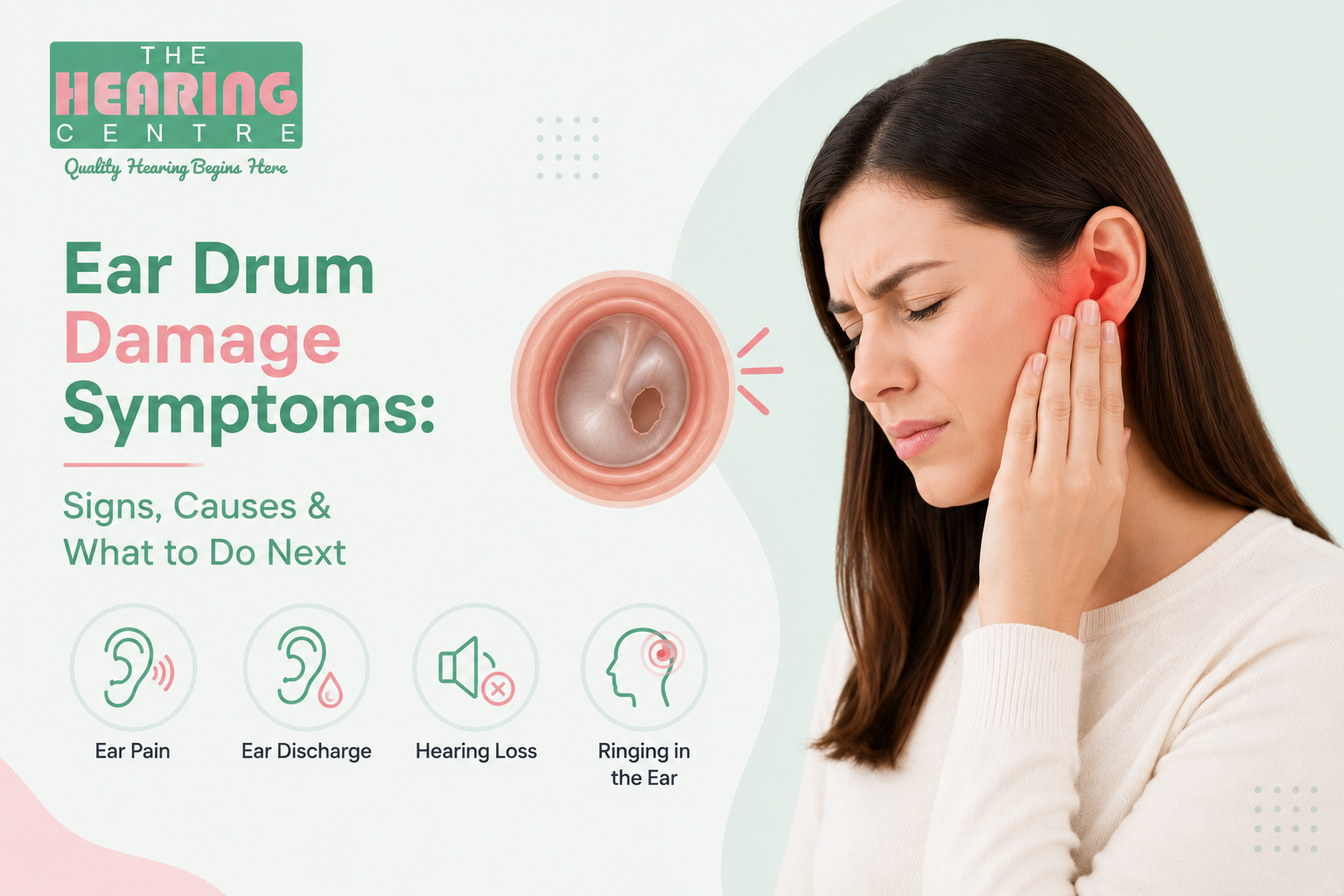
TLDR: Ear drum damage symptoms include sudden sharp pain, muffled or reduced hearing, ringing in the ear, dizziness, and fluid draining from the ear canal. Some eardrum damage heals on its own within weeks. Larger tears, ongoing infection, or symptoms that aren’t improving need proper medical assessment. Don’t put anything in the ear while it’s healing — including most eardrops unless specifically prescribed for a perforated eardrum.
Most people who’ve damaged their eardrum describe the same moment. Something happens — a slap to the ear, a sudden pressure change on a flight, an ear infection that built up pressure until something gave — and there’s a sharp pain followed by a distinct hollow feeling in the ear. Sometimes there’s fluid coming out. Everything sounds muffled on that side.
It’s alarming when it happens. And the first instinct is usually to stick something in the ear to investigate, which is exactly the wrong move.
Here’s what ear drum damage symptoms actually mean, what causes them, and what happens next — explained properly rather than in clinical jargon that doesn’t help you understand your own situation.
At The Hearing Centre in Singapore, our audiologists assess ear drum damage symptoms regularly and guide patients through the process from diagnosis to recovery. This guide covers everything you need to know.
What Does the Eardrum Actually Do?
Your eardrum — the tympanic membrane — is a thin piece of tissue stretched across the inner end of your ear canal, roughly the size and thickness of your fingernail. It sits between the outer ear and the middle ear and does two things simultaneously.
When sound waves travel down the ear canal and hit the eardrum, it vibrates. Those vibrations transfer to three tiny bones in the middle ear — the malleus, incus, and stapes — which amplify and transmit the signal to the inner ear. That’s your hearing mechanism working.
The eardrum also acts as a physical barrier, keeping water, bacteria, and debris from reaching the middle ear. When it’s damaged, both functions are disrupted at once.
Ear Drum Damage Symptoms
Ear drum damage symptoms don’t all appear at the same time or with the same intensity. Some hit immediately. Others develop gradually. Knowing what each symptom means helps you understand what’s happening and how serious it is.
Sudden Sharp Pain
This is usually the first ear drum damage symptom people notice. The pain can be immediate and intense — a stabbing or piercing sensation at the moment of damage. Interestingly, the pain sometimes drops off quite quickly after that, especially when an ear infection is the cause. The reduction in pain happens because the pressure that was building behind the eardrum gets released when it ruptures.
That relief can be misleading. The eardrum has given way, the middle ear is now exposed, and if there was an infection driving the rupture, it still needs treatment.
Muffled or Reduced Hearing
One of the most consistent ear drum damage symptoms. The eardrum can no longer vibrate normally, so sound doesn’t transmit properly. On the affected side, everything sounds quieter, more distant, or like someone has put their hand over your ear.
This type of hearing loss is conductive — a mechanical problem rather than nerve damage. The degree of reduction depends on how large the tear is and where it’s located. A small peripheral tear causes mild muffling. A large central tear can cause a significant drop in hearing. Most conductive hearing loss from eardrum damage recovers once the eardrum heals.
Tinnitus
Ringing, buzzing, hissing, or humming in the affected ear is a common accompanying ear drum damage symptom. It usually settles as the eardrum heals. Persistent tinnitus after the eardrum has recovered, particularly if acoustic trauma was involved, may indicate some inner ear involvement alongside the damage.
Dizziness or Vertigo
The middle ear is physically connected to the vestibular system that controls balance. Significant eardrum damage — particularly from trauma — can temporarily disrupt balance and cause spinning sensations or general unsteadiness. This is usually more pronounced in the first few days and settles as healing progresses.
More severe or persistent vertigo following ear drum damage suggests possible inner ear involvement beyond just the eardrum. This needs assessment.
Fluid or Blood Draining from the Ear
Discharge from the ear is one of the more obviously alarming ear drum damage symptoms, but what drains out tells you something specific. Clear or slightly bloody fluid immediately after trauma is typical. Pus-like or yellowish discharge points to infection — either the infection that caused the rupture or a secondary infection that developed because the middle ear is now open to the environment.
Any discharge that smells bad, looks unusual, or continues beyond the first week needs a doctor’s assessment.
A Feeling of Fullness or Pressure
Even after fluid has drained, many people describe a persistent hollow or blocked sensation in the ear. This comes from the disrupted mechanics of the eardrum and any residual inflammation. It usually lifts as healing progresses.
Ear Drum Damage Symptoms: Mild vs Moderate vs Severe
Severity | What It Feels Like | What It Means |
Mild | Slight muffling, minor discomfort, small amount of clear discharge | Small perforation, usually heals without intervention |
Moderate | Noticeable hearing drop, tinnitus, persistent fullness, some discharge | Medium tear, may need antibiotics and monitoring |
Severe | Significant hearing loss, loud tinnitus, vertigo, heavy discharge | Large tear or inner ear involvement — needs prompt assessment |
What Causes Ear Drum Damage?
Middle Ear Infection
The most common cause in Singapore. When infection builds up fluid and pressure behind the eardrum, the membrane can rupture under that pressure. Ear infections that rupture the eardrum are usually preceded by days of worsening ear pain — and then the pain drops noticeably when the perforation happens. The infection still needs antibiotic treatment even after the rupture.
Cotton Buds and Foreign Objects
Cotton buds are probably the most common cause of traumatic eardrum damage in Singapore. The ear canal is longer than people expect and the eardrum is closer to the entrance than most people realise. A cotton bud pushed in too far reaches and punctures the membrane. Hairpins, keys, pen lids used to scratch the ear — same result.
Barotrauma
Rapid pressure changes create a pressure difference across the eardrum that it can’t equalise fast enough. Flying — particularly during descent with a cold or sinus congestion — is the most common scenario in Singapore, given the high volume of air travel. Diving, altitude changes, and a direct open-palm slap to the ear all create the same mechanism.
Loud Noise or Acoustic Trauma
A single extremely loud sound — an explosion, a gunshot close to the ear, industrial accident — can physically rupture the eardrum from the pressure wave. This often comes with immediate tinnitus and hearing loss. Ear drum damage symptoms from acoustic trauma may also involve inner ear damage alongside the eardrum itself.
Head Trauma
Significant impacts to the head involving the temporal bone can tear the eardrum as part of broader ear injury. This type of eardrum damage is often accompanied by other symptoms that take priority clinically.
Can Ear Drum Damage Affect Hearing Permanently?
This is usually the question people most want answered.
The hearing loss from eardrum damage is conductive — the mechanical sound pathway is disrupted, not the inner ear or auditory nerve. When the eardrum heals, hearing typically returns to normal or very close to it.
Permanent hearing loss from eardrum damage alone is uncommon. The risk increases when complications develop: damage to the ossicular chain (the three tiny bones in the middle ear), a cholesteatoma, or significant acoustic trauma affecting the inner ear alongside the eardrum.
Whether it is possible to recover from hearing loss depends heavily on the cause and how quickly treatment happens. Conductive hearing loss from a perforated eardrum almost always improves with treatment. Inner ear damage is a different conversation.
A hearing test at The Hearing Centre gives you a precise baseline of where your hearing is now and lets us track whether it’s recovering as expected.
Complications If Ear Drum Damage Goes Untreated
Leaving eardrum damage without proper assessment carries real risks.
Recurring middle ear infections — the open perforation allows bacteria from the ear canal and environment into the middle ear. Repeated infections damage the ossicular chain over time.
Cholesteatoma — skin cells can migrate through the perforation into the middle ear and accumulate. This abnormal growth erodes surrounding bone progressively and can eventually affect the facial nerve and inner ear structures. It needs surgical removal.
Permanent hearing loss — if the ossicular chain is significantly damaged by repeated infection, the conductive hearing loss may not reverse even after the eardrum is repaired.
Mastoiditis — infection spreading into the mastoid bone behind the ear. A serious complication that requires urgent treatment.
How Ear Drum Damage Gets Diagnosed
How Ear Drum Damage Gets Diagnosed
At The Hearing Centre, our audiologists use several tools to get the full picture.
Otoscopy — direct visual examination of the ear canal and eardrum. Most perforations are clearly visible as a tear or opening in the membrane. Video otoscopy allows you to see what the audiologist sees.
Tympanometry — measures how the eardrum responds to small pressure changes. A perforated eardrum produces a flat tympanogram because the membrane can’t respond normally.
Pure tone audiometry — measures hearing across different frequencies to confirm the degree of hearing loss and track recovery over time.
ABR/ASSR testing — used when there’s concern about inner ear involvement alongside the eardrum damage.
Treatment Options for Ear Drum Damage
Treatment depends on the size of the tear, what caused it, and whether infection is present.
Watchful waiting with home management — small perforations from minor trauma often heal on their own within three to six weeks if kept dry and left alone. This means no swimming, no cotton buds, no eardrops unless specifically prescribed for a perforated eardrum.
Antibiotics — prescribed when infection is present, either oral tablets or topical drops specifically formulated for use with a perforation. Standard eardrops are not safe for a perforated eardrum — they contain ingredients that can damage the inner ear if they reach it through the hole.
Eardrum patch — a fine paper patch placed over the perforation acts as a scaffold for the membrane to grow across. Done in a clinic, takes minutes, may need repeating.
Fat graft myringoplasty — minor surgical repair using the patient’s own fat tissue for small to medium perforations.
Tympanoplasty — the standard surgical repair for larger or chronic perforations. A tissue graft, usually fascia or cartilage, reconstructs the eardrum. Done under general or local anaesthetic with good success rates.
The Hearing Centre refers patients to ENT specialists in Singapore for surgical evaluation when this is the appropriate next step.
Hearing Aids and Ear Drum Damage
This section matters for anyone who wears hearing aids or is considering them after eardrum damage.
During an active perforation, don’t wear an in-ear or receiver-in-canal hearing aid on the affected side. The device sits against or near the tear, traps moisture and bacteria, and significantly slows healing.
Once the eardrum has fully healed, hearing aids can be an appropriate long-term management option if there’s residual conductive or mixed hearing loss. For people with permanent conductive hearing loss from eardrum damage or ossicular chain damage, there are several device options worth knowing about:
- Standard hearing aids — for residual conductive loss where amplification helps
- Bone-anchored hearing aids (BAHA) — bypass the damaged middle ear entirely by transmitting sound through bone directly to the inner ear
- Cochlear implants — for cases where there is also significant sensorineural involvement
Understanding the differences matters before making decisions. The comparison between hearing aids vs cochlear implant surgery is worth reading if you’re at the stage of discussing long-term options with your audiologist.
For people whose eardrum damage has healed but left them with persistent hearing difficulties, a hearing aid guide Singapore gives a good overview of what’s available before you come in for assessment.
Brands like Phonak offer a full range of devices suited to different types of hearing loss including conductive loss from middle ear damage. Exploring the Phonak hearing aid model range gives you a sense of what’s available at different technology levels.
Prevention: How to Protect Your Eardrum
Stop using cotton buds inside the ear canal. This is the single most preventable cause of traumatic eardrum damage. Your ears are self-cleaning. The only thing cotton buds reliably do is push wax deeper and risk puncturing the eardrum.
Treat ear infections early. Don’t wait out a painful ear infection for more than a day or two without seeing a doctor. Early antibiotic treatment stops the pressure buildup that ruptures eardrums.
Protect your ears during pressure changes. Flying with a cold? Use decongestant nasal spray before descent. Chew gum, swallow frequently, try the Valsalva manoeuvre. Pressure-regulating earplugs made for flying help significantly.
Wear proper hearing protection around loud noise. Industrial environments, concerts, motorsport events — proper earplugs or earmuffs protect the eardrum as well as the inner ear.
Keep ears dry after water exposure. Tilt your head, let water drain, pat the outer ear. For anyone with a history of ear infections or a known perforation, waterproof earplugs while swimming are worth the small inconvenience.
When to Come to The Hearing Centre
Come in if you’ve experienced any ear drum damage symptoms and want them properly assessed. Come in if you’ve had a recent ear infection and your hearing on that side hasn’t recovered. Come in if you wear hearing aids and need guidance on managing during the healing period. Come in if you’ve recovered from eardrum damage and your hearing isn’t back where it was.
The Hearing Centre has clinics across Singapore. Our audiologists do comprehensive assessments — otoscopy, tympanometry, pure tone audiometry — and refer to ENT specialists when surgery or more complex management is needed. Book a hearing test if you’re unsure where your hearing stands.
For hearing aids Singapore users managing ongoing hearing challenges after eardrum damage, our audiologists work through device options with you based on your specific audiogram and lifestyle — not a one-size-fits-all recommendation.
Frequently Asked Questions
Sudden sharp ear pain, muffled or reduced hearing on the affected side, ringing or buzzing in the ear, dizziness, and fluid or blood draining from the ear canal. Not everyone gets all of them — the combination depends on the cause and severity.
The most reliable way is having an audiologist look directly at the eardrum with an otoscope. At home, sudden ear pain followed by muffled hearing and fluid from the ear strongly suggests a perforation, but visual confirmation is the only way to know for certain.
Small perforations often do, within three to six weeks with proper care. Larger tears, chronic perforations, or ones complicated by infection are less likely to close without medical intervention.
Temporary hearing loss is almost universal with eardrum damage. Permanent loss is uncommon from the perforation alone. It becomes a risk when complications like ossicular chain damage or cholesteatoma develop from untreated perforations.
Don’t put anything in the ear. Don’t use standard eardrops unless a doctor has confirmed they’re safe for a perforated eardrum. Don’t swim or submerge your head. Don’t blow your nose hard. Don’t assume you’re healed just because the pain has settled.
Not on the affected ear during active healing. Once the perforation has healed and been confirmed by an audiologist, hearing aids can be appropriate for managing any residual hearing loss.
Small perforations from minor trauma heal in a few weeks. Larger tears can take two to three months. Chronic perforations that have been present for a long time rarely close without surgical help.
When the perforation is large, hasn’t healed after several months of conservative treatment, or is causing recurring infections. Tympanoplasty (surgical repair) has good success rates in experienced hands.