TLDR: A bone anchored hearing aid (BAHA) sends sound through bone vibration directly to the inner ear, bypassing the outer and middle ear completely. It works well for people with conductive hearing loss, mixed hearing loss, or single-sided deafness who can’t benefit from conventional hearing aids. Surgery is minor and recovery is straightforward. Two main brands in Singapore are Cochlear and Oticon Medical. A soft band version is available for children or anyone not ready for surgery.
Most people think of hearing aids as devices that sit in or around the ear canal and make sounds louder. A bone anchored hearing aid works completely differently. It skips the outer and middle ear entirely and sends sound through the bones of the skull straight to the inner ear. For some types of hearing loss, that’s not just a different approach, it’s the only approach that actually works.
If you or someone you know has been told a conventional hearing aid won’t help, or you’ve had recurring ear infections making it impossible to wear an in-ear device, a bone anchored hearing aid might be what actually solves the problem.
At The Hearing Centre in Singapore, our audiologists assess patients for bone anchored hearing aids as part of a full hearing care pathway. Here’s everything you need to know before any decisions are made.
How a Bone Anchored Hearing Aid Works
Normal hearing starts with sound entering the ear canal, vibrating the eardrum, and passing through the middle ear bones to the cochlea. The cochlea converts those vibrations into signals the brain reads as sound.
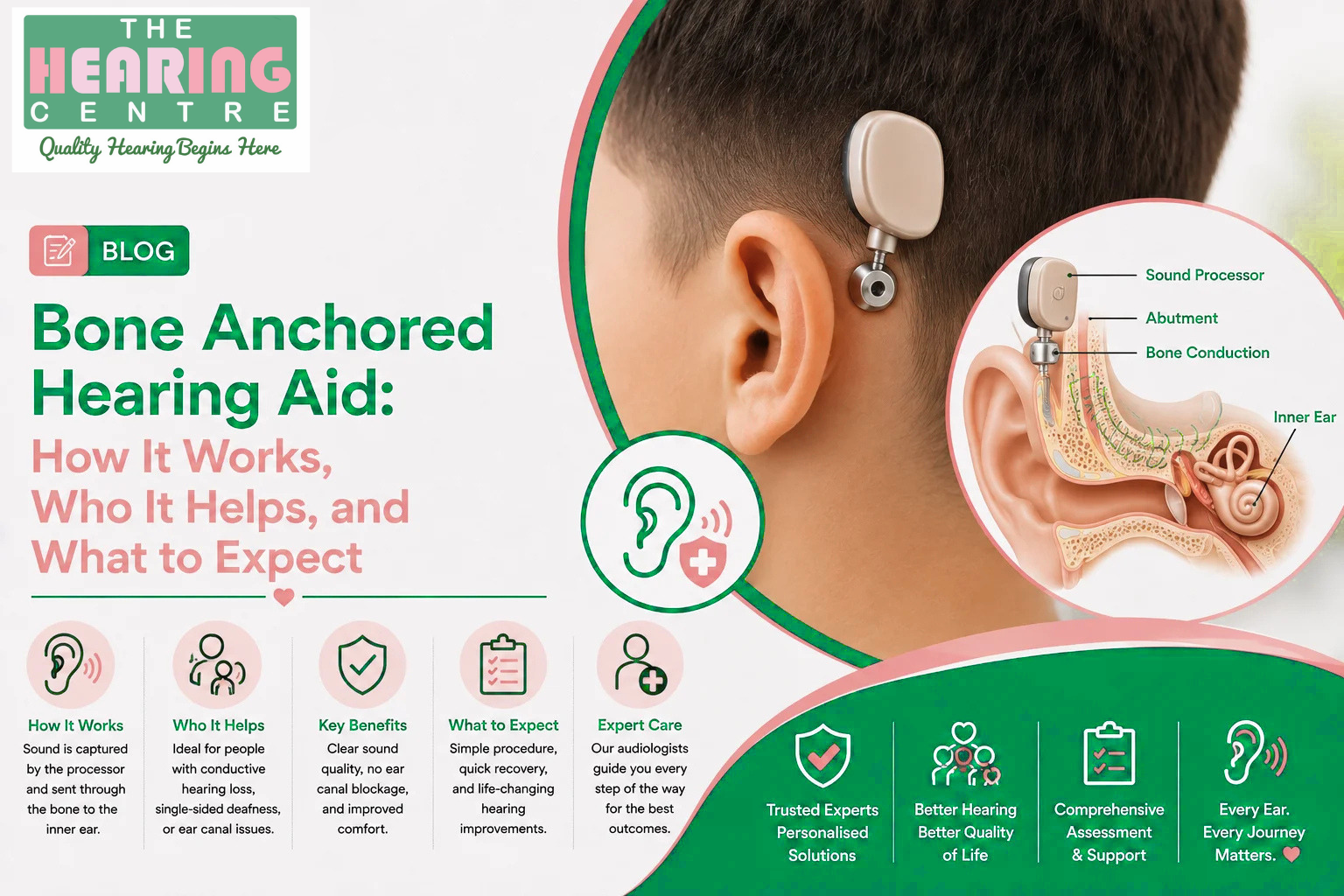
A bone anchored hearing aid skips the first two steps. It picks up sound through an external processor, converts it to vibration, and sends that vibration through the skull bone directly to the cochlea. The cochlea and auditory nerve are bypassed around the damaged outer or middle ear entirely.
This works because bone is an excellent conductor of vibration. In fact, bone conduction is how you hear your own voice when you speak — you’re hearing the vibration of your own skull alongside the airborne sound. A bone anchored hearing aid uses that same principle but with engineered precision.
The Three Parts of a Bone Anchored Hearing Aid System
Every bone anchored hearing aid has the same basic structure:
- Titanium implant — a small screw surgically inserted into the skull bone behind the ear. Over several months, the bone grows around it in a process called osseointegration
- Connector — either an abutment that sticks through the skin, or a magnet system sitting under the skin
- Sound processor — the external device worn outside the head that picks up sound and converts it to the vibration that travels through the implant
Types of Bone Anchored Hearing Aid
Abutment Type (Transcutaneous)
A small metal post comes through the skin. The sound processor clips directly onto this post. The connection is direct, which makes sound transmission very efficient. The downside is the abutment protruding through the skin needs regular cleaning and carries a small risk of skin irritation around the site.
Magnet Type (Percutaneous)
The implant sits under the skin with no part breaking through. The external processor attaches magnetically to the outside. Cleaner in terms of skin management, though the magnetic connection results in slightly less direct sound transmission than the abutment type. Newer models have significantly reduced this difference.
Soft Band (Non-Surgical)
For children under five whose skull bone isn’t yet thick enough for implant surgery, or for adults who want to trial the technology before committing, the processor can be held against the skull using a soft headband. There’s no surgery involved. Sound still transmits through bone. It’s not as efficient as the implanted version but gives a good indication of whether the system will help. At The Hearing Centre, a soft band trial is usually offered before any surgical commitment.
Who Is a Bone Anchored Hearing Aid For?
Not everyone with hearing loss is a candidate. BAHA is specifically suited to three groups.
People with Conductive Hearing Loss
Conductive hearing loss happens when sound can’t travel properly through the outer or middle ear. Causes include ear canal malformations present from birth, chronic ear infections that have damaged the ear canal, otosclerosis, or a persistent perforated eardrum. Conventional hearing aids amplify sound through the ear canal — if the canal is blocked, malformed, or chronically infected, that approach simply doesn’t work. A bone anchored hearing aid bypasses all of that.
People with Mixed Hearing Loss
Mixed hearing loss has both a conductive component and a sensorineural component. If the conductive part is significant and prevents normal hearing aid use, a bone anchored hearing aid handles the conductive element while the cochlea receives the signal directly.
People with Single-Sided Deafness
Single-sided deafness means one ear has profound or complete hearing loss while the other is normal or near-normal. The problem with this isn’t just volume — it’s that sounds from the deaf side are missed entirely, and sound localisation becomes difficult or impossible. A bone anchored hearing aid fitted on the deaf side picks up sounds and vibrates the skull, where the cochlea on the good side picks it up. It effectively routes sound from the dead side to the working side. More about treatment options is covered in our guide on treatment options for single sided deafness and our dedicated hearing aids for single sided deafness service.
Bone Anchored Hearing Aid Brands in Singapore
Two brands dominate the BAHA market globally and in Singapore.
Cochlear (BAHA and Osia systems)
Cochlear is the most widely used brand for bone anchored hearing aids in Singapore. Their current flagship is the Cochlear Osia system, which uses a piezoelectric actuator — a different vibration technology that delivers stronger, cleaner signal than traditional electromagnetic systems. The Cochlear BAHA 6 Max is their powerful abutment-type processor for patients needing more amplification. In April 2024, the Osia system received FDA approval for children as young as five, expanding the age range significantly. Cochlear’s processors connect to phones and devices via Bluetooth, which is now standard across their range.
Feature | Cochlear (Osia/BAHA) | |
Surgery type | Abutment or magnet | |
Newest technology | Piezoelectric (Osia) | |
Bluetooth | Yes | |
Children eligible age | From 5 (Osia) | |
Available at THC | Yes |
BAHA vs Conventional Hearing Aids
Feature | Bone Anchored Hearing Aid | Conventional Hearing Aid |
How sound travels | Through skull bone to cochlea | Through ear canal and middle ear |
Requires surgery | Yes (implant version) | No |
Suits ear canal problems | Yes | No |
Suits chronic infections | Yes | No |
Best for single-sided deafness | Yes | Limited (CROS alternative) |
Visible | Small processor outside head | In or behind ear |
Rechargeable | Most modern versions | Yes on most brands |
BAHA vs Cochlear Implant
People sometimes confuse these two. They work on different principles entirely. A full comparison is in our cochlear implant vs hearing aid guide, but briefly:
A bone anchored hearing aid relies on a functioning cochlea. The device does the job the outer and middle ear can’t do — it delivers sound vibration to a cochlea that is still working. A cochlear implant, on the other hand, bypasses a damaged cochlea entirely and directly stimulates the auditory nerve with electrical signals. It’s for people with severe to profound sensorineural hearing loss where the cochlea itself is the problem.
If your inner ear works but sound can’t reach it through the outer or middle ear — BAHA. If your inner ear is damaged — cochlear implant is more likely the conversation.
The Surgery Process
BAHA surgery is minor compared to most procedures. It’s usually done under local anaesthesia for adults and general anaesthesia for children. The whole thing takes around 30 to 60 minutes.
The surgeon makes a small incision behind the ear and inserts the titanium implant into the skull bone. For magnet-type systems, everything stays under the skin with no external post. For abutment types, a small connector post is attached.
After surgery, the healing phase before the processor can be attached typically takes three to six months. This waiting period allows the bone to fully bond with the titanium implant — osseointegration. Once the bond is confirmed, the processor is fitted and activated.
The surgery itself has very few serious risks. Skin irritation around an abutment site is the most common complication. Infection risk is low. Implant failure requiring replacement is rare.
Recovery and What to Expect After Surgery
Most people go home the same day or after one overnight stay.
The incision area needs to be kept clean and dry for the first few weeks. Physical activity restrictions are minimal after the first week or two. The biggest thing to manage is the waiting period before the processor goes on — three to six months of day-to-day life before you start hearing through the device.
Once the processor is fitted, there’s an adjustment period while the brain adapts to bone conduction sound. Most patients describe the sound as clear and natural — often more natural than they expected. Fine-tuning appointments over the first few months optimise the settings.
How It Affects Daily Life
One of the things people don’t hear enough about is what day-to-day life actually looks like with a bone anchored hearing aid.
The processor is worn outside the head, making it visible. Most people stop noticing it quickly. It clips on and off easily for sleeping and showering. Rechargeable models on both Cochlear and Oticon Medical charge overnight. Bluetooth streaming means phone calls, TV, and music come directly into the processor.
The change in how well you hear in different situations tends to be significant. Following conversations on the previously deaf or hard-to-hear side becomes possible. Sound localisation improves meaningfully for single-sided deafness patients. The cognitive effort that comes with constantly compensating for poor hearing reduces. How poor hearing affects concentration at work covers what those daily effects actually look like — and what changes when hearing improves.
For people dealing with hearing loss in one ear who haven’t yet looked into device options, a bone anchored hearing aid is often the most effective solution specifically for the single-sided scenario.
Children and Bone Anchored Hearing Aids
BAHA is one of the most common hearing implant options for children in Singapore born with ear canal problems or single-sided deafness.
Children under five start with the soft band. This lets them get the benefit of bone conduction hearing during the critical speech and language development years, without waiting for the skull to be thick enough for surgery. Both Cochlear and Oticon Medical soft band systems are compact and durable enough for daily wear in young children.
Surgery is typically considered from around age five onward, once the skull bone has sufficient thickness and density to hold the implant. The Hearing Centre has a paediatric audiologist pathway for children, with parents involved at every stage of assessment and fitting.
Cost and Subsidies in Singapore
Bone-anchored hearing aids usually cost more than regular hearing aids. The total cost can include the implant, processor, and surgery, so the final price can vary.
A few important things to know about payment:
- Government subsidies cannot be used for purchases at The Hearing Centre or other private clinics.
- The Hearing Centre does not offer or process government subsidies.
- All hearing devices and services are paid for privately and out of pocket.
- Credit card instalment plans are available to help manage the cost.
- Some insurance plans may cover hearing aids, so check with your insurance agent before making a purchase.
The audiologists can also help you choose a suitable option based on your hearing needs and budget.
Getting Assessed at The Hearing Centre
A bone anchored hearing aid is not a device you walk in and buy. Candidacy assessment involves:
- Pure tone audiometry to confirm the type and degree of hearing loss
- Tympanometry to assess middle ear function
- Bone conduction testing to confirm the cochlea is working
- BAHA soft band trial to get a real-world sense of what the device will sound like
- ENT surgeon referral for surgical assessment
The audiologists at The Hearing Centre coordinate the full process from initial assessment through to post-fitting follow-up, working alongside ENT surgeons in Singapore for the surgical component.
For hearing aids Singapore patients who have already tried conventional devices and found them inadequate, a bone anchored hearing aid assessment is a natural next conversation. Book a hearing test to start.
Frequently Asked Questions
People with conductive hearing loss, mixed hearing loss, or single-sided deafness who cannot benefit from or wear conventional hearing aids. An audiologist assessment confirms suitability.
It’s a minor procedure. Done under local or general anaesthesia, takes 30 to 60 minutes, and most people go home the same day. Serious complications are rare. Skin irritation at the abutment site is the most common issue for abutment-type systems.
Three to six months. This waiting period allows the bone to fully bond with the titanium implant before the processor is attached.
Cochlear (Osia and BAHA systems) and Oticon Medical (Ponto and Sentio systems) are the two main brands available. Both are fitted at The Hearing Centre.
Yes. Children under five start with a soft band. Surgery is typically possible from around age five when the skull bone is thick enough to support the implant.
Yes. The soft band holds the processor against the skull without any implant. It gives a genuine sense of how bone conduction hearing works and is a standard trial step before committing to surgery.
Yes, Medisave can be used for the surgical component. ATF and SMF subsidies may also apply to the device cost depending on eligibility.
A BAHA works when the cochlea is functioning but sound can’t reach it through the outer or middle ear. A cochlear implant bypasses a damaged cochlea and stimulates the auditory nerve directly. They suit different types of hearing loss entirely.