Why Getting a Hearing Aid Is a Decision Worth Taking Seriously
Most purchases, you do your research, compare prices, read reviews, and then decide. Hearing aids don’t work that way — or at least, they shouldn’t. A hearing aid that isn’t programmed to your specific audiogram, fitted properly to your ear canal, and followed up with proper adjustments is a device that will underperform no matter what it cost you.
That’s why the question of where to buy hearing aid in singapore matters just as much as which hearing aid to buy. The clinic, the audiologist, the aftercare process — these shape your actual daily experience with the device far more than the brand name on the box.
What Are the Signs You Actually Need a Hearing Aid
Most people wait far too long — research consistently shows the average person waits seven to ten years after first noticing hearing difficulties before doing anything about it. By that point, the brain has spent years adapting to poor sound input, and adjusting to amplified sound takes longer.
Here are the signs worth taking seriously rather than explaining away:
- You frequently ask people to repeat themselves, especially in group conversations
- Following phone calls has become genuinely tiring or frustrating
- You’ve turned up the TV or radio volume and others in the room have commented on it
- You struggle to follow conversations in restaurants, hawker centres, or any background noise
- Women’s voices and children’s voices are harder to catch than deeper voices
- You notice a ringing or buzzing in your ears — this is called tinnitus and often accompanies sensorineural hearing loss
- You feel mentally exhausted after social situations that never used to drain you
If several of these feel familiar, it’s not age, it’s not distraction, and it’s not the other person mumbling. It’s worth getting a proper hearing test done.
What Type of Hearing Loss Do You Have — And Why It Matters First
Before anything else before brands, before styles, before prices you need to know what you’re dealing with. There are three main types of hearing loss and they require genuinely different approaches.
Sensorineural hearing loss is the most common. It happens when the hair cells inside your cochlea or the auditory nerve itself are damaged. This type is usually permanent. It tends to affect high-frequency sounds first, which is why people with this condition often struggle with speech clarity rather than just volume — you can hear that someone is talking but can’t make out the words, especially in a noisy room. Ageing, prolonged noise exposure, and certain medical conditions all contribute to it. Digital hearing aids are the standard solution, and the earlier you address it the better your brain adapts to amplified sound.
Conductive hearing loss happens when something is physically blocking sound from reaching your inner ear — earwax buildup, fluid from an infection, a perforated eardrum, or abnormal bone growth. Unlike sensorineural loss, this type is often treatable medically or surgically. A hearing aid may still be needed if the problem persists, but a proper diagnosis tells you which route to take. Getting a hearing aid before ruling out a treatable cause is putting the cart before the horse.
Mixed hearing loss is a combination of both. You’ll need a thorough assessment to understand what you’re working with, and treatment may involve both medical care and a device.
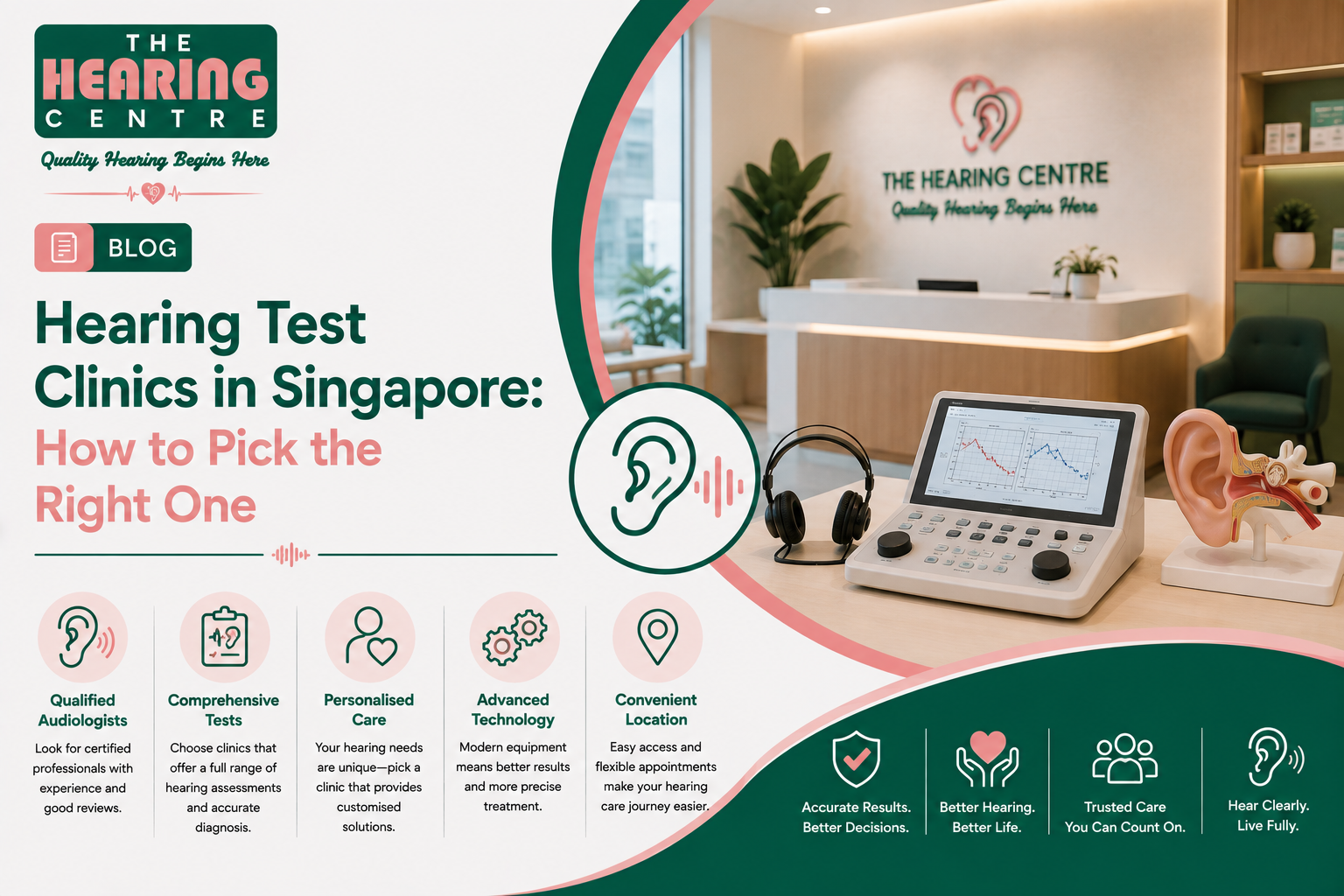
None of this can be determined without a proper hearing test in a soundproof clinic environment. An online screening is not a diagnosis — it’s an indication at best. If the result suggests something worth looking at, a qualified audiologist in Singapore should be your next step, not a device purchase.
Types of Hearing Aids Available in Singapore
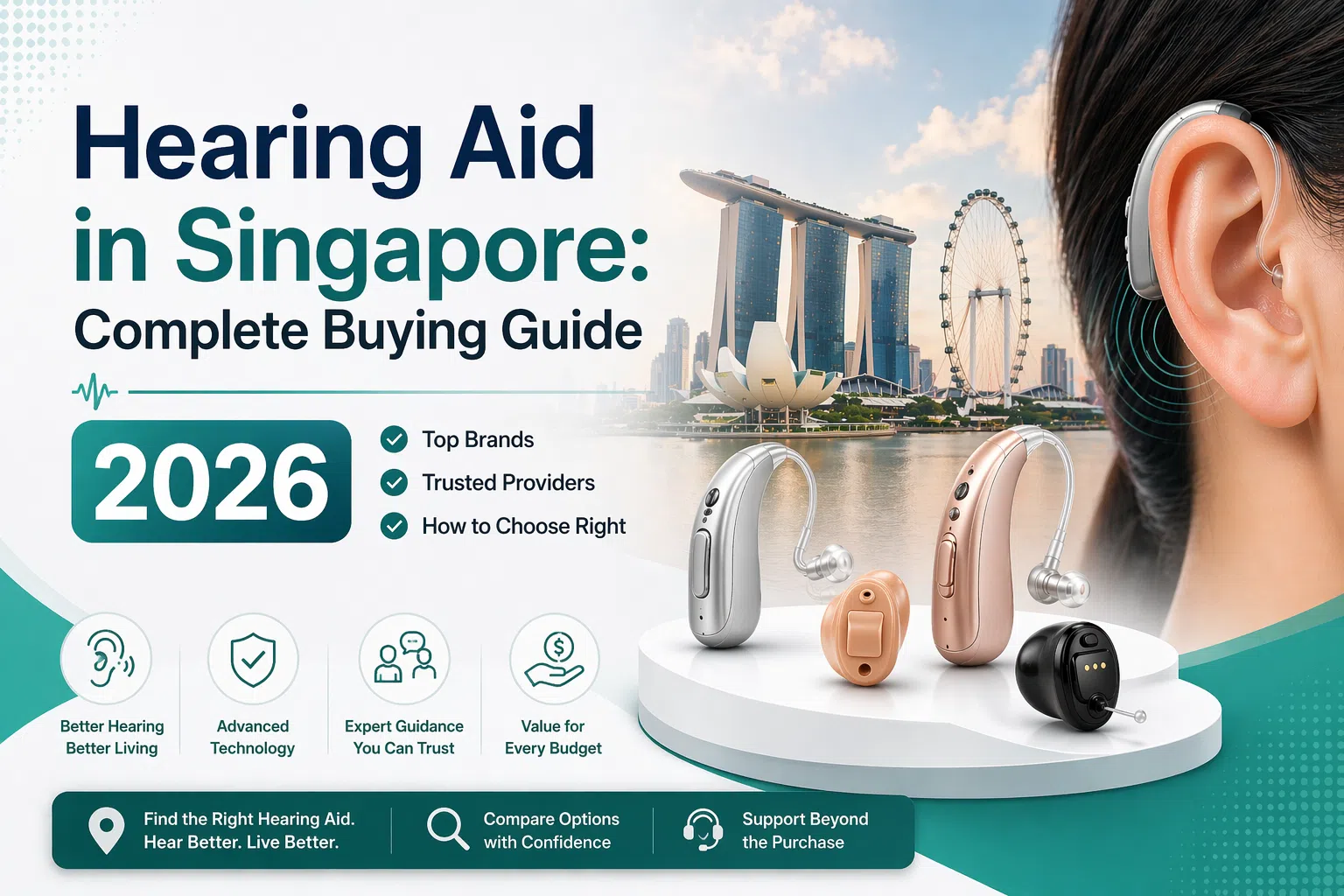
Once you have your audiogram, your audiologist will match a style to your hearing profile and lifestyle. Here’s what the main options actually mean in practice:
BTE — Behind-the-Ear: The most powerful and versatile style. The electronics sit in a casing behind your ear connected to an earmold in the canal. Handles everything from mild to profound hearing loss. Easier to handle and maintain — genuinely practical for seniors and people who prefer a more robust device.
RIC — Receiver-in-Canal: The speaker sits directly in the ear canal on a thin wire, making the whole thing smaller and more discreet than a standard BTE. Sound quality is very natural and the open-fit design prevents that blocked ear feeling many people complain about. Most working adults end up here.
ITE — In-the-Ear: Custom-moulded to fit the outer portion of your ear. All components in one unit. Good for moderate to severe hearing loss and easier to handle than smaller canal styles.
ITC — In-the-Canal: Sits partly in the canal, less visible than ITE. Fits mild to moderately severe hearing loss and can include directional microphones and wireless features.
CIC — Completely-in-Canal: Sits fully inside the canal. Barely visible. Suits mild to moderate hearing loss but the size limits some advanced features. Requires a precise custom fit.
IIC — Invisible-in-Canal: Deepest fitting, practically undetectable. Suitable for mild to moderate hearing loss. Because it needs to be fabricated precisely per individual ear, it sits at the higher end of the price range.
Rechargeable versions now exist across almost all these styles. Charge overnight, wear all day — no fiddling with tiny batteries, which matters more than people expect once you’re actually wearing a device every day.
Top Hearing Aid Brands Available at The Hearing Centre Singapore — Compared in Detail
1. Phonak Hearing Aids — The Noise-Fighting Workhorse
Brand Origin: Swiss | Part of Sonova Group | Founded 1947
Phonak’s AutoSense OS platform — now in its fifth generation — analyses your listening environment continuously and transitions the device between more than 200 blended processing modes without any manual input. You don’t tap a button to switch between restaurant mode and quiet-room mode. The device detects the shift and moves on its own, usually within about 0.4 seconds.
Key Technology Highlights
- AutoSense OS 5.0 — automatic environment classification and seamless mode transitions
- Phonak Sphere Infinio — dedicated AI chip with deep neural network for multi-talker noise
- Roger Wireless Microphone System — direct streaming from a distance, uniquely useful for conference rooms and restaurants
- Paradise & Lumity Series — strong Bluetooth dual streaming from iPhone and Android simultaneously
- myPhonak App — real-time remote adjustments, hearing diary, and wellness tracking
- Robust IP68 rating — fully waterproof and dustproof across most current models
Pros
- Best-in-class performance in complex, noisy environments like hawker centres and group settings
- Widest Roger accessory ecosystem for challenging listening situations
- Simultaneous Bluetooth streaming from two devices at once
- Broadest range from mild to profound hearing loss across all styles
Cons
- Premium models carry a higher price point than some competing brands at similar technology levels
- App interface has more features than many first-time users need, which can feel complex initially
- Roger accessories are purchased separately and add to overall cost
2. Signia Hearing Aids — The Discreet Choice With the Smartest Own-Voice Technology
Brand Origin: German | Part of WS Audiology | Formerly Siemens Audiology
Signia’s Own Voice Processing (OVP) separates your own voice from all other sounds and processes it on an entirely independent channel. The result is that your voice sounds natural to you while external sounds — conversations, ambient noise, media — are amplified and processed normally. In practice, this means the hollow, booming, “I sound like I’m in a barrel” sensation that causes many new users to abandon their hearing aids within the first few weeks is significantly reduced from day one.
Key Technology Highlights
- Own Voice Processing (OVP) — dedicated processing channel for your own voice, unique to Signia
- Augmented Focus — simultaneous foreground/background acoustic separation
- Signia IX (Integrated Xperience) — current flagship with motion-sensor-integrated processing
- Styletto — slim rechargeable RIC, arguably the most discreet and design-conscious device in the market
- Silk Charge&Go IX — smallest ready-to-wear CIC, no custom impression needed
- TeleCare — remote fine-tuning capability, audiologist can adjust settings without an in-person visit
- Signia App — streaming, remote control, and hearing assistant built in
Pros
- OVP makes the adjustment period significantly easier for first-time users — your own voice sounds right from the start
- Styletto and Silk designs specifically address the stigma concern many Singapore patients raise
- TeleCare remote adjustment reduces the need for follow-up clinic visits
Cons
- OVP requires an initial calibration session that takes slightly longer than standard fittings
- Styletto’s slim form factor means smaller battery capacity — shorter runtime than bulkier rechargeable models
- In extremely loud environments (concerts, construction sites), some users prefer Phonak’s noise suppression depth
3. Starkey Hearing Aids — The American Innovator Redefining What a Hearing Aid Can Do
Brand Origin: American | Headquartered in Eden Prairie, Minnesota | Founded 1967
Starkey’s Edge AI — their current flagship — contains a dedicated AI chip, an integrated 3D motion sensor, and a multi-purpose health platform that operates continuously while you wear the device. The fall detection feature does not simply register that you have fallen; it sends an automatic alert to designated contacts (family members, caregivers) with your GPS location. For elderly patients in Singapore living alone or with limited family nearby, this is not a gimmick — it is a meaningful safety feature that has clear practical value.
Key Technology Highlights
- Starkey Edge AI — dedicated AI processor, fall detection with GPS alert, body and activity tracking
- Neuro Sound Technology — auditory nerve-inspired processing for natural sound reproduction
- Thrive Hearing Control App — AI hearing assistant responds to voice commands for setting adjustments
- Healthable Hearing — integrated health sensors tracking physical activity, cognitive engagement, and social participation
- Edge Mode+ — one-tap AI boost for the most challenging listening moments
- Custom ITE/IIC/CIC range — among the most refined custom in-ear devices available globally
- Self Check — in-app hearing aid diagnostic to identify issues before your next appointment
Pros
- Only hearing aid with meaningful integrated health monitoring — fall detection, activity tracking, GPS alerts
- Neuro Sound Technology produces an exceptionally natural, organic sound signature
- Best custom in-the-ear fabrication quality in the market — IIC devices are essentially invisible
- Thrive App’s AI assistant allows voice-command adjustment — useful for users with dexterity limitations
Cons
- Health monitoring features require consistent smartphone connectivity, which some older users may find demanding
- Custom in-the-ear styles take longer to manufacture — expect a wait of one to two weeks post-impression
- Premium-tier models are among the higher-priced options available in Singapore
4. ReSound Hearing Aids — Natural Sound Architecture and Best-in-Class Wireless Connectivity
Brand Origin: Danish | Part of GN Group | Founded 1943
Overview
Their current flagship, the ReSound NEXIA, achieves something that only a handful of devices in the world currently offer: true direct Bluetooth streaming from both iPhone and Android simultaneously, without an intermediary streamer or clip. This means you can switch between a phone call on Android and streaming music from an iPhone without removing or reprogramming anything. In a household or workplace where multiple devices are in use — which describes most Singapore homes — this flexibility matters daily.
Key Technology Highlights
- ReSound NEXIA — current flagship with dual simultaneous Bluetooth streaming (iPhone + Android)
- M&RIE Technology — in-ear microphone placement for natural, spatially accurate sound capture
- Organic Hearing Philosophy — preserves full soundscape rather than aggressively suppressing background noise
- Auracast-ready — compatible with next-generation broadcast Bluetooth standard for public venues
- ReSound Smart 3D App — granular manual control with environment presets and tinnitus soundscapes
- All-Access Directionality — lets the brain choose what to focus on rather than forcing a single directional beam
- Built-in Tinnitus Sound Therapy — library of relief sounds streamed directly into the hearing aid
Pros
- Most natural-sounding amplification in the market — avoids the “processed” quality some users find fatiguing
- M&RIE delivers genuine spatial hearing that most other RIC designs cannot replicate
- Best simultaneous multi-device Bluetooth connectivity in the market
- Auracast compatibility is future-proof for Singapore’s developing public audio infrastructure
Cons
- M&RIE style requires a specific fit — not suitable for all ear canal shapes
- The natural sound philosophy means less aggressive noise suppression than Phonak in extremely loud environments
- Premium models are priced at the higher end of the Singapore market
5. Oticon Hearing Aids — Brain-First Hearing Science From Denmark’s Oldest Audiological Brand
Brand Origin: Danish | Part of Demant Group | Founded 1904 — over 120 years in audiology
The practical implication of BrainHearing is that Oticon’s hearing aids sound different from other brands, especially in complex listening environments. Where a Phonak device will aggressively separate speech from background noise and deliver a cleaner but more narrow soundscape, an Oticon device will deliver more of the full scene — trusting your auditory cortex to focus. For many users — particularly those with long experience of natural hearing before their loss developed — this approach feels more like how they remember the world sounding.
Key Technology Highlights
- BrainHearing Philosophy — full-scene access supports natural brain-based sound processing
- Oticon Intent — current flagship with 4D Sensor Technology for intention-aware directional processing
- Deep Neural Network — trained on 12 million real-world sound scenes for acoustic environment recognition
- OpenSound Navigator — delivers a balanced full soundscape rather than a narrow directional beam
- OpenSound Optimizer — advanced feedback management that prevents whistling before it starts
- Oticon ON App — remote control, programme switching, and hearing aid health monitoring
- More & Real Series — DNN processing at accessible price points for mild to moderate hearing loss
Pros
- Most natural-feeling listening experience for wearers who want the world to sound dimensional, not narrowed
- 4D Sensor Technology reduces unwanted setting changes during natural head movement
- DNN-powered environment recognition is among the most sophisticated in the industry
- Consistently strong clinical evidence base — Oticon publishes more peer-reviewed research than most competitors
Cons
- The full-scene approach means less aggressive noise suppression than Phonak in extremely loud settings
- First-time users accustomed to more selective amplification may need an adjustment period to appreciate the philosophy
- Premium Intent models sit at the higher end of the price range in Singapore
6. Rexton Hearing Aids — Genuine Quality Without the Premium Price Tag
Brand Origin: German | Part of WS Audiology (same group as Signia and Widex) | Founded 1955
Because Rexton shares technology development infrastructure with Signia and Widex within the WS Audiology group, its sound processing core is built on the same engineering foundation as devices that command significantly higher prices. What differs is the feature set layered above that core. Rexton devices have fewer automatic environment detection programs, simpler app interfaces, and a more limited range of styles — but the fundamental job of a hearing aid, which is delivering clear, amplified, processed sound calibrated to your audiogram, is done at a level that serves most everyday listening environments well.
Key Technology Highlights
- WS Audiology Platform — shares core DSP technology with Signia, from the same parent group
- Emerald Series — rechargeable RIC with directional microphone and noise reduction
- Stellar Series — advanced noise management with premium processing at accessible price points
- myRexton App — simplified remote control and volume adjustment for less tech-heavy users
- Bluetooth Streaming — available on select models for phone calls and audio
- Rechargeable Options — full-day battery life across main product lines; no battery replacement needed
Pros
- Genuine digital signal processing programmed to your audiogram — not an amplifier
- Rechargeable options eliminate the dexterity challenge of battery replacement, particularly relevant for elderly users
- Significantly more accessible price point than premium brands
- Maximises subsidy-assisted purchasing power under SMF and ATF schemes
Cons
- Fewer automatic environment programs than premium-tier brands — requires more manual adjustment in varied settings
- Limited range of styles compared to Phonak, Signia, or Starkey
- Bluetooth functionality is limited to certain models and does not support simultaneous multi-device streaming
Quick Brand Comparison: Which Hearing Aid Is Right for You?
Brand | Strongest For | Key Technology | Price Range |
Phonak | Noisy environments, active lifestyle, children | AutoSense OS, Roger Wireless, AI noise separation | Mid–Premium |
Signia | First-time users, aesthetics, own-voice comfort | Own Voice Processing (OVP), Augmented Focus, Styletto design | Mid–Premium |
Starkey | Health monitoring, elderly safety, invisible in-ear | Edge AI, fall detection, Neuro Sound Technology | Premium |
ReSound | Natural sound, tinnitus, multi-device connectivity | M&RIE, Organic Hearing, Auracast Bluetooth | Mid–Premium |
Oticon | Listening fatigue, brain-supportive processing | BrainHearing, 4D Sensors, 12M scene DNN | Mid–Premium |
Rexton | Budget-conscious, SMF/ATF subsidy users, quiet environments | WS Audiology platform, rechargeable options | Accessible |
Where to Buy Hearing Aid in Singapore: Your 3 Main Options
Option 1 — Public hospitals with ENT departments
Hospitals like SGH, NUH, and TTSH have audiology departments that offer subsidised care for Singapore citizens and PRs who come with a polyclinic referral. The subsidy is real and meaningful, especially for seniors. The tradeoff is waiting time — appointments can take months, and follow-up visits are often similarly delayed. For someone who needs urgent adjustments or has a fast-changing condition, this is a genuine limitation.
Option 2 — Private hearing clinics
Private clinics like The Hearing Centre offer appointments within days, not months. The full range of brands and styles is available, fitting and aftercare are typically bundled into the purchase, and the relationship with your audiologist is more continuous. You see the same person who assessed you and understands your history. The upfront cost is higher, but when you factor in subsidy eligibility and what’s included, the difference narrows considerably.
Option 3 — Online / off-the-shelf
Consumer amplifiers are available online for a few hundred dollars. These are not prescription hearing aids. They amplify everything indiscriminately — background noise goes up along with voices. For genuine sensorineural hearing loss, wearing one of these causes more listening fatigue, not less. They are not HSA-regulated prescription medical devices. The savings are real; the results are not.
Red Flags to Watch for When Choosing Where to Buy
Not every clinic is equal. A few things worth paying attention to:
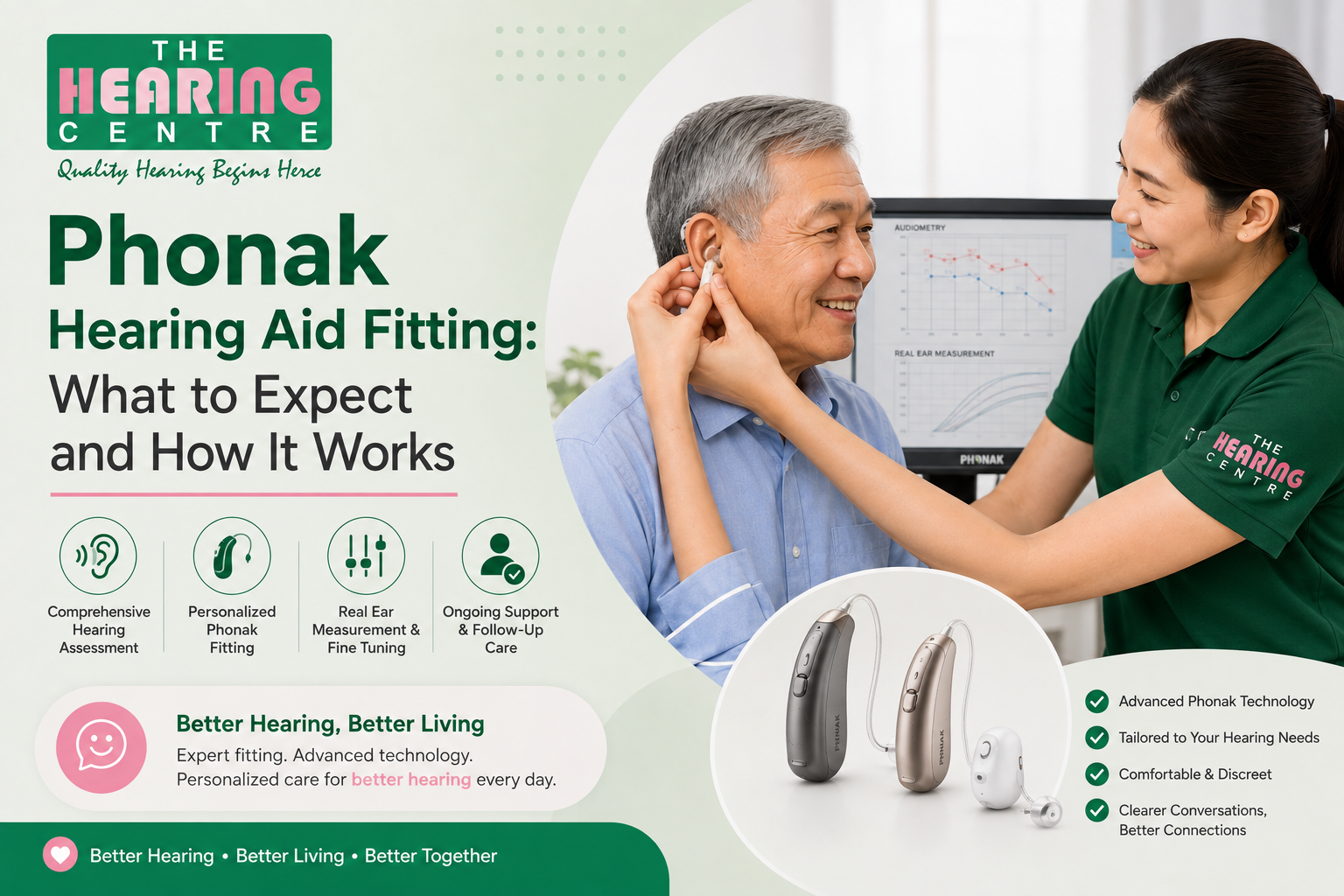
- No real-ear measurement offered. This is the clinical process of calibrating the device to your actual ear canal measurements. Without it, the hearing aid is running on factory defaults, not your audiogram. Any reputable clinic includes this as standard. The Hearing Centre’s real ear measurements service is part of every fitting.
- Pressure to decide on the day. A device you’ll wear every day for five to seven years deserves considered thought. Walk away from any clinic that creates urgency around the purchase.
- No written explanation of what aftercare is included. If it’s not clear whether follow-up visits, cleaning, and adjustments are included or charged separately, ask explicitly.
- Only one or two brands available. A clinic with a limited range may be steering you toward what they have rather than what suits your hearing profile and lifestyle.
What to Check Before Your First Appointment
Going in prepared means a better outcome:
- Note specific situations where hearing feels hardest — crowded rooms, phone calls, TV, one-on-one conversations
- Bring a family member if possible — they often notice things you’ve stopped noticing
- Ask whether a trial period is available before committing to purchase
- Ask specifically what happens if the device needs adjusting in the first six months
- Check your subsidy eligibility before the appointment — details below
Government Subsidies That Reduce the Cost Significantly
Two main schemes apply in Singapore. As of January 2026, both have updated eligibility thresholds worth knowing.
The Seniors’ Mobility and Enabling Fund (SMF) covers Singaporeans and now also Permanent Residents aged 60 and above. It subsidises up to 90% of the hearing aid cost. The monthly per capita household income cap was raised to $4,800 — considerably higher than the previous threshold. If you checked and didn’t qualify before, it’s worth checking again now.
The Assistive Technology Fund (ATF) through SG Enable covers people with disabilities under 60, with the same 90% subsidy rate and a $40,000 lifetime cap. Both schemes require an audiological assessment to apply — which is another reason starting at a qualified clinic matters.
MediSave cannot be used for standard hearing aid purchases. This catches a lot of people off guard. For a full breakdown of how to apply for available subsidies, The Hearing Centre’s hearing aid government subsidy covers the complete picture.
What Happens After You Buy — Why Aftercare Is Not Optional
Your hearing changes over time. The programming that worked perfectly in month one may need adjustment by month six. Your ear canal shape can shift slightly, affecting fit and seal. Earwax accumulates in the device and degrades performance if not cleaned properly. The environments you spend time in change with life — retirement, a new job, moving house — and the device’s settings need to follow.
Good aftercare means your hearing aid continues performing the way it should throughout its five to seven year lifespan. Poor aftercare — or no aftercare — means a device that gradually drifts from optimal and eventually gets left in a drawer. The Hearing Centre’s hearing aid repairs and adjustments service handles everything from routine cleaning and recalibration to more involved repairs, and it’s built into the relationship from day one rather than treated as an extra.
Why The Hearing Centre Is Worth Considering
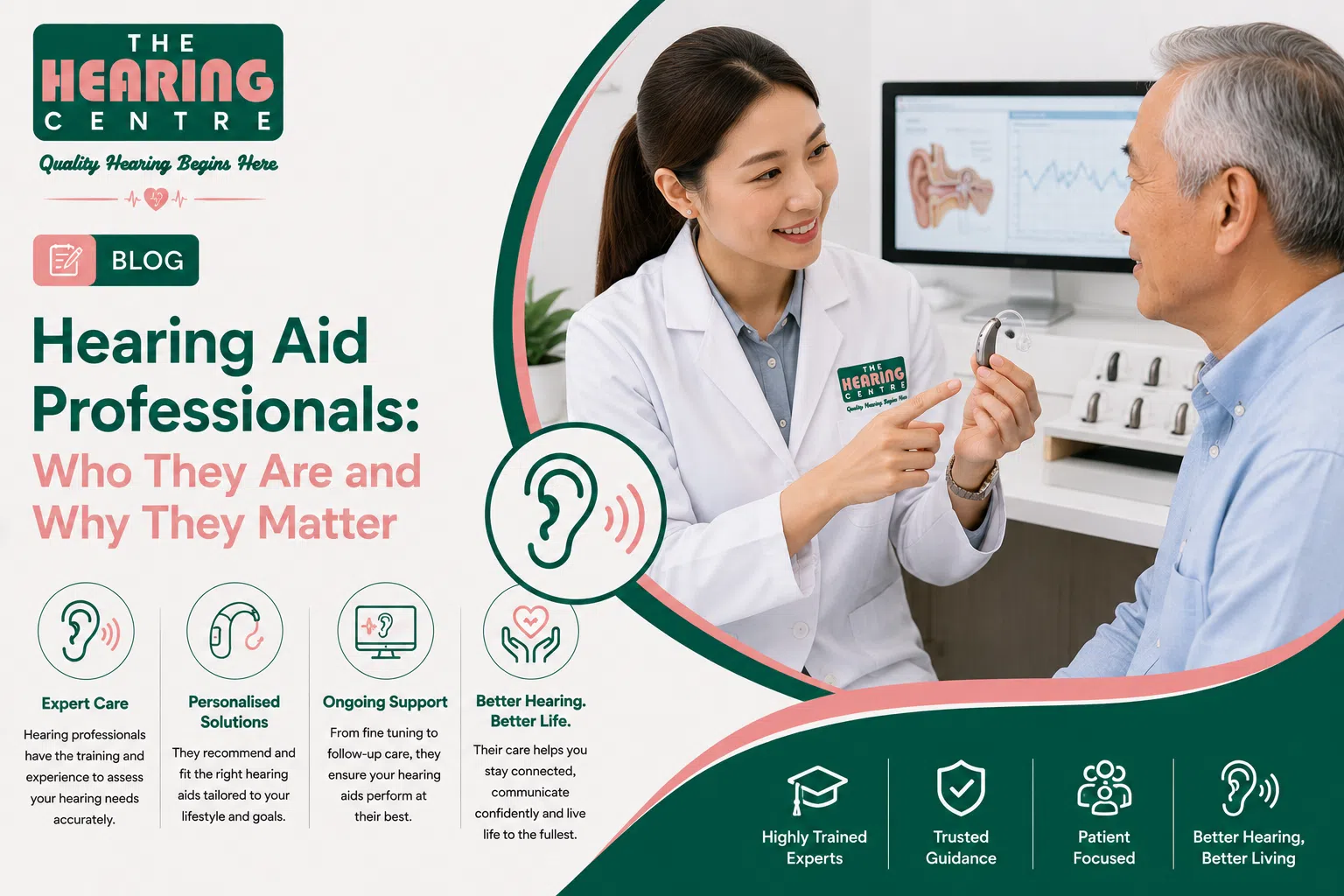
With over 20 years of clinical experience and a team of MOH-approved hearing therapists, The Hearing Centre approaches hearing care as a long-term relationship rather than a one-time sale. From the initial hearing loss treatment assessment through to fitting, follow-up, and ongoing servicing, the process is built around your specific hearing profile and how your needs evolve over time.
The clinic carries the full range from Phonak, Signia, Starkey, ReSound, and Oticon which means recommendations are based on your requirements, not on stock availability. And for seniors specifically, the hearing aids for senior citizens service covers the full pathway including subsidy application guidance.
Frequently Asked Questions:
A hearing aid is a small medical device that picks up sound through a microphone, processes it digitally, and delivers amplified and filtered sound into your ear canal. Modern devices do far more than simply make things louder — they filter background noise, adapt to different environments automatically, and in many cases connect wirelessly to your phone or TV.
Yes, without question. A hearing test produces an audiogram that maps your specific pattern of hearing loss across different frequencies. Without this, no device can be programmed correctly for your ears.
A prescription hearing aid is an HSA-regulated medical device fitted and programmed by a qualified audiologist to your specific audiogram. An over-the-counter amplifier simply makes everything louder without filtering. For genuine hearing loss, amplifiers often cause more fatigue, not less, because background noise goes up along with speech.
Most people need between four to eight weeks to fully adjust. The brain has to relearn how to process sounds it hasn’t been receiving clearly — this takes time and patience. Regular follow-up visits during this period to fine-tune the device make a significant difference to how quickly and comfortably adaptation happens.
You can, but if you have hearing loss in both ears most audiologists will recommend bilateral fitting — one device per ear. Wearing only one device when both ears are affected means the brain still has to work harder to process sound, and you lose the spatial awareness that comes from having balanced input on both sides.
Most devices last five to seven years with proper care. Signs it may be time to replace include deteriorating sound quality even after servicing, repeated repairs becoming more frequent, or your hearing having changed significantly enough that the current device can no longer meet your needs even with reprogramming.
For most people, rechargeable devices are more practical — charge overnight, wear all day, no fumbling with tiny batteries. Battery-powered models still have advantages in very remote situations where charging isn’t possible, and tend to cost slightly less upfront. For seniors or people with dexterity concerns, rechargeable is almost always the better choice.
Yes, and early fitting is strongly recommended. Hearing loss in children affects speech and language development, and the earlier a properly fitted device is in place the better the developmental outcome. The Hearing Centre has specific services for paediatric fitting with child-appropriate devices and aftercare.
Ask whether real-ear measurement is included in the fitting, what aftercare is bundled into the price, how quickly you can get a follow-up appointment if something needs adjusting, and whether a trial period is available before you commit. These four questions will tell you a lot about how a clinic operates.
Yes. The Seniors’ Mobility and Enabling Fund covers Singaporeans and PRs aged 60 and above, and the Assistive Technology Fund covers persons with disabilities under 60. Both provide subsidies of up to 90% of the device cost. As of January 2026, the income eligibility thresholds were raised so even if you checked before and didn’t qualify, it’s worth checking again now.