TLDR: An audiologist test for hearing loss checks how well you hear different pitches and volumes, usually with headphones on in a quiet room. It doesn’t hurt, it’s not invasive, and most people are in and out within an hour. Costs in Singapore run roughly SGD 15 to SGD 140 depending on what’s included, and you’ll walk out with an audiogram — basically a chart of your hearing — plus a straight answer on whether anything’s off. You don’t need a doctor’s referral to book one either.
Here’s something I’ve noticed after years of doing this: people will book an eye test the moment their vision blurs slightly, but they’ll put off a hearing check for a decade even after their spouse starts complaining about the TV volume. Part of it is just not knowing what actually happens in the room. So let’s get into it properly — what the test involves, what it costs, and what you’re supposed to make of the results once you have them.
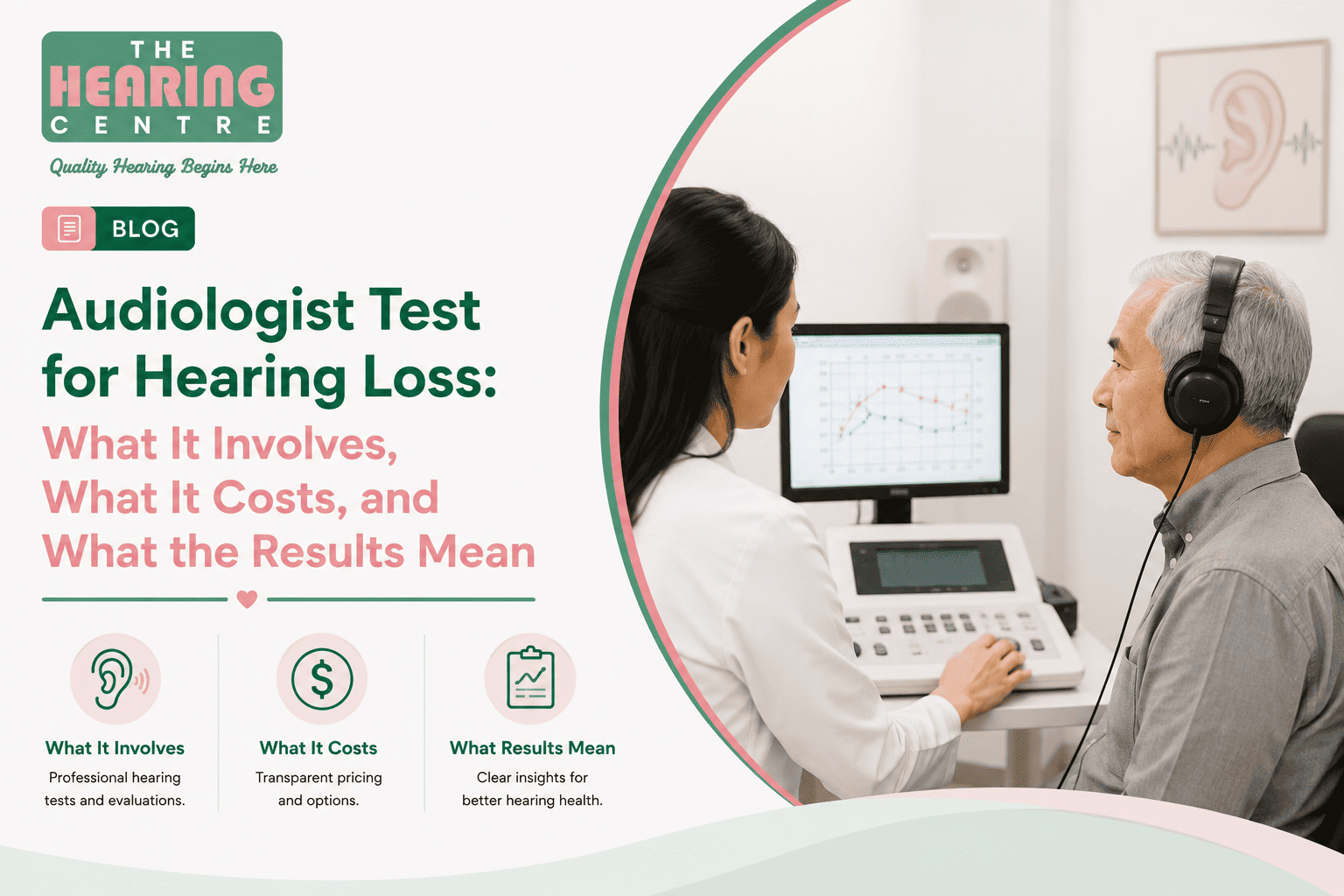
Strip away the clinical name and it’s fairly simple. A hearing test — audiologists sometimes call it an audiometric or audiological assessment — measures how well you pick up sound across different pitches and loudness levels. An audiologist runs it, and their whole job is diagnosing and managing hearing and balance issues, so this is very much their territory, not a generalist’s. What they’re really trying to work out is whether hearing loss exists, and if it does, what kind and how far along it’s gotten. Everything gets plotted on an audiogram, and your audiologist should walk you through it in person, not just hand you a printout and send you off.
Nobody gets the full battery of tests every time. What you actually go through depends on your age, your symptoms, and what the audiologist is trying to rule in or out that day.
Test | What It Checks | Typical Duration | Who It’s For |
Pure Tone Audiometry (PTA) | Softest sound you can hear at different pitches | 15–20 min | Adults and older children |
Tympanometry | How your eardrum moves with changes in air pressure | 5–10 min | All ages — checks middle ear function |
Speech Audiometry | How well you hear and repeat words at different volumes | 10–15 min | Adults, older children |
Otoacoustic Emissions (OAE) | Sounds the inner ear’s hair cells produce on their own | 5–10 min | Newborns, young children, quick screening |
Auditory Brainstem Response (ABR/ASSR) | Whether the inner ear and brain are communicating properly | 30–60 min | Infants, young kids, anyone who can’t respond reliably to PTA |
Bone Conduction Test | Whether the hearing loss sits in the inner ear or somewhere earlier | 10–15 min | Anyone with suspected conductive loss |
For most adults, this boils down to an ear exam plus pure tone audiometry, with tympanometry thrown in if something looks off. You’re rarely getting all six in one sitting unless there’s a specific reason.
I’ll walk through this the way it usually unfolds, because most of the anxiety around booking one comes from not knowing the order of things.
None of it takes more than an hour, start to finish. No needles, no fasting beforehand, nothing that should make anyone nervous about going.
Hearing loss doesn’t announce itself. It creeps. Which is exactly why most people don’t notice until someone else points it out. A few things worth paying attention to:
If a couple of these ring true, it’s worth just booking the test instead of talking yourself out of it for another year.
Results come back in decibels hearing level, or dB HL, and they land in one of these bands:
Hearing Level | Classification | What It Generally Means |
-10 to 25 dB | Normal hearing | No real trouble in day-to-day situations |
26 to 40 dB | Mild hearing loss | Soft speech or background noise gets tricky |
41 to 55 dB | Moderate hearing loss | Following normal conversation without help starts to feel like work |
56 to 70 dB | Moderately severe | Hard to hear even close-range conversation |
71 to 90 dB | Severe hearing loss | Only loud speech comes through, and even that takes effort |
91+ dB | Profound hearing loss | Little to no hearing without significant amplification |
You’ll also find out which type you’re dealing with, because it changes the whole treatment conversation:
Test Type | Approximate Cost (SGD) |
Basic hearing screening | $15 – $45 |
Comprehensive audiometry test | $45 – $140 |
Tympanometry (add-on) | Usually bundled in, or $20–$40 alone |
Free screening promotions | $0 — some clinics run these periodically |
A quick note that catches people off guard: Medisave doesn’t cover standard hearing tests or hearing aids. That said, schemes like the Senior Mobility Fund and the Assistive Technology Fund can help with hearing aid costs if you qualify, and some clinics apply CHAS subsidies for eligible seniors. Worth asking about directly when you call to book, since eligibility isn’t the same for everyone.
Not much prep needed here, but a few things genuinely help:
Age Group | Recommended Frequency |
Newborns | Screened shortly after birth — standard practice in Singapore |
Children | If speech delay or listening issues come up |
Adults under 50 | Every few years, sooner if symptoms show up |
Adults 50 and above | Once a year — age-related loss is genuinely common by this point |
Anyone in noisy occupations | Yearly, as part of routine workplace health checks |
Over 60% of adults aged 60 and above in Singapore are dealing with some degree of hearing loss. Most of them wait years past the first symptoms before doing anything about it, which is the part that doesn’t quite make sense to us.
Honestly, the equipment isn’t really the deciding factor here. Who’s reading the results is. A hearing loss treatment plan built on a rushed test, or one read too quickly, can point someone toward the wrong solution entirely, and that’s a bigger problem than most people realise until it’s happened to them. A properly run audiometry test from an experienced audiologist in Singapore doesn’t just confirm hearing loss exists — it tells you what kind, roughly where it’s headed, and what actually makes sense for you specifically, instead of a one-size-fits-all recommendation.
If you already recognised some of the signs of hearing loss mentioned earlier while reading this, that’s usually your cue to book rather than keep waiting it out.
We deliberately don’t rush people through this. Appointments include an actual consultation, not a five-minute tone test and a rushed goodbye, and you get your results the same day, explained without the jargon. Equipment’s calibrated properly, pricing’s clear before you even book, and if it turns out your hearing’s fine, you leave knowing that for certain — not just hoping it is.
Reading about symptoms and dB ranges only gets you so far — the only real way to know where your hearing stands is to actually book an audiologist test for hearing loss and get an audiogram in hand. If you’re anywhere in Singapore and searching for Hearing aids Singapore, get in touch and we’ll find a time that works for you.
It’s a painless check, usually with headphones on in a quiet room, that measures how well you pick up different pitches and volumes so an audiologist can tell whether hearing loss is present and how far it’s gone.
Most appointments run 30 to 60 minutes total — consultation, ear check, the test itself, and going through the results together.
Not even a little. No needles, no fasting, nothing invasive. The most that touches your ear is a small probe during tests like tympanometry.
Basic screenings start around $15. A fuller audiometry test usually runs $45 to $140, depending on what’s included.
Generally no. Most private audiology clinics here let you book directly. Your insurer might ask for one if you’re claiming reimbursement, but that’s a separate matter.
A chart plotting the softest sounds you can hear at each frequency. It’s the main tool used to figure out whether hearing loss is there and how it’s classified.
You can use one as a rough flag, but it’s not a substitute. Online tests miss things a controlled, professional evaluation catches, and they shouldn’t be treated as a diagnosis.
Every few years if you’re younger and symptom-free. Once you hit 50, or if you work somewhere loud, make it annual.
Your audiologist explains what type it is and how severe, then talks through what’s next — hearing aids, a referral, wax removal, or sometimes just keeping an eye on it.
Yes. Newborns are typically screened right after birth, and older children go through age-appropriate versions like play audiometry, where the test is basically built into a game.