People don’t usually think about this until something goes wrong. They get a hearing aid fitted somewhere, and three months later it’s sitting in a drawer. Too loud in some places. Tinny in others. Uncomfortable all around. So they assume hearing aids just don’t work for them.
Nine times out of ten, the problem isn’t the device. It’s that nobody built a proper prescription for it in the first place.
At The Hearing Centre Singapore, this is honestly the most common thing we see. Someone walks in with a device that was never programmed to their specific audiogram. They’ve been wearing a generic setting not their setting. And that’s like borrowing a stranger’s glasses. Things might look a little clearer, but not the way they actually should for your eyes.
What Is a Hearing Aid Prescription, Really?
When Singaporeans hear “prescription,” most picture a slip from a GP that lets you pick up medication. This is completely different.
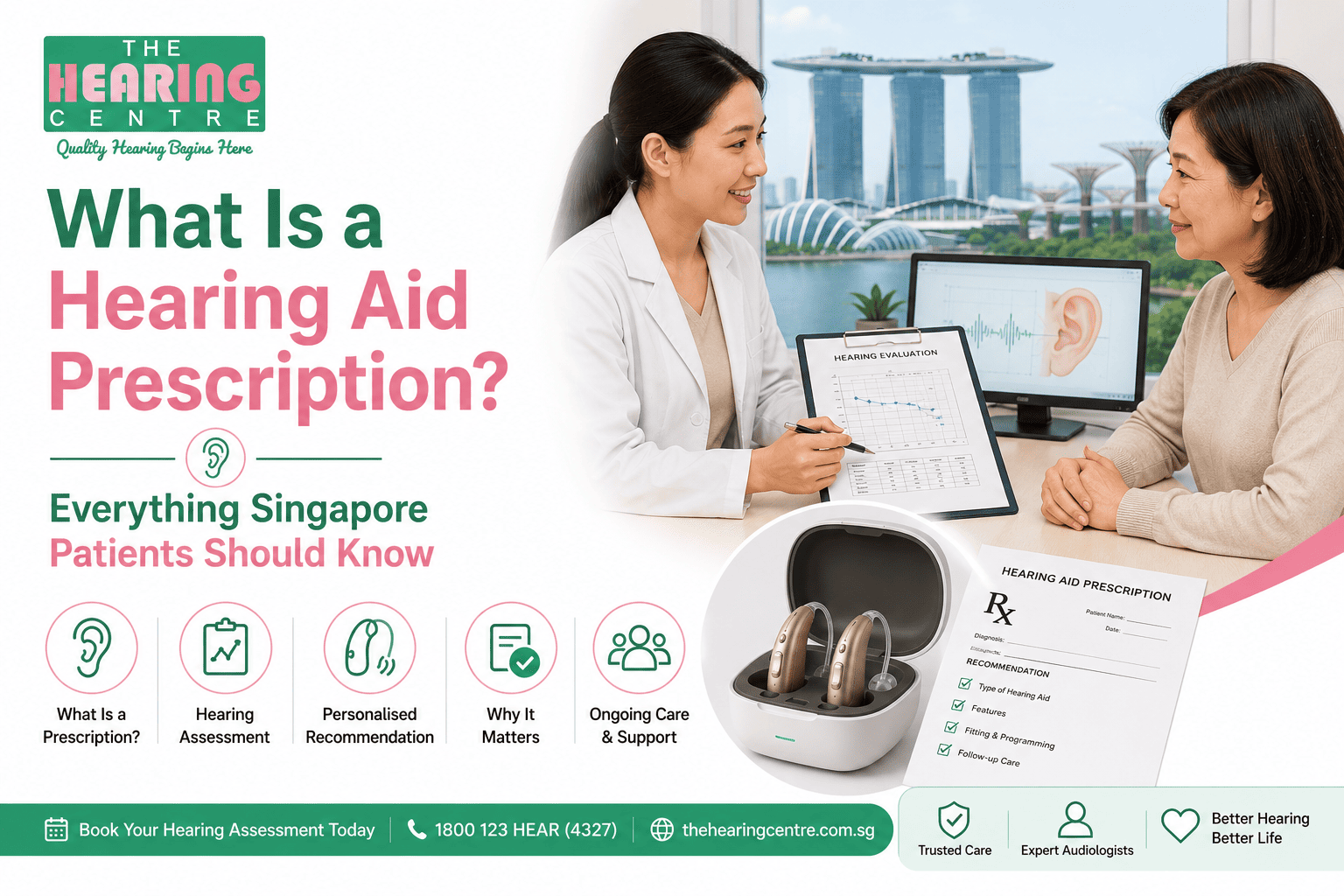
A hearing aid prescription is a mathematical calculation. Your audiologist takes your audiogram the graph that maps how your hearing performs across different sound frequencies and runs it through a prescriptive formula. What comes out is a set of amplification targets: this much gain at 500 Hz, that much at 2000 Hz, more at 4000 Hz where your high-frequency loss drops off.
No two people’s targets are identical. Even two patients who score similarly on a basic hearing test can need very different amplification once you look at the full picture. That’s the whole point of doing this properly rather than just turning up the volume and hoping.
How the Numbers Get Calculated
Your audiogram is the starting point. Turning it into a usable prescription isn’t guesswork though there are well-researched formulas audiologists rely on.
The most widely used one for adults in Singapore is NAL-NL2, developed by the National Acoustics Laboratory in Australia. It’s built specifically for digital hearing aids. The goal is speech clarity making sure amplification helps you follow conversations without becoming fatiguing over the course of a day.
For children, the preferred method is DSL (Desired Sensation Level). Singapore General Hospital uses DSL as standard for paediatric fittings, because children need more gain at the frequencies that carry speech sounds. Those years of language development are critical, and a child missing those frequencies consistently falls behind in ways that compound over time.
Then there are manufacturer proprietary formulas. Phonak uses Adaptive Phonak Digital, Signia has NxFit, Oticon uses VAC+, ReSound runs Audiogram+. These aren’t necessarily wrong, but they can’t be independently verified the way NAL-NL2 and DSL can. A clinic relying entirely on manufacturer software is trusting the brand’s formula rather than measuring what’s actually happening in your ear. Hearing aid technology levels also affect how accurately a device can execute the prescription — so the device tier matters alongside the programming.
“Sounds Fine” Doesn’t Mean It’s Actually Correct
Why Real Ear Measurement Verifies Your Hearing Aid Prescription
Once a device gets programmed, how does anyone actually know it’s delivering the right amplification? The software shows a curve. The audiologist adjusts the settings. You say it sounds okay. Done, right?
Not really. Ear canals vary enormously in shape and size, and the same device programmed identically behaves differently inside different ears. A setting that hits the prescription targets in one person’s canal might be under-amplifying by 10 dB in another’s. You’d never know just by listening.
Real Ear Measurement fixes this. A small probe microphone goes into the ear canal alongside the hearing aid and measures what the device is actually outputting at your eardrum — the real number, not the software prediction.
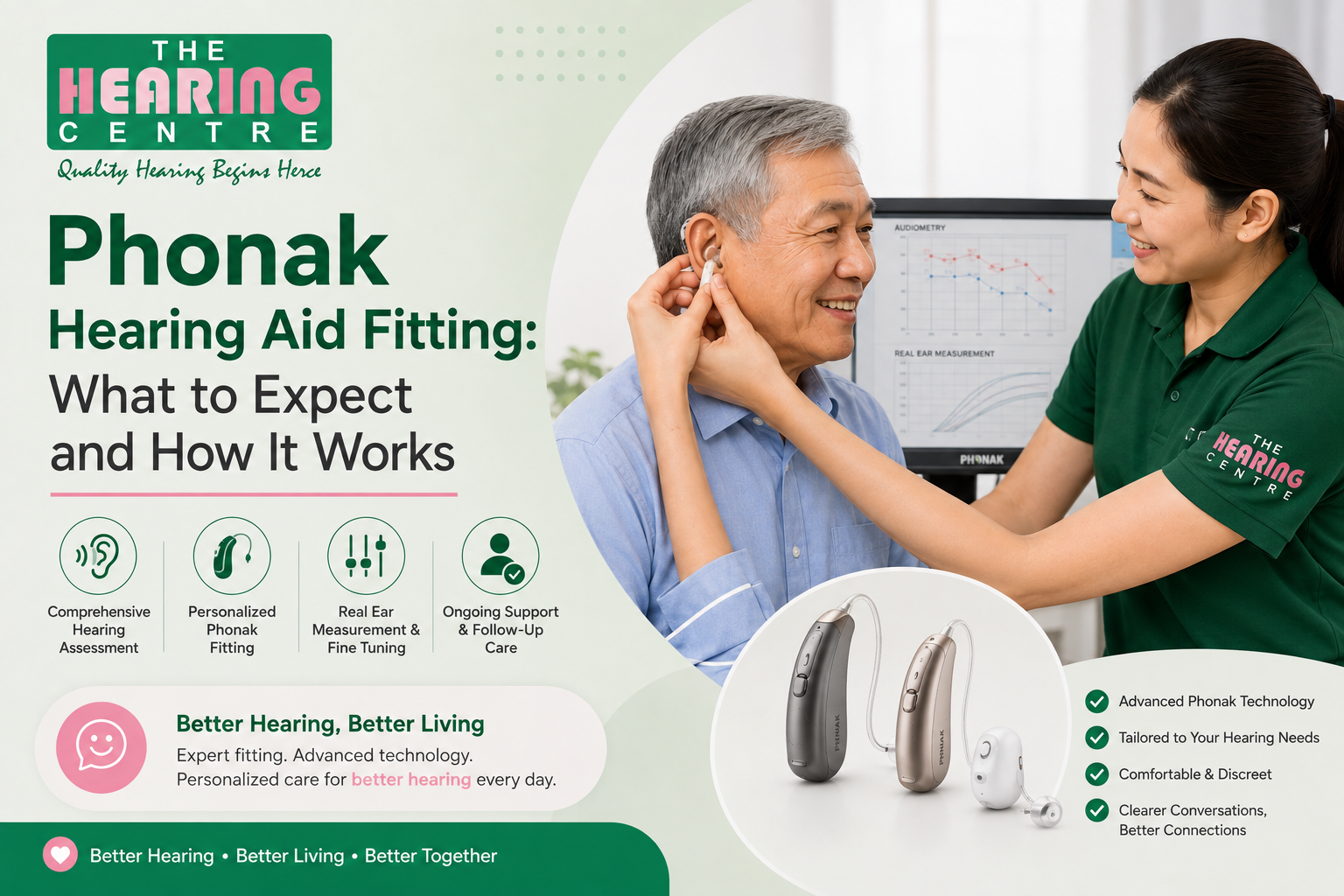
At The Hearing Centre, Real Ear Measurement is standard in every fitting. Not an upgrade, not optional — standard. Fitting a hearing aid without it is calibrating a scale without any weights. You’re working from assumptions. If you want to understand what a properly clinical fitting looks like from start to finish, the hearing aid fitting process guide covers exactly what’s involved.
Prescription Hearing Aids vs OTC in Singapore
Singapore’s Health Sciences Authority classifies prescription hearing aids as medical devices. That matters practically, not just legally.
OTC devices: bought online or off a shelf without any hearing test — use preset amplification for a general mild-to-moderate profile. Some people do get some benefit from them. But they can’t be tailored to your specific audiogram, they don’t come with any professional fitting or follow-up support, and they’re generally not eligible for SMEF or ATF government subsidies.
A prescription device, fitted by a qualified hearing specialist in Singapore, is built around your actual audiogram. It gets adjusted as your hearing changes. The hearing aid fitting service that wraps around it the REM verification, the follow-up programming sessions, the fine-tuning is what determines whether the device still works for you a year from now.
Frequently Asked Questions:
They’re related but not the same thing. Your audiogram shows your hearing thresholds — where the loss sits and how steep it is across frequencies. A hearing aid prescription is what your audiologist calculates from that data: the specific amplification targets your device needs to hit. One is the measurement, the other is the treatment derived from it.
No. You can book directly with a hearing clinic or audiologist. Some patients come through a GP or ENT specialist first, but it’s not a requirement.
Yes — and it should be reviewed regularly. Most adults experience gradual progression of hearing loss. If your audiogram shifts, your prescription needs updating so the device keeps delivering what your ears actually need. Annual hearing reviews catch this before the mismatch becomes obvious.
Yes. Eligible Singaporeans can access the SMEF (citizens aged 60 and above) and ATF (citizens and PRs with qualifying disabilities) to offset costs. OTC devices typically don’t qualify under either scheme.
Go back and say so. The prescription targets can be adjusted, and if Real Ear Measurement was used during the original fitting, your audiologist can quickly check whether the device is hitting the right numbers or whether the programming needs to change. A well-prescribed device should feel clear and natural. If it doesn’t, the numbers need revisiting — not the device.
It depends on how your hearing changes. Most people need a review every year or so. If your hearing gets worse, the prescription needs updating too — otherwise your device slowly stops doing its job properly.
You can buy an OTC device without one, but it won’t be built around your actual hearing. A proper prescription means your audiologist looks at your audiogram and programs the device specifically for you. That’s the difference between something that kind of helps and something that actually works.
You’ll know. It sounds off — too loud in some places, too quiet in others, maybe tinny or muffled. The fix is usually a reprogramming session, not a new device. If your original fitting included Real Ear Measurement, your audiologist can check the numbers quickly and adjust from there.
Almost never. Most people have different hearing loss in each ear, so each side gets its own amplification targets. Wearing the same setting in both ears when the loss is different is one of the most common reasons people find hearing aids uncomfortable.
At most clinics, follow-up adjustments are included as part of the fitting service — especially in the first few months while you’re getting used to the device. Always check this before you commit to a clinic. It’s worth knowing upfront.