
TL;DR: Six main types exist: BTE, RIC/RITE, ITE, ITC, CIC, and IIC. The difference mostly comes down to size, how visible they are, and how much power they can push. BTE and RIC work for almost anyone, severe hearing loss included. ITE, ITC, CIC, and IIC shrink down step by step and get harder to spot, but they’re only meant for mild to moderate loss.
So You’ve Been Told You Need a Hearing Aid. Now What?
You sit through a hearing test, the audiologist says it’s time, and suddenly there’s a wall of letters in front of you. BTE. RIC. Nobody explains what any of it means, and you’re just supposed to nod along.
Most people feel the same way at this stage. That’s normal.
Once you actually know what these types of hearing aids do and who they’re built for, picking one stops feeling like a shot in the dark. It won’t necessarily be easy since every ear and every lifestyle is different, but at least you’ll know what questions to ask instead of just trusting whatever gets handed to you.
This guide goes through every major style sold in Singapore. What it looks like, who it suits, roughly what you’ll pay, and a few things clinics don’t always bother mentioning.
How Does a Hearing Aid Actually Work?
Before jumping into the types, it’s worth knowing what’s happening inside these devices. Strip away the branding and every hearing aid, cheap or expensive, is doing the same three jobs.
- A microphone catches sound around you
- A processor cleans it up and makes it louder
- A speaker pushes that sound into your ear
That’s really all there is to it. What separates a $1,000 device from an $8,000 one comes down to how clever that middle step is. Premium hearing aids can tell the difference between a quiet room and a noisy hawker centre and adjust on their own. Cheaper models mostly just turn the volume up on everything, good and bad noise alike.
Nearly every style falls under two umbrellas: behind-the-ear (BTE) and in-the-ear (ITE). Everything else you read about is a variation on one of those two.
Why the Type of Hearing Aid You Pick Actually Matters
Around one in six people in Singapore live with some degree of hearing loss, and plenty don’t even know it yet. Given how fast the population is ageing here, that number isn’t going down.
Choosing the wrong style isn’t only about wasted money, although yes, a $3,000 device sitting untouched in a drawer stings. The real issue is fit. A device that feels off or doesn’t suit how you actually live tends to get left in a drawer. People stop wearing it and go back to half-following conversations, nodding when they’ve missed half of what was said.
Get the fit right and it’s a different story entirely. A few things shape what “right” looks like:
- How severe the hearing loss is
- The size and shape of your ear canal
- What your day-to-day actually looks like
- Dexterity and eyesight
- How much you care about visibility
- Budget
That’s the whole reason a proper test with a qualified audiologist in Singapore needs to come before anything else. Grabbing a device based on what a friend or relative uses, without your own testing, is one of the more common ways people end up disappointed.
And on that note: buying hearing aids online with no fitting and no proper test might look convenient, but it usually creates more problems than it fixes. A hearing aid just isn’t something you can buy off a shelf and expect to work.
The 6 Main Types of Hearing Aids in Singapore
1. Behind-the-Ear (BTE)
This is what most people picture when they think “hearing aid.” The main unit, holding the microphone, processor, and battery, sits behind the ear, connected by a thin tube to an earmold or dome resting in the canal. Simple design, and that simplicity is exactly why it’s stuck around this long.
It works across almost every degree of hearing loss, from mild right through to profound, which is why it’s the go-to for children (the earmold gets swapped as their ears grow, no need for a whole new device), older adults, and anyone struggling with dexterity. Easier to clean too, since there’s more to actually hold onto, and the bigger battery lasts longer than what you’d get in a smaller style.
The trade-off is visibility. It’s the most noticeable of all the types, and it can get a bit awkward if you’re wearing glasses and a mask at the same time, which, let’s be honest, describes a lot of daily life now.
2. Receiver-in-Canal (RIC/RITE)
From a distance RIC looks almost identical to BTE, but the speaker sits inside the ear canal rather than in the main casing, connected by a thin wire instead of a tube. Doesn’t sound like much of a change, but it makes a real difference to how natural the sound comes through.
Receiver-in-Canal devices are what most audiologists reach for first with new patients these days, in Singapore and pretty much everywhere else. First-time wearers do well with it. So do people with mild to severe loss who want something that doesn’t scream “hearing aid” but still performs.
You get more natural sound because the receiver sits closer to the eardrum, less of that stuffy, plugged-up feeling, and most models now come with Bluetooth and rechargeable batteries built in. The wire can wear out eventually and need replacing, and it’s not the pick for profound hearing loss where you need serious power.
3. In-the-Ear (ITE)
ITE fits inside the bowl-shaped part of your outer ear, the part visible from the front. Made from an actual impression of your ear, so it’s genuinely custom, not just sized off a chart.
Works well for mild to severe hearing loss. Glasses wearers tend to like it since there’s no behind-the-ear piece competing for space with the frames, and it suits people who want a custom fit but find the really tiny canal styles too fiddly for daily handling.
Comfortable over long stretches, easy to get in and out, and there’s usually room for volume controls and program buttons. The downside is visibility again, it sits more in view than the canal styles, and you’ll need a clinic visit for the ear impression before anything gets made.
4. In-the-Canal (ITC)
Somewhere between ITE and CIC in size. Most of the device sits inside the canal, with just a small piece visible on the outer ear.
Good for adults with mild to moderately severe loss who want something more discreet than ITE without going all the way down to the tiny canal styles. More hidden than ITE, still custom-fitted, and the deeper placement usually means fewer whistling or feedback problems.
Battery’s smaller, so you’ll be changing it more often, and the feature set is more limited than what you get with BTE or RIC. Not built for severe hearing loss either.
5. Completely-in-Canal (CIC)
Fits almost entirely inside the ear canal. The only thing you’ll see from outside is a tiny removal cord.
Suits adults with mild to moderate hearing loss, particularly anyone who really doesn’t want it noticed. Quite discreet, custom-fitted for comfort, and the deep placement helps with natural sound direction.
The battery’s small and drains faster, features are limited (don’t expect much Bluetooth here), and it’s genuinely tricky to handle if your dexterity isn’t great. Not an option for anything past moderate hearing loss.
6. Invisible-in-Canal (IIC)
The smallest and most hidden of all the types of hearing aids sold here. It sits past the second bend of the ear canal, deep enough that there’s nothing visible at all from outside.
Made for adults with mild to moderate hearing loss where appearance is the deciding factor above everything else. Worth knowing that not every ear canal is shaped to allow this fit, so it’s better to check that early rather than set your heart on it.
Completely invisible when worn, excellent natural sound direction thanks to the deep placement, and barely any wind noise. On the flip side, it’s the priciest of the custom styles, the battery life is shortest of the bunch, and it’s not built for round-the-clock wear, so you’ll be taking it out fairly often.
Quick Comparison Table
Type | How visible | Hearing loss it suits | Good fit for |
BTE | Most visible | Mild to profound | Kids, seniors, severe loss |
RIC/RITE | Low | Mild to severe | First-time users, active lifestyle |
ITE | Moderate | Mild to severe | Glasses wearers, dexterity needs |
ITC | Low | Mild to mod-severe | Balance of discretion and control |
CIC | Very low | Mild to moderate | Cosmetic priority |
IIC | Invisible | Mild to moderate | Maximum discretion |
A Few Specialised Types Worth Knowing About
The six styles above cover most people, but a handful of cases need something different.
Bone-anchored hearing aids skip the ear canal entirely and send sound vibrations through the skull bone straight to the inner ear. Bone-anchored hearing aids get used for conductive hearing loss, single-sided deafness, or conditions like microtia where the ear canal never formed properly.
CROS and BiCROS systems are built for people who’ve lost hearing in just one ear. A microphone on the weaker side picks up sound and sends it wirelessly to a device on the better ear. BiCROS does the same thing but also boosts the better ear if that one has some hearing loss too.
Then there’s extended wear, with the Phonak Lyric being the main example. It gets placed deep in the canal by a clinician and stays there through showers, sleep, everything, for weeks at a stretch. No daily handling at all, though it runs on a subscription rather than a straight purchase, and it isn’t suitable for every ear shape.
What’s Behind Your Hearing Loss Actually Matters Too
Hearing loss isn’t one single thing, and what’s causing yours affects which type gets recommended. Sensorineural hearing loss, caused by damage to the inner ear or the auditory nerve, is by far the most common kind in adults, and it’s what most hearing aids are built to manage. Curious what actually causes it? This piece on what causes sensorineural hearing loss covers ageing, noise exposure, and a few other triggers people don’t expect. Conductive hearing loss is a different story, usually involving a blockage or structural issue, and it sometimes needs medical treatment before a hearing aid even comes into the picture.
Digital vs Analogue: Does This Even Matter Anymore?
Not really, though the question still comes up now and then. Analogue hearing aids amplified everything at once, speech and background noise together, with no real way to tell them apart. You won’t find them being sold anymore.
Every hearing aid on the Singapore market today is digital. Digital processing is what lets a device separate a friend’s voice from the air-con humming behind it, and adjust to that in real time. The gap between a budget digital hearing aid and a premium one comes down to how good that processing is, not whether it’s digital in the first place.
Rechargeable or Battery-Powered Types of Hearing Aids? Here’s the Real Difference
Rechargeable models charge overnight and usually get you through a full day. No fumbling with tiny disposable batteries, which older users and anyone with dexterity struggles tend to appreciate. Costs a bit more upfront, but a lot of people say it’s worth it.
Battery-powered ones let you swap batteries wherever you are, no charger required, which helps when travelling or when your routine’s unpredictable. Cheaper to start with too.
Most modern BTE and RIC devices in Singapore now come with rechargeable options. Tiny custom styles like CIC and IIC usually stick with disposable batteries simply because there’s no room inside for charging components. If you do go rechargeable, a few small habits stretch the life of the battery further than you’d expect. This guide on extending your hearing aid’s battery life covers some that most people never think to try.
Brands You’ll Come Across in Singapore
The style matters, but the brand does too. Quick rundown:
- Signia: known for Own Voice Processing, which keeps your own voice sounding like your voice instead of coming through tinny
- Phonak: solid reputation for speech clarity, and they make the Roger wireless microphone system
- ReSound: early mover on Bluetooth hearing aids, still a favourite for smartphone pairing
- Oticon: their BrainHearing approach and AI processing aim for sound that feels natural rather than just loud
- Starkey: American brand, known for built-in health tracking alongside the hearing support
- Widex: often described as having warmer, more musical sound than some rivals
Each of these brands builds across BTE, RIC, and ITE lines, so brand and style end up being two separate decisions, not one.
How to Actually Choose the Right One Among All These Types of Hearing Aids
Start with an actual hearing test, not a phone app or an online quiz. A proper audiometry test shows exactly what kind of hearing loss you’re dealing with, which immediately narrows down which styles are even on the table.
Think honestly about your lifestyle. Someone who’s out exercising most days and someone who mostly stays home need different things, even if their test results look identical.
Consider your hands, not just your ears. If dexterity or eyesight is an issue, a bigger BTE or RIC will serve you better day to day than a tiny IIC, whatever the appeal of “invisible.”
Set a real budget. Devices range from around $800 for entry-level up to $8,000 and beyond for premium models, and that’s before follow-up visits and maintenance, which add up over time.
Ask about a trial period. Any decent Singapore clinic should offer one before asking you to commit fully.
Check subsidies before anything else. The Seniors’ Mobility and Enabling Fund and the Assistive Technology Fund can cover up to 90% of costs for those who qualify, so it’s worth confirming eligibility before you even start comparing prices.
What Happens After You Get One
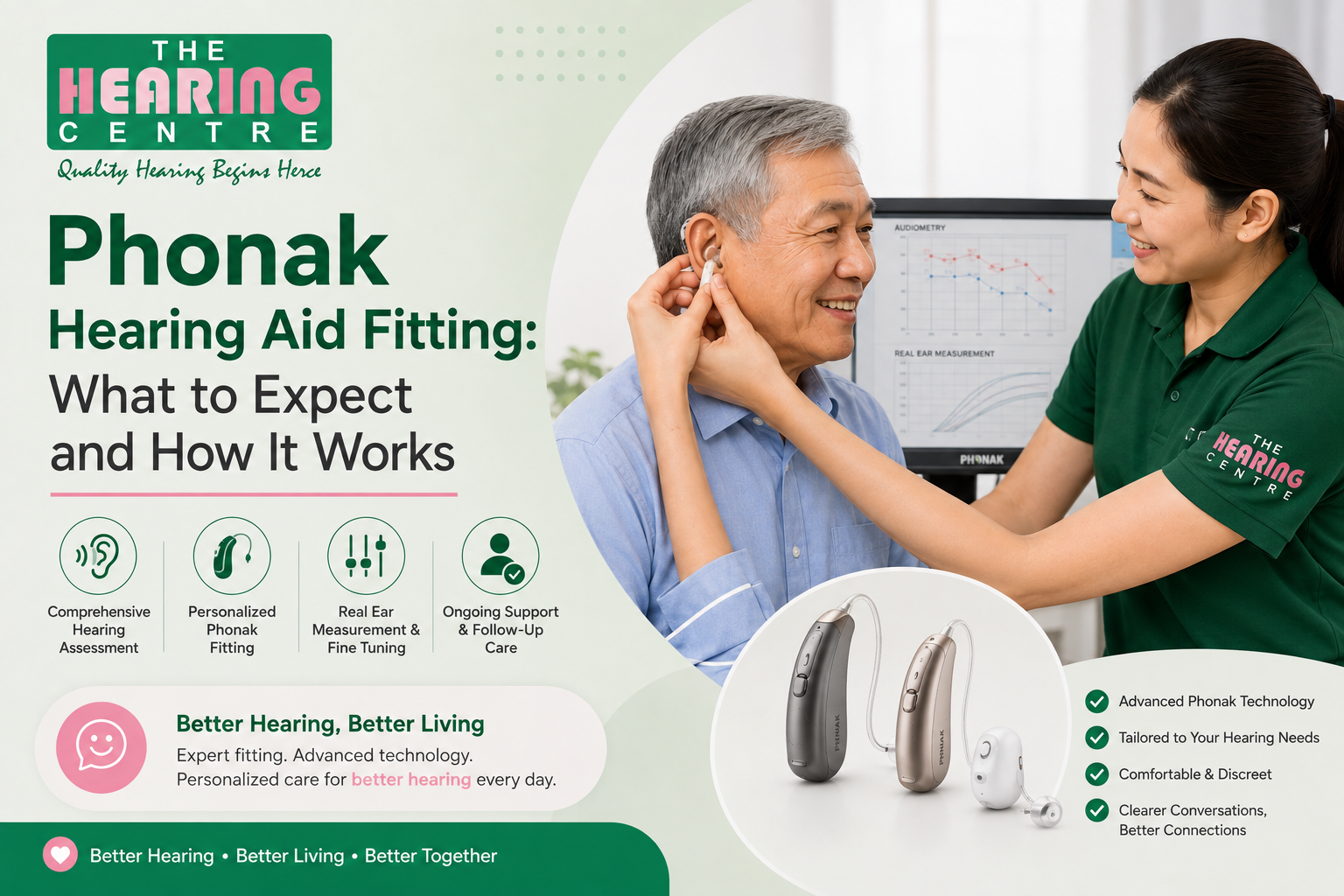
Getting the device isn’t where this ends. A proper fitting means going over your test results, taking ear impressions if the style needs one, programming the device to your specific hearing profile, and running Real Ear Measurement to check it’s actually delivering the right amplification rather than just assuming it does.
Most people need a handful of follow-up visits over the first few months. That’s expected, not a red flag. Your brain needs time to adjust to sounds it hasn’t properly picked up in a while, sometimes years.
Once you’re wearing one daily, upkeep starts to matter more than people expect going in. Skipping the basics is one of the bad habits that hurt your hearing health over time, and that applies to the device as much as your ears.
Common Myths About Types of Hearing Aids That Need to Go Away
“Invisible is always the better option.” Not if your hearing loss is severe. A device you can actually hear through beats an invisible one that can’t keep up with what you need.
“Bigger means older technology.” Not true. Larger BTE units often carry more power and better battery life than the tiny styles, size has nothing to do with how outdated something is.
“One hearing aid is enough if I can still hear a bit.” If both ears have hearing loss, two devices work noticeably better together. Speech clarity, sense of direction, less fatigue by the end of the day, all of it improves with binaural fitting.
“Hearing aids fix your hearing completely.” They amplify and process sound. They don’t restore what’s been lost. Still a meaningful improvement, just not a cure.
Where to Go From Here
All the different types of hearing aids in Singapore can feel like a lot to take in at once. But once you understand what each style actually does, it stops being confusing pretty quickly. Whether you end up with a BTE, a RIC, or something smaller like a CIC, there’s a fit out there that matches your hearing, your lifestyle, and your budget.
The one move that makes this whole process easier is starting with a proper hearing assessment instead of guessing your way through it. At The Hearing Centre Singapore, our certified audiologists run full hearing tests, personalised fittings, and ongoing support across all the major brands. Hearing well isn’t something to keep putting off. Book a consultation and get a recommendation built around your actual ears, not a generic checklist.
Frequently Asked Questions:
Six main types: BTE, RIC/RITE, ITE, ITC, CIC, and IIC. There are also specialised options like bone-anchored hearing aids and CROS/BiCROS systems for cases like single-sided deafness.
RIC/RITE, by a fair margin. It balances comfort, discretion, and access to features like Bluetooth better than most of the alternatives, which is why it’s usually what audiologists suggest first for new users.
IIC. It sits deep past the second bend of the ear canal, so nothing shows from outside at all. Only works for mild to moderate hearing loss though, not beyond that.
Somewhere between $800 and $8,000 per device depending on style and technology level. Premium AI-driven models sit at the top of that range.
Yes. The SMF and the ATF can cover up to 90% of costs for those who qualify. Best to speak with an audiologist or social worker directly about eligibility.
If both ears have hearing loss, two devices are generally the better call. It genuinely improves speech clarity and cuts down on listening fatigue compared to wearing just one.
Comes down to your routine. Rechargeable works well for people who like predictability and struggle with tiny batteries. Battery-powered gives you more flexibility when travelling or on unpredictable days.
BTE or RIC, most of the time. Easier to handle day to day, and rechargeable versions take away the hassle of swapping small batteries.
Yes, and they should if there’s hearing loss present. BTE is the standard recommendation since the earmold gets replaced as the child grows, without needing to swap out the whole device.
Usually 4 to 7 years with proper care. The climate here is genuinely tough on the electronics, so moisture protection and regular cleaning matter more than they would somewhere drier.