My uncle refused to admit anything was wrong for three years. He’d just nod along in conversations, laugh when others laughed, and quietly move to the edge of every group gathering. His wife noticed before he did. His doctor confirmed it. By then, he’d already missed a lot.
Hearing loss symptoms don’t arrive with a warning. They blend into daily life so smoothly that most people write them off as tiredness, or bad acoustics, or other people not speaking clearly enough.
Three years is a long time to wait.
Quick — What Type Are We Talking About
Not all hearing loss is the same and the type changes everything about treatment.
Conductive — something is physically blocking sound before it hits the inner ear. Wax, fluid, a perforated eardrum, bone issues, infection. The inner ear is usually fine. This type is often treatable.
Sensorineural — the inner ear or auditory nerve itself is damaged. Ageing does this. So does years of loud noise, certain medications, genetics. This one’s usually permanent but manageable.
Mixed — both happening together. Treatment depends on what’s driving it most.
How Severe Is It — The Grading Scale
Hearing loss runs across a spectrum. Understanding where you sit changes what comes next.
Mild (26–40 dB loss) — Soft speech and quiet conversations get difficult. Noisy environments strip out clarity fast. You turn the TV up a bit. Most people at this stage don’t think they have hearing loss — they think other people speak unclearly.
Moderate (41–60 dB loss) — Normal conversation without a hearing aid becomes genuinely challenging. You’re lip-reading without realising it. Phone calls are hard. Social exhaustion is real.
Severe (61–80 dB loss) — Shouted speech at close range. Hearing aids are essential, not optional. Communication strategies and assistive devices become part of daily life.
Profound (81 dB+ loss) — Very little usable hearing without significant amplification. Cochlear implants are often the most effective option at this level.
What Causes It
Ageing is the biggest factor, especially past 60. But it’s genuinely not the only one.
Loud noise over years destroys tiny hair cells in the inner ear — and those don’t grow back. Chronic ear infections. Some antibiotics. Chemotherapy drugs. Head injuries. Family history. People in their 30s and 40s get hearing loss too, usually from noise exposure they didn’t take seriously at the time.
Pure Tone Audiometry and ABR/ASSR tests can pinpoint the specific cause when symptoms alone don’t tell the full story.
In Singapore, noise-induced hearing loss affects roughly 5 in 100,000 people — and that’s only the cases tied to workplace noise. Age-related hearing loss is significantly more widespread. The Ministry of Health recommends annual hearing screening for all Singaporeans aged 60 and above as part of routine functional health checks. Most people in that age group haven’t had a single hearing test
The Hearing Loss Symptoms People Actually Miss
These don’t feel medical. That’s the whole problem.
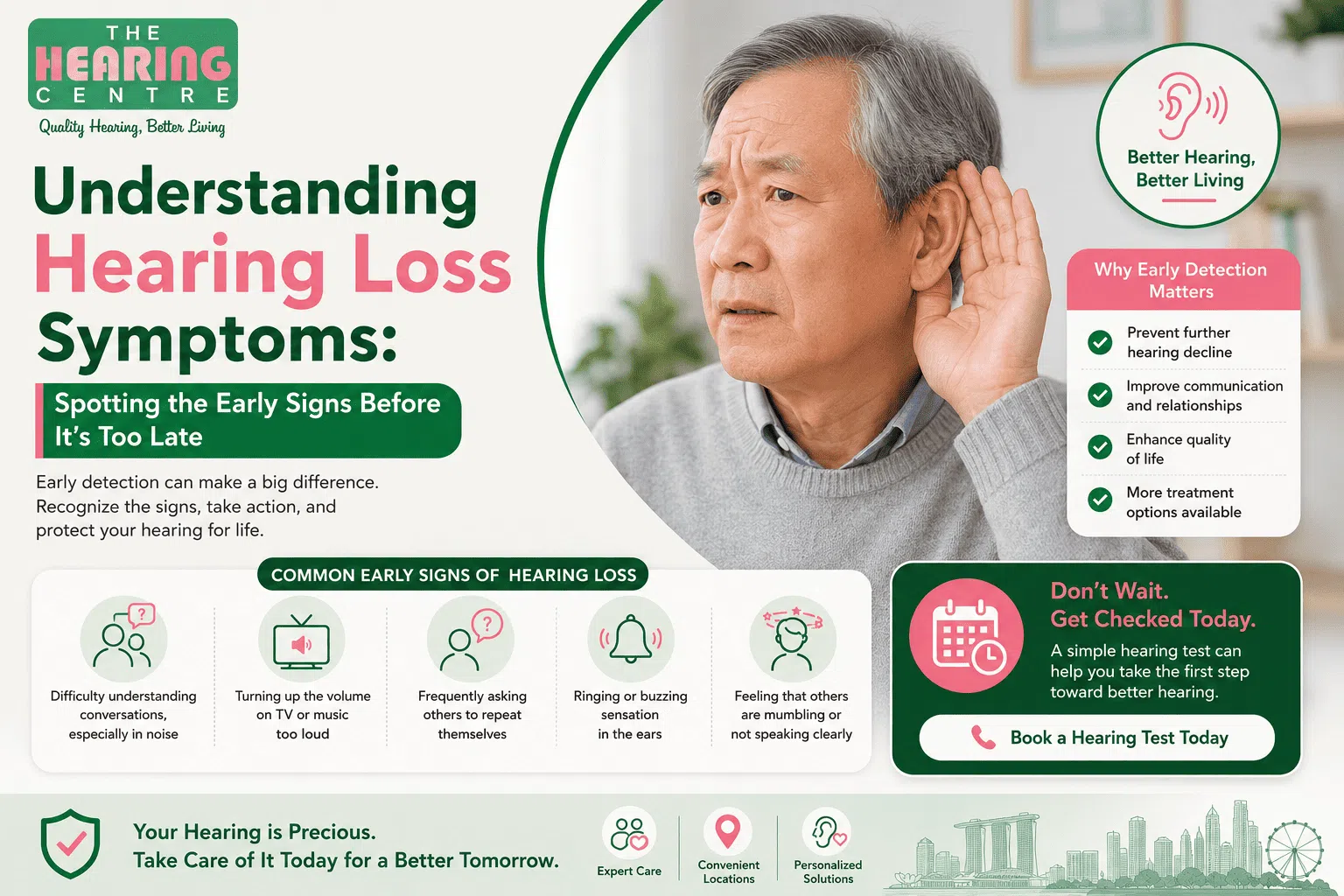
Asking people to repeat themselves — all the time
Once in a while is fine. But when it’s happening in most conversations, with most people, in most settings — that pattern isn’t about other people’s diction.
Volume keeps creeping up
TV, phone, car radio. It happens so gradually people don’t notice. Then a visitor sits down and winces at the TV volume and suddenly it’s obvious something has shifted.
Busy places feel impossible
Following a conversation in a noisy café or a family dinner with everyone talking — this becomes exhausting before it becomes impossible. Background noise strips out the clarity that’s already reduced. This tends to be one of the first hearing loss symptoms people notice without connecting the dots. Early signs of hearing loss in adults covers how this pattern typically unfolds.
Everything sounds muffled
Not deaf — just like the sharpness has gone. Voices sound like they’re coming from further away than they are. Consonants blur together.
Avoiding people without knowing why
Skipping dinners. Sitting out group conversations. Turning down invitations. This gets chalked up to introversion or mood. Usually it’s just that conversations stopped being worth the effort.
Ringing or buzzing that sticks around
Tinnitus often shows up before hearing loss becomes obvious. Persistent ringing, hissing, buzzing — the auditory system signalling that something has changed. A lot of people live with this for years before connecting it to their hearing.
Phone calls got harder
In person, people lip-read without realising they’re doing it. Facial expressions, mouth movement, and body language fill in what the ear misses. On a phone call, all of that disappears. The gaps that were invisible in person suddenly become obvious.
People who cope fine in face-to-face conversations often struggle badly on calls, and that contrast is itself a symptom worth paying attention to.
High-pitched sounds disappeared quietly
Birds outside. Children’s voices. The top end of music. High frequencies fade first with most types of hearing loss. People lose them so slowly they genuinely don’t notice until someone points it out.
Can’t locate where sounds come from
Not knowing which direction a voice or alarm came from means the two ears are processing sound unevenly. Subtle, but significant.
Conversations feel draining
When hearing takes serious effort, communication becomes exhausting. Irritability after social events, anxiety in group settings, preferring to stay home — these emotional patterns often trace directly back to hearing strain nobody’s named yet.
If several of these ring true, a proper tympanometry test alongside a hearing evaluation gives you real answers.
Different Ages, Different Patterns
Children
Delayed speech. Not reacting to loud sounds. Struggling at school without a clear academic reason. Hearing loss in kids gets misread as attention problems constantly. Early signs of hearing loss in children is worth reading if something feels off.
Adults
Work suffers quietly. Relationships strain from constant miscommunication. Safety becomes an issue — not catching alarms, not hearing cars, missing instructions. Adults compensate and cover for a long time before anyone notices.
Older adults
Social withdrawal, depression, and cognitive decline are all linked to untreated hearing loss in seniors. The research on hearing loss and dementia risk is consistent and fairly alarming. Age-related hearing loss covers why catching it earlier matters so much for this age group.
Sudden Hearing Loss — This One Is Different
Most hearing loss symptoms build slowly over months or years. But there’s one type that doesn’t — Sudden Sensorineural Hearing Loss, or SSHL.
It happens fast. Usually in one ear. Many people wake up and notice immediately that something is wrong. The ear feels full. There may be ringing. Sound on that side has dropped sharply overnight or within hours.
SSHL is a medical emergency. Not “see someone this week.” Today. The treatment window for steroids — which can restore some or all of the hearing — is narrow. Waiting even a few days significantly reduces the chances of recovery.
If hearing drops suddenly in one ear with no obvious cause like a blocked canal, go to an ENT or A&E the same day. Don’t wait to see if it clears on its own.
The Stuff That Doesn’t Show on a Chart
Hearing loss changes how people live. Not just how they hear.
People pull back from dinners, avoid crowded places, stop calling friends because phone conversations got too hard. From the outside it looks like they’ve become more withdrawn. From the inside it’s just that the effort stopped paying off.
Frustration, embarrassment, low mood — these are standard companions to untreated hearing loss. Relationships crack under the weight of constant misunderstandings. The sustained mental effort of filling in missing sound information all day, every day, adds up cognitively in ways that compound over time.
Hearing aids from Starkey, Signia, Phonak, and Resound have been built with these real-life consequences in mind, not just the audiogram numbers.
Stop Waiting If Any of This Fits
See a specialist if:
- The hearing loss symptoms above have been showing up regularly
- Ringing or buzzing started and hasn’t gone away
- Someone else commented on your hearing before you did
- Conversations have become noticeably harder work
- You’re past 50 and haven’t had a hearing test in the last two years
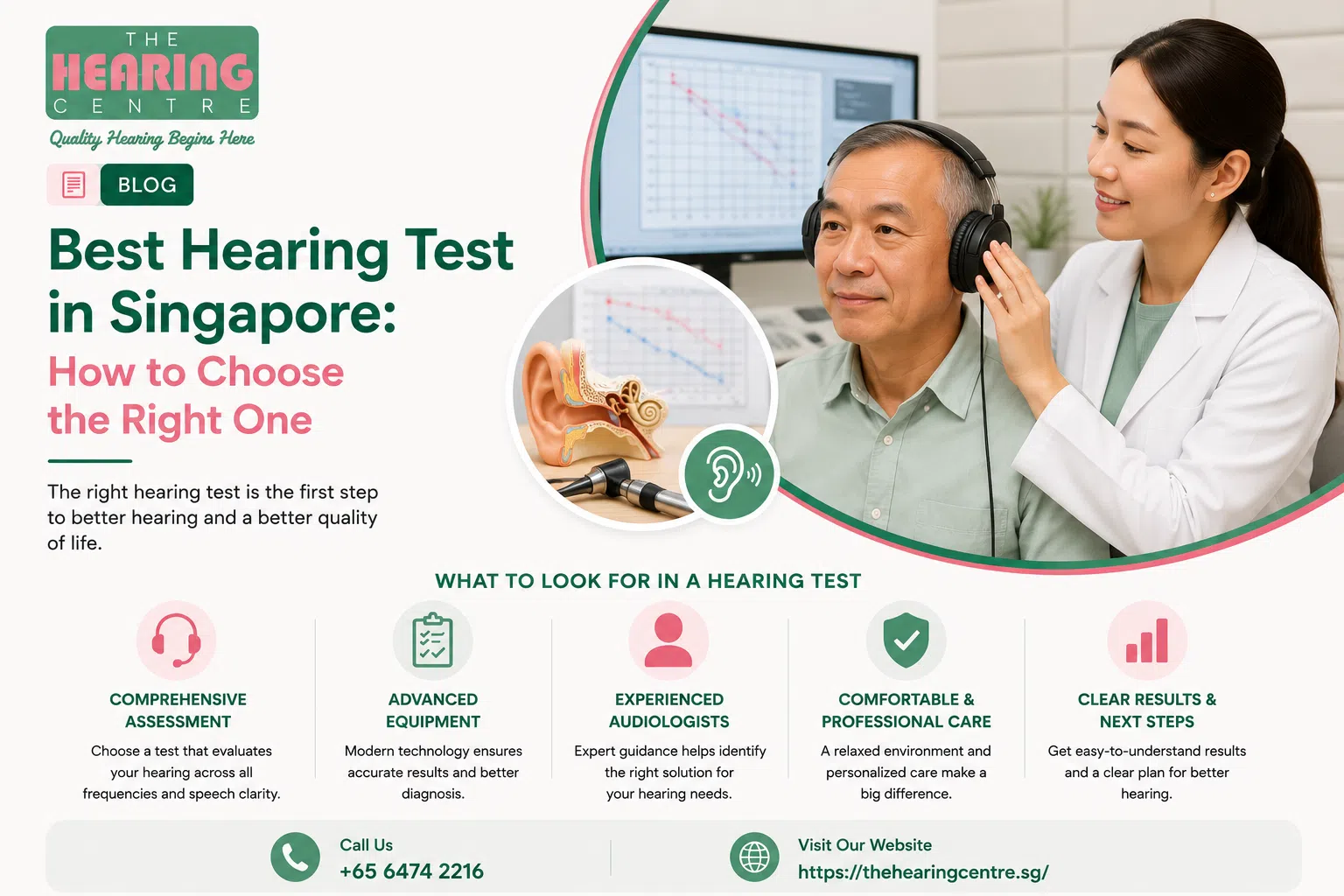
One note on online hearing tests they can give a basic indication that something may be off, but they can’t tell you what’s causing it. Earwax, an infection, and early sensorineural damage can all produce similar results on a self-administered tone test. A proper evaluation with an audiologist identifies the type, the severity, and the cause which is what determines the right next step.
What Happens When You Go
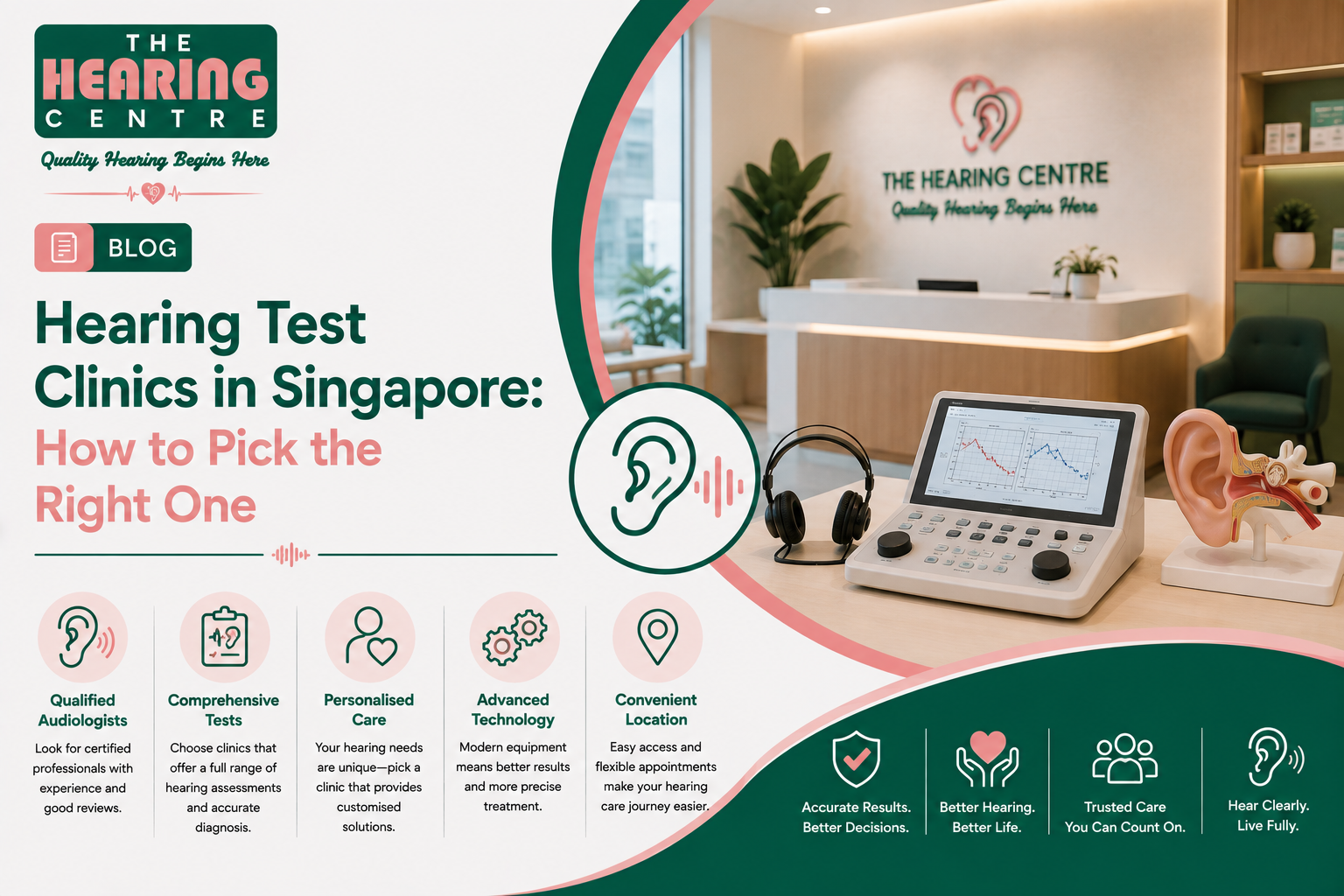
Hearing tests — full evaluation maps type, degree, and cause. Everything else is built on this.
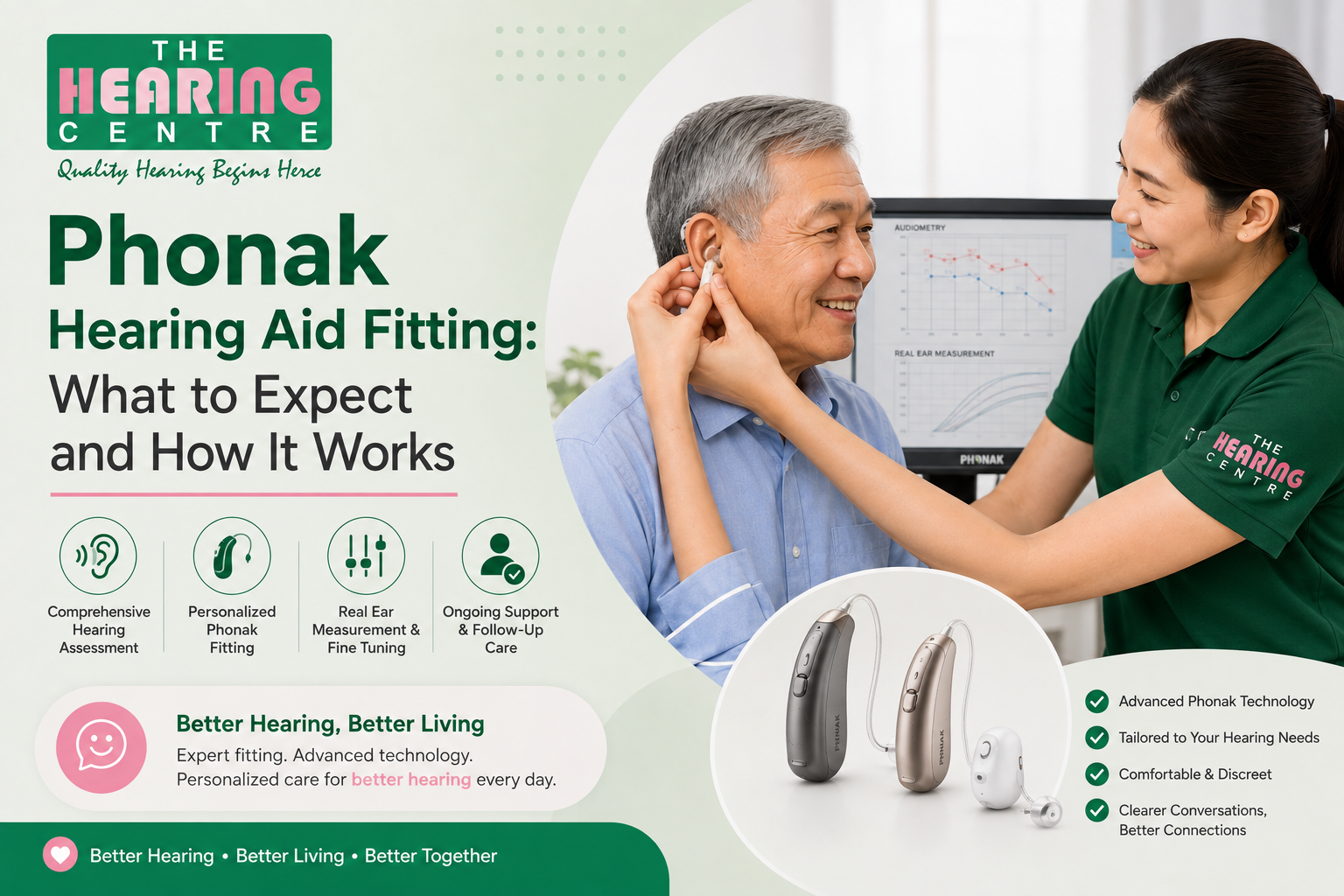
Hearing aids — modern devices are small, discreet, connect to phones wirelessly, and handle noise filtering well. Not a cure, but a genuine quality-of-life improvement. The hearing aids in Singapore buying guide covers what’s actually available and what to look for.
Cochlear implants — for profound hearing loss where aids aren’t enough. Restores functional hearing for people who need it most.
Assistive devices — amplified phones, TV streamers, alerting systems. These fill practical gaps at home and work.
Medical treatment — wax removal, infection treatment, eardrum repair. Some causes are simply fixable. Noise-induced hearing loss is one type where early action changes the outcome significantly.
Early action matters more than anything else here. The longer hearing loss sits untreated, the more the brain adapts to working with reduced input — and reversing that adaptation gets harder over time.
The Real Point
Hearing loss symptoms start small. Volume nudging up. Conversations getting harder. Social situations becoming something to get through rather than enjoy.
Those small signs are worth acting on before they’re not small anymore.
Hearing aids Singapore runs full audiological evaluations — book one while the early signs are still early.
Quick Self-Check — How Many Apply to You?
Go through this honestly. The number that applies gives you a sense of where you stand.
- You regularly ask people to repeat themselves in normal conversation
- You’ve turned the TV volume up and others in the room find it too loud
- Following conversations in restaurants or crowded places is exhausting
- You feel like people are mumbling more than they used to
- Phone calls have become noticeably harder than face-to-face conversations
- You’ve missed things — alarms, doorbells, someone calling your name
- There’s a ringing, buzzing, or hissing that doesn’t go away
- You’ve started avoiding social situations without being able to explain why
- You find yourself watching people’s lips to follow what they’re saying
- Sounds from one side seem quieter than the other
If three or more of these apply regularly, a proper hearing evaluation is worth booking. If five or more apply — don’t put it off.
Frequently Asked Questions
Difficulty following conversations in noisy places, turning volume up more than others need, and frequently asking people to repeat themselves. These three show up before anything more obvious.
No. Noise damage, genetics, infections, certain medications, and head injuries cause it at any age.
Conductive hearing loss from wax or infection often can be. Sensorineural hearing loss is usually permanent but very manageable.
Every one to two years past 50. Earlier if hearing loss symptoms appear regardless of age.
They don’t reverse the underlying loss but they significantly improve day-to-day hearing and communication.
Most are very small and discreet. Many are practically invisible in the ear.
Consistently, yes. Research links untreated hearing loss to higher rates of cognitive decline, especially in older adults.
Bring it up gently. Offer to go with them to the appointment. Most people need someone else to say it out loud before they take action.
Hearing loss is a spectrum of reduced ability. Deafness refers to the profound or total end of that spectrum.
Often yes. Tinnitus frequently accompanies hearing loss and sometimes appears before the hearing drop itself becomes noticeable.